
Disasters are draining American wallets on a scale that shocks even the experts. In 2024, the U.S. weathered 27 separate disaster events, each inflicting losses of over $1 billion. Most people expect technology to save the day when a crisis hits. The twist? Strategy and preparation are lagging far behind. Only about half of organizations have a real disaster recovery plan, leaving millions of families and businesses one step away from disaster when the unexpected comes crashing in.
Table of Contents
- Current Disaster Recovery Trends And Figures
- Impact Of Disasters On Families And Businesses
- How Agencies And Professionals Respond In 2025
- Actionable Insights For Effective Disaster Recovery
Quick Summary
| Takeaway | Explanation |
|---|---|
| Rising Economic Impact of Disasters | In 2024, the U.S. faced 27 weather and climate disaster events, each causing over $1 billion in losses, indicating an urgent need for robust disaster recovery strategies. |
| Small Business Survival Challenges | 40% of small businesses never reopen after a natural disaster, and 25% of those that do eventually fail within a year, highlighting the need for effective recovery planning. |
| Strategic Planning and Preparedness | Only 54% of organizations have documented disaster recovery plans; regular testing and development of flexible frameworks are crucial for effective preparedness. |
| Technological Innovation and Adaptation | Nearly 49% of organizations are investing in AI and automation to improve recovery capabilities, showcasing the importance of technology in disaster resilience. |
| Human-Centered Recovery Support | Agencies are incorporating mental health support and community reconnection into disaster response, emphasizing the need for holistic recovery approaches. |
Current Disaster Recovery Trends and Figures
Disaster recovery has become increasingly critical as environmental and technological challenges continue to reshape our understanding of risk management. The landscape of disaster response is evolving rapidly, with significant implications for agencies, families, and organizations nationwide.
Rising Economic Impact of Disasters
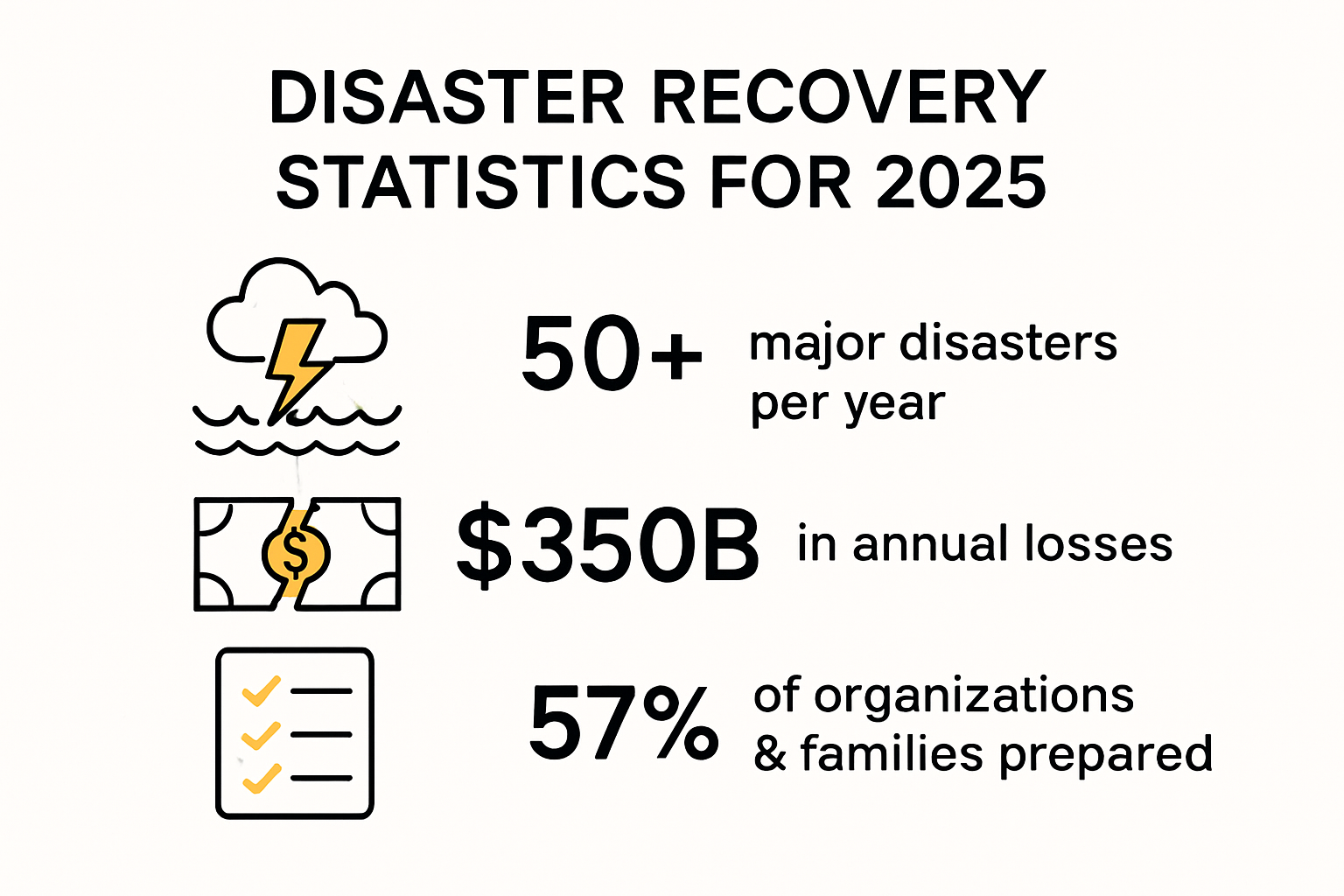
The financial toll of disasters has reached unprecedented levels. Data from the National Oceanic and Atmospheric Administration reveals a stark reality: in 2024, the United States experienced 27 separate weather and climate disaster events, each causing over $1 billion in losses. This trend underscores the growing economic vulnerability faced by communities and businesses.
Organizations are facing unprecedented challenges in maintaining operational continuity. Research indicates that 100% of surveyed organizations reported revenue losses due to IT outages in 2025, with companies experiencing an average of 86 outages per year. More alarming is the fact that 55% of organizations report weekly disruptions, highlighting the critical need for robust disaster recovery strategies.
Small Business Survival Challenges
The impact on small and medium enterprises is particularly devastating. Statistical analysis shows that 40% of small businesses never reopen after a natural catastrophe. Even more concerning, an additional 25% of those that do manage to reopen ultimately fail within a year. These figures paint a grim picture of the long-term resilience challenges faced by smaller organizations.
Technological and Strategic Adaptations
In response to these challenges, organizations are rapidly evolving their disaster recovery approaches. Technology is playing an increasingly crucial role, with advanced data backup systems, cloud-based recovery solutions, and real-time monitoring becoming standard practice. Our comprehensive guide on disaster recovery phases provides deeper insights into these emerging strategies.
Emergency preparedness is no longer just about response but about creating comprehensive, adaptive systems that can quickly recover and minimize potential losses. The trend is moving towards more proactive, technology-driven approaches that anticipate and mitigate risks before they become full-blown disasters.
As the landscape of disaster recovery continues to transform, organizations and families must stay informed, adaptable, and prepared. The key lies in understanding these trends, investing in robust recovery strategies, and maintaining flexibility in the face of unpredictable challenges.
Impact of Disasters on Families and Businesses

Disasters strike without warning, leaving devastating consequences that ripple through families and businesses, transforming lives and economic landscapes in profound ways. The impact extends far beyond immediate physical damage, creating long-lasting psychological, financial, and operational challenges.
Financial Devastation and Recovery Challenges
The economic toll of disasters is staggering. Research from the Small Business Administration reveals that 90% of businesses fail within one year if they cannot resume operations within five days after a disaster. This statistic underscores the critical importance of rapid recovery and comprehensive disaster preparedness strategies.
Small businesses bear the brunt of these catastrophic events. Statistical analysis shows an alarming trend: 40% of small businesses never reopen after a natural catastrophe, and an additional 25% that do reopen ultimately collapse within a year. Family-owned enterprises are particularly vulnerable, often lacking the financial reserves and complex recovery infrastructure of larger corporations.
Psychological and Social Disruption
Beyond financial losses, disasters create profound psychological trauma. Our comprehensive guide on recovery phases highlights the complex emotional journey families experience. Displacement, loss of personal belongings, and disrupted social networks can lead to long-term mental health challenges, including increased rates of anxiety, depression, and post-traumatic stress disorder.
Communities experience massive social disruption. Families are often separated, support networks are fractured, and the sense of stability is fundamentally challenged. Children are particularly vulnerable, with educational continuity and emotional well-being significantly impacted by sudden environmental and living changes.
Technological and Operational Resilience
In the digital age, technological infrastructure plays a crucial role in disaster recovery. Research indicates that 100% of organizations reported revenue losses due to IT outages in 2025, with companies experiencing an average of 86 outages per year. Businesses must now consider not just physical recovery, but also digital resilience.
Modern disaster recovery strategies increasingly focus on comprehensive, multi-dimensional approaches. This includes robust backup systems, cloud-based recovery solutions, remote work capabilities, and adaptive communication technologies that enable business continuity even under extreme circumstances.
As disasters become more frequent and complex, families and businesses must develop flexible, proactive strategies. The key lies in understanding potential risks, investing in comprehensive preparedness, and maintaining the adaptability to recover quickly and effectively. Recovery is not just about returning to previous conditions, but about building stronger, more resilient systems that can withstand and rapidly respond to unexpected challenges.
How Agencies and Professionals Respond in 2025
The disaster response landscape in 2025 has transformed dramatically, with agencies and professionals adopting innovative strategies to address increasingly complex and unpredictable challenges. Modern response mechanisms now blend technological sophistication with human-centered approaches to maximize effectiveness and resilience.
Technological Integration and Advanced Response Systems
Emergency response professionals are increasingly embracing artificial intelligence and data-driven technologies. Eighty-five percent of first responders recognize that disruptive events like power grid failures, hurricanes, and wildfires can overwhelm traditional public safety systems. This awareness has driven substantial investments in cloud-native, interoperable technologies that enhance coordination and rapid response capabilities.
The Disaster Recovery as a Service (DRaaS) market reflects this technological shift, with projected revenues reaching $4.03 billion in 2025. Cloud-based solutions now enable agencies to maintain operational continuity, quickly recover critical infrastructure, and provide real-time information to affected communities.
Collaborative and Adaptive Recovery Frameworks
The National Disaster Recovery Framework has emerged as a critical blueprint for multi-agency collaboration. This structured yet flexible approach emphasizes building community resilience through coordinated efforts. Agencies are no longer working in isolation but creating integrated response networks that can rapidly mobilize resources and expertise.
Our emergency response trends guide highlights the importance of adaptive strategies. Professionals now focus on creating scalable, flexible response mechanisms that can quickly adjust to unique disaster scenarios. This approach recognizes that each disaster presents distinct challenges requiring nuanced, context-specific interventions.
Human-Centered and Holistic Support
Beyond technological solutions, agencies are adopting more compassionate, comprehensive support models. Mental health support, community reconnection, and long-term recovery planning have become integral components of disaster response. Professionals understand that effective recovery extends far beyond immediate physical restoration.
Training programs for first responders now incorporate psychological resilience, cultural competency, and advanced communication skills. The goal is not just to manage emergencies but to support holistic community healing and empowerment.
As disaster landscapes become more complex, agencies and professionals must continue evolving. The future of disaster response lies in seamlessly integrating cutting-edge technology, collaborative frameworks, and deeply empathetic human approaches. Success will be measured not just by immediate crisis management, but by the ability to help communities rebuild stronger, more resilient systems that can withstand future challenges.
Actionable Insights for Effective Disaster Recovery
Effective disaster recovery requires a strategic, proactive approach that combines technological innovation, comprehensive planning, and adaptive thinking. Organizations and families must develop robust systems that can quickly respond to and mitigate the impacts of unexpected catastrophic events.
Strategic Planning and Preparedness
Research reveals a critical gap in organizational preparedness: only 54% of organizations have documented disaster recovery plans. This statistic highlights the urgent need for comprehensive, well-structured recovery strategies. Organizations must move beyond basic contingency planning to create flexible, detailed frameworks that address multiple potential scenarios.
Our comprehensive disaster recovery guide emphasizes the importance of regular plan testing and refinement. Current data shows that 7% of organizations never test their recovery plans, while half test only once a year or less frequently. This lack of preparation can be catastrophic during actual emergencies.
Technological Innovation and Adaptive Solutions
Technology is transforming disaster recovery approaches. Nearly half (49%) of organizations are now investing in artificial intelligence and automation to enhance their recovery capabilities. These technological solutions provide several key advantages: faster response times, more accurate resource allocation, and improved predictive capabilities.
Cloud-based systems and AI-driven analytics enable organizations to:
- Predict potential risks with greater accuracy
- Automate initial response protocols
- Quickly assess and allocate resources
- Maintain operational continuity
Financial and Community Resilience
Federal funding resources play a crucial role in disaster recovery. The U.S. government provides substantial grants to individuals and communities, creating a critical safety net for those most impacted by catastrophic events. Understanding and effectively accessing these resources can significantly accelerate recovery processes.
Deploying aid effectively requires a multi-faceted approach. Families and organizations should:
- Develop comprehensive emergency funds
- Understand available government assistance programs
- Create network of support and resources
- Maintain flexible financial strategies
Successful disaster recovery is not about perfect prediction but about building adaptive, resilient systems. Organizations and families must embrace continuous learning, technological integration, and collaborative approaches. The goal is not just to survive disasters but to develop the capacity to quickly recover and potentially emerge stronger.
By combining strategic planning, technological innovation, and a proactive mindset, individuals and organizations can transform disaster recovery from a reactive process to a dynamic, empowering journey of resilience and adaptation.
Frequently Asked Questions
What are the key trends in disaster recovery for 2025?
Disaster recovery trends for 2025 emphasize technological integration, with 49% of organizations investing in AI and automation. There is also a focus on holistic support for communities and families, with agencies prioritizing mental health and adaptive recovery frameworks.
How much financial loss do disasters cause in the United States?
In 2024, the U.S. experienced 27 weather and climate disaster events, each causing over $1 billion in losses. This highlights the urgent need for robust disaster recovery strategies to mitigate economic impacts.
What percentage of small businesses recover after a disaster?
Alarmingly, 40% of small businesses never reopen following a natural disaster, and among those that do reopen, 25% fail within a year. This underscores the importance of effective disaster recovery planning.
Why is disaster recovery planning essential for families?
Disaster recovery planning is critical for families to minimize financial and emotional impact during unexpected disasters. Effective preparedness helps ensure quick recovery, maintain stability, and provide access to necessary resources during crises.
Ready for Real Recovery? Your Next Move Matters
The numbers do not lie. Disaster recovery statistics for 2025 show families and agencies are facing bigger risks and harder challenges every year. Massive financial losses. Frequent outages. Businesses and loved ones left stranded by the gaps in planning. It is easy to feel overwhelmed when each new crisis threatens stability and peace of mind.
You do not have to face these statistics alone. Disaster Victim Services brings a proven, compassionate approach to disaster recovery, rooted in the latest trends and data shared in this article. Whether you are looking for emergency housing or immediate support to start rebuilding, explore our New Recovery Solutions designed to address the pain points families and organizations are experiencing right now. Do not wait until disaster strikes again—visit our main site and take the first step toward security with a partner who understands the journey every step of the way.
Recommended Articles
- Emergency Response Trends 2025: What Stakeholders Need to Know – Disaster Victim Services | Helping You Recover After Disaster
- Natural Disaster Statistics 2025: Key Trends for Families & Responders – Disaster Victim Services | Helping You Recover After Disaster
- Storm Impact Statistics 2025: Key Data for Disaster Response – Disaster Victim Services | Helping You Recover After Disaster