
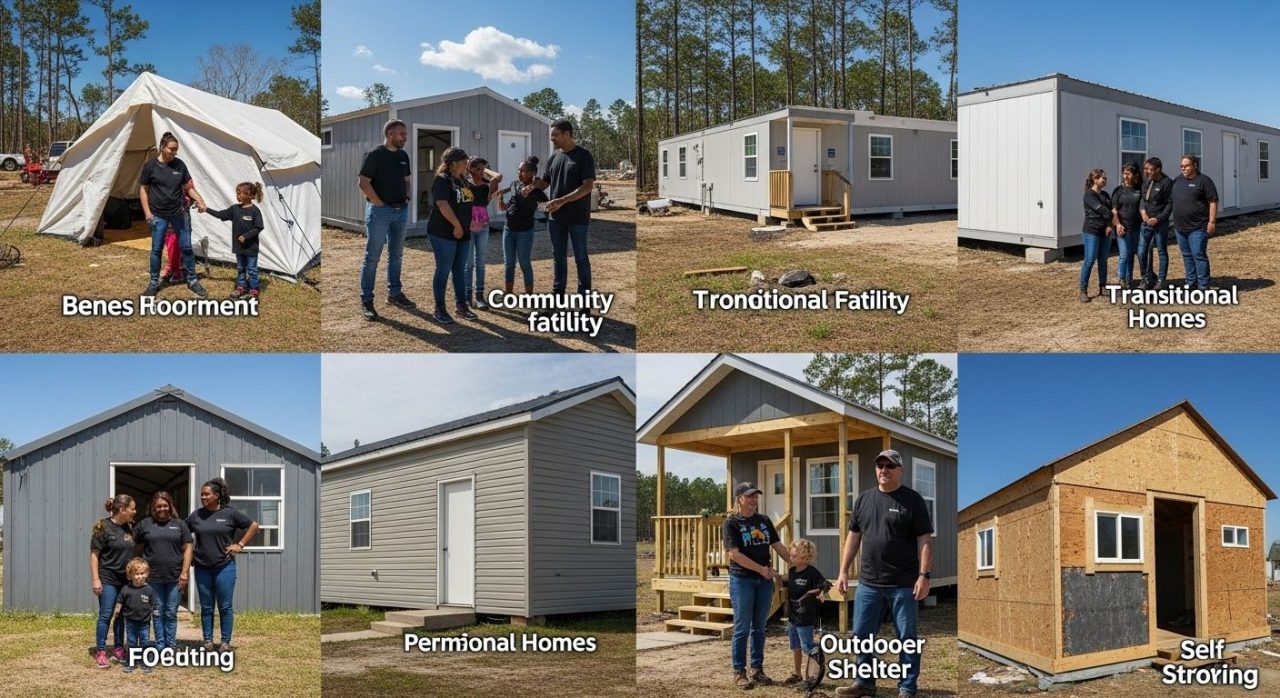
Disaster strikes with no warning and suddenly the need for emergency shelters becomes urgent. Most people expect shelters to be just basic tents or crowded gymnasiums. Yet the reality is that emergency housing now spans everything from rapid-deployment tents to mobile, tech-equipped units and even self-built shelters made from local materials. Shelter is no longer just a roof for survival, it is about restoring calm and dignity when everything else is lost.
Table of Contents
- Temporary Shelters For Immediate Relief
- Transitional Shelters For Short-Term Stay
- Permanent Shelters For Long-Term Needs
- Community Shelters In Local Facilities
- Mobile Shelters For Displaced Individuals
- Outdoor Tents For Quick Deployment
- Self-Constructed Shelters For Situational Flexibility
Quick Summary
| Takeaway | Explanation |
|---|---|
| Temporary shelters provide immediate protection. | They serve as crucial lifelines for displaced families after disasters, offering safety and basic necessities. |
| Transitional shelters support longer recovery periods. | These provide a stable environment for weeks, helping families transition back to normalcy with essential amenities. |
| Permanent shelters ensure long-term stability. | Designed for sustainable living, they help disaster victims reintegrate into communities and rebuild their lives. |
| Community shelters leverage local facilities for support. | Utilizing familiar spaces, they enhance community connections and provide efficient emergency response during crises. |
| Mobile shelters offer flexibility in deployment. | Quickly transportable, they adapt to evolving needs, ensuring timely housing solutions in dynamic disaster scenarios. |
1: Temporary Shelters for Immediate Relief
In the critical aftermath of a disaster, temporary shelters become lifelines for displaced individuals and families. These emergency housing solutions provide immediate protection, safety, and basic necessities when homes are damaged or destroyed. Understanding the types of temporary shelters can significantly impact survival and recovery during challenging times.
Temporary shelters serve multiple essential functions beyond basic protection. They offer psychological comfort during traumatic situations, create spaces for community support, and serve as critical transition points between crisis and recovery. According to research from the National Institutes of Health, these shelters play a crucial role in humanitarian response by addressing both physical and emotional needs of disaster victims.
Key characteristics of effective temporary shelters include:
- Rapid deployment and setup
- Protection from environmental elements
- Basic sanitation facilities
- Capacity for group or individual accommodation
- Adaptability to different disaster scenarios
The primary goal of these shelters is to provide immediate, safe, and dignified living spaces that help individuals and families stabilize after experiencing sudden displacement. They bridge the gap between emergency response and long term recovery, offering critical support during vulnerable moments.
Most temporary shelters are designed with flexibility in mind, recognizing that each disaster scenario presents unique challenges. Learn more about selecting the right emergency shelter to understand how professionals assess and deploy these critical resources.
While temporary shelters might seem basic, they represent far more than simple structures. They are symbols of hope, resilience, and community support during some of life’s most challenging moments.
2: Transitional Shelters for Short-Term Stay
Transitional shelters represent a critical bridge between immediate emergency response and long-term housing solutions. These specialized accommodations provide disaster victims with a stable environment for weeks to months, offering more comprehensive support than temporary emergency shelters. Unlike immediate relief structures, transitional shelters focus on helping individuals and families rebuild their lives with greater dignity and comfort.
These shelters are strategically designed to address multiple recovery needs simultaneously. They offer not just physical protection, but also psychological stability during challenging transition periods. Research from housing experts indicates that well-designed transitional shelters can significantly reduce stress and accelerate community recovery processes.
Key features of effective transitional shelters include:
- More spacious and private living arrangements
- Basic amenities like cooking facilities
- Proximity to community resources
- Longer-term accommodation options
- Support services for recovery and rehabilitation
Transitional shelters typically accommodate families for 30 to 180 days, providing a critical window for insurance processing, home repairs, or finding permanent housing alternatives. Explore our comprehensive guide to shelter recovery strategies to understand how these shelters support comprehensive disaster recovery.
The psychological impact of transitional shelters cannot be overstated. By offering a sense of stability and hope, these spaces help disaster victims transition from survival mode to active recovery. They represent more than physical structures – they are environments of healing, rebuilding, and community resilience.
Understanding the nuanced role of transitional shelters is crucial for disaster response professionals, insurance providers, and community support organizations. These shelters are not merely stopgap measures, but strategic tools in comprehensive disaster recovery frameworks.
3: Permanent Shelters for Long-Term Needs
Permanent shelters represent the ultimate goal in disaster recovery, providing stable, sustainable housing solutions for individuals and families who have lost their homes. These shelters go beyond temporary protection, offering comprehensive living environments that support complete rehabilitation and community reintegration.
Unlike temporary or transitional shelters, permanent shelters are designed to provide long-term stability and normalize life after catastrophic events. According to research from the National Academies Press, successful permanent housing strategies must address the unique needs of diverse populations, ensuring equitable and sustainable recovery.
Key considerations for permanent shelter development include:
- Accessibility for individuals with disabilities
- Integration with existing community infrastructure
- Cost-effective construction methods
- Resilience against future potential disasters
- Cultural and social compatibility
Permanent shelters are not just about rebuilding structures, but about reconstructing lives. They provide psychological security, helping disaster victims transition from survival mode to rebuilding mode. These shelters often incorporate flexible design elements that can be adapted to changing family needs over time.
Discover our comprehensive guide to safe housing placement to understand the intricate process of creating sustainable housing solutions. The goal is not just to replace lost homes, but to create resilient living spaces that restore dignity, hope, and a sense of normalcy.
The development of permanent shelters requires collaboration between multiple stakeholders – including government agencies, insurance providers, construction experts, and community organizations. By working together, these groups can create housing solutions that are not just structurally sound, but emotionally supportive and community-centered.
4: Community Shelters in Local Facilities
Community shelters in local facilities represent a critical infrastructure for emergency response, transforming familiar public spaces into lifesaving havens during disasters. These shelters leverage existing community buildings like schools, community centers, churches, and municipal halls to provide immediate protection and support for displaced populations.
Unlike standalone emergency structures, community shelters offer unique advantages by utilizing spaces already known and trusted by local residents. According to Ready.gov, these facilities are strategically selected and prepared to meet diverse community needs during emergency situations.
Key characteristics of effective community shelters include:
- Pre-established infrastructure
- Familiarity for local residents
- Multiple entry and exit points
- Capacity for large group accommodations
- Basic amenities and emergency supplies
Community shelters serve more than just a physical protection function. They become critical social support centers where individuals can connect, share resources, and maintain a sense of community during challenging times. Local facilities often have existing communication networks, making information dissemination faster and more efficient.
Learn more about strategic shelter selection strategies to understand the complex process of transforming public spaces into emergency accommodations. The success of these shelters depends on thorough pre-disaster planning, community engagement, and flexible response mechanisms.
Emergency managers and local governments play a crucial role in preparing these facilities. This involves regular maintenance, stockpiling essential supplies, training staff, and developing comprehensive evacuation and management protocols. By investing in community shelter preparedness, cities and towns can significantly enhance their resilience and ability to protect residents during unexpected crises.
5: Mobile Shelters for Displaced Individuals
Mobile shelters represent a revolutionary approach to emergency housing, offering unprecedented flexibility and rapid deployment capabilities for disaster response scenarios. These adaptable structures can be quickly transported and set up in areas experiencing sudden displacement, providing immediate relief where traditional shelter options are impractical or unavailable.
Unlike stationary shelters, mobile units can be strategically positioned to meet evolving emergency needs, ensuring that displaced individuals receive timely protection. According to UNHCR, these shelters play a crucial role in humanitarian response by addressing urgent housing requirements in dynamic environments.
Key features of effective mobile shelters include:
- Rapid transportation and setup capabilities
- Versatility across multiple terrain types
- Modular design for scalable accommodation
- Self-contained utility systems
- Resilience against various environmental conditions
Mobile shelters are not just temporary structures but comprehensive living solutions that address multiple human needs. They often come equipped with essential amenities like basic electrical systems, water filtration, climate control, and secure entry points. Explore our comprehensive guide to emergency housing solutions to understand the intricate design considerations behind these critical resources.
The strategic value of mobile shelters extends beyond immediate disaster response. They provide emergency management teams with unparalleled operational flexibility, allowing rapid redeployment as community needs shift. By bridging the gap between emergency response and long-term housing solutions, mobile shelters represent a critical innovation in humanitarian support infrastructure.
6: Outdoor Tents for Quick Deployment
Outdoor tents represent the frontline of emergency shelter solutions, offering unparalleled speed and flexibility in disaster response scenarios. These lightweight, portable structures provide immediate protection for individuals and families displaced by natural disasters, humanitarian crises, or sudden environmental emergencies.
Unlike more complex shelter systems, outdoor tents can be deployed within minutes, creating instant safe spaces in challenging environments. According to FEMA’s Emergency Support Function documentation, these shelters are critical components of rapid emergency response strategies, enabling quick humanitarian interventions.
Key characteristics of effective emergency deployment tents include:
- Lightweight and compact design
- Rapid assembly capabilities
- Weather-resistant materials
- Scalable configuration options
- Portable and easily transportable
Emergency tents are engineered to withstand diverse environmental conditions, from scorching heat to freezing temperatures. They serve multiple critical functions beyond basic shelter, providing spaces for medical treatment, community gathering, supply distribution, and temporary living quarters.
Explore our comprehensive guide to emergency shelter strategies to understand the intricate planning behind these essential emergency resources. Modern outdoor tents are not merely simple fabric structures but sophisticated systems designed to meet complex humanitarian needs.
The strategic value of outdoor tents extends far beyond their immediate protective capabilities. They represent hope, resilience, and human adaptability in the face of unprecedented challenges, serving as temporary sanctuaries that bridge the gap between crisis and recovery.
7: Self-Constructed Shelters for Situational Flexibility
Self-constructed shelters represent the ultimate expression of human adaptability in emergency situations, empowering individuals to create protective spaces using available resources when traditional shelter options are unavailable. These improvised structures leverage personal knowledge, creativity, and immediate environmental materials to provide critical protection during unexpected crises.
Unlike pre-fabricated shelter solutions, self-constructed shelters rely on individual skills, resourcefulness, and understanding of immediate environmental dynamics. According to Ready.gov, effective self-constructed shelters require strategic planning, basic survival skills, and an understanding of local terrain and weather conditions.
Key considerations for building effective self-constructed shelters include:
- Local environmental assessment
- Available material evaluation
- Understanding basic structural integrity principles
- Identifying natural protection zones
- Implementing waterproofing techniques
Self-constructed shelters are more than simple survival mechanisms. They represent a profound psychological strategy of maintaining control and dignity during challenging circumstances. By actively participating in their own protection, individuals can reduce stress and enhance their sense of personal agency during emergencies.
Discover our comprehensive emergency preparedness strategies to understand the complex considerations behind personal shelter construction. The ability to create a safe space demonstrates remarkable human resilience and adaptability in the face of unpredictable challenges.
Mastering self-constructed shelter techniques requires practice, knowledge, and a deep understanding of fundamental survival principles. These skills transcend mere physical protection, embodying the human capacity to innovate, adapt, and overcome challenging environmental conditions.
The table below provides a comprehensive summary of the seven main types of emergency shelters discussed in the article, including their core purpose, key features, and unique benefits.
| Shelter Type | Core Purpose | Key Features | Unique Benefits |
|---|---|---|---|
| Temporary Shelters | Immediate protection after a disaster | Rapid setup, environmental protection, basic sanitation, flexible group/individual use | Lifeline for displaced families, bridges crisis to recovery |
| Transitional Shelters | Short-term, stable recovery environment | Larger spaces, basic amenities, proximity to resources, weeks-to-months duration | Supports psychological stability, eases move toward normalcy |
| Permanent Shelters | Long-term housing and community reintegration | Accessibility, community integration, cost-effective, disaster-resilient, culturally aligned | Enables sustainable rebuilding and security |
| Community Shelters | Emergency support using local facilities | Pre-existing infrastructure, familiar spaces, large capacity, amenities, supply stockpiles | Enhances social support and rapid local response |
| Mobile Shelters | Flexible, rapid housing for displaced people | Quick transport/setup, modular, multi-terrain, self-contained utilities, weather resilient | Adapts to changing needs and ensures speedy deployment |
| Outdoor Tents | Fast, portable protection in disaster zones | Lightweight, compact, quick to assemble, weatherproof, scalable | Immediate safe space and supports various emergency roles |
| Self-Constructed Shelters | DIY solutions using available local resources | Use of found materials, survival skills, tailored to environment, improvisation, basic shelter | Empowers individuals, maintains agency and psychological control |
Take the First Step Toward Reliable Emergency Shelter
When disaster disrupts your life, you need more than just information about shelter options. You need real solutions that provide safety, dignity and a plan for recovery. If you are searching for help with any of the seven types of emergency shelter mentioned in this article, your needs are urgent and complex. You might be struggling to find temporary housing or overwhelmed by the logistics of moving from short-term to long-term shelter. These challenges can add stress to an already difficult situation and getting professional support can make all the difference.
Our team at Disaster Victim Services specializes in guiding disaster victims through every phase of emergency sheltering. We work around the clock to connect you with the right housing solutions and coordinate all the details with insurance providers, government agencies, and recovery partners. For more on how smart design and planning impact recovery, visit our Project Design resources. Need to move quickly from crisis response to rebuilding? Our Developing projects show you what is possible. Do not wait to protect your loved ones and restore peace of mind. Contact us now and let our experts help you find shelter and support when you need it most.
Frequently Asked Questions
What are the different types of emergency shelters available?
Emergency shelters can be categorized into several types, including temporary shelters for immediate relief, transitional shelters for short-term stays, permanent shelters for long-term needs, community shelters in local facilities, mobile shelters for displaced individuals, outdoor tents for quick deployment, and self-constructed shelters for situational flexibility.
How do temporary shelters differ from transitional shelters?
Temporary shelters provide immediate protection and basic necessities for displaced individuals after a disaster, while transitional shelters offer more comfort, privacy, and stability for weeks to months, helping families rebuild their lives and transition to permanent housing solutions.
What features should I look for in a permanent shelter?
When considering a permanent shelter, key features to look for include accessibility for individuals with disabilities, integration with community infrastructure, cost-effective construction methods, resilience against future disasters, and cultural compatibility for the occupants.
How can self-constructed shelters provide protection during an emergency?
Self-constructed shelters utilize available materials and personal skills to create protective spaces in emergencies. They empower individuals by allowing them to maintain control over their safety and well-being while adapting to their immediate environment.