

Getting your documents in order for disaster relief might sound like basic prep, but it is anything but simple. Think about this. FEMA reports that over 60 percent of disaster survivors struggle to access help because they cannot quickly find documents like IDs, insurance papers, or medical records. Most people stack these papers in a drawer and hope for the best, yet a single waterproof folder or a secure cloud file can be the one thing standing between you and fast recovery when chaos hits.
Table of Contents
- Understanding Required Documents in Emergencies
- Step-by-Step Guide to Preparing Key Documents
- Best Practices for Organizing and Storing Records
- Tips for Digital Documentation and Easy Access
Quick Summary
| Takeaway | Explanation |
|---|---|
| Prepare essential personal identification documents | Documents like ID cards and proof of residency are crucial for accessing disaster relief services. |
| Organize financial and insurance records | Keep insurance policies and financial documents ready to expedite assistance during emergencies. |
| Develop a comprehensive household inventory | Document and photograph your possessions to assist in recovery efforts post-disaster. |
| Implement secure digital and physical storage | Use password-protected cloud storage and fireproof safes to protect critical documents. |
| Create an emergency access plan for documents | Ensure family members know where important documents are stored and how to access them during a crisis. |
Understanding Required Documents in Emergencies
When disaster strikes, having the right documents can mean the difference between swift recovery and prolonged hardship. Proper documentation serves as your lifeline during emergency situations, enabling you to access critical resources and support when you need them most.
Essential Personal Identification Documents
Documents establish your identity and legal status during emergency scenarios. The most crucial items include government issued photo identification like driver’s licenses, passports, and birth certificates. Learn more about document recovery strategies when original copies are lost or damaged.
According to the U.S. government’s official disaster assistance portal, key identification documents required for disaster relief applications include:
- Social Security documentation: Original or replacement card
- Government photo ID: Driver’s license or state identification
- Proof of residency: Utility bills, lease agreements, or property documents
Maintaining both physical and digital copies of these documents stored securely can significantly expedite your recovery process. Digital backups stored in cloud services or encrypted drives provide an additional layer of protection against physical document loss.
Financial and Insurance Documentation
Financial records play a critical role in disaster relief applications. The IRS guidelines for disaster relief emphasize the importance of comprehensive documentation.
Critical financial documents include:
- Insurance policies: Homeowners, renters, flood, and earthquake coverage details
- Income verification: Recent tax returns, pay stubs, and employment records
- Bank statements: Proving financial status and direct deposit information
- Property ownership documents: Deed, mortgage statements, property tax records
These documents help relief organizations and government agencies assess your specific needs and determine appropriate assistance levels. Keeping these records organized and easily accessible can dramatically reduce stress during emergency situations.
Medical and Health Documentation
Health related documents are equally important during disaster scenarios. Comprehensive medical records can help ensure continuous care and support. Include vaccination records, prescription information, medical history summaries, and health insurance documentation.
Key medical documents should encompass:
- Health insurance cards
- Prescription medication lists
- Recent medical history summaries
- Emergency contact information
- Vaccination records
By understanding and preparing these critical documents in advance, you create a robust emergency preparedness strategy. Digital and physical backups, stored in secure yet accessible locations, provide peace of mind and practical support during challenging times.
To help you review what documents should be gathered and preserved for disaster relief, the following table summarizes the key types of required documentation and their main uses:
| Document Type | Examples | Main Purpose in Disaster Relief |
|---|---|---|
| Personal Identification | Driver’s license, passport, SS card | Verify identity and eligibility |
| Proof of Residency | Utility bills, lease agreement | Confirm home address for relief |
| Insurance Policies | Home, flood, renters policies | Validate claims and recover losses |
| Financial Records | Tax returns, bank statements | Prove income and access financial aid |
| Medical and Health Records | Insurance cards, prescriptions | Ensure continued medical care |
| Property Documentation | Deeds, mortgage, tax records | Establish property ownership |
| Household Inventory | Photos, itemized lists, receipts | Support insurance and recovery claims |
Step-by-Step Guide to Preparing Key Documents
Preparing documents for potential disaster scenarios requires strategic planning and systematic organization. A well-structured approach can make the difference between quick recovery and prolonged disruption. Learn more about document preservation strategies to protect your critical records.
Digital and Physical Document Preservation
Creating robust document preservation strategies involves multiple layers of protection. According to research from the University of Missouri System, developing a comprehensive vital records plan is crucial for effective emergency preparedness.
Key preservation strategies include:
- Digital Backup: Scan and store documents in secure cloud storage with encryption
- Physical Copies: Create waterproof and fireproof copies stored in multiple locations
- External Storage: Use portable hard drives or secure safety deposit boxes
Ensure digital files are saved in multiple formats like PDF and JPEG to maximize accessibility. Password protect sensitive documents and consider using encrypted storage solutions that provide additional security layers.
Systematic Document Organization
The Consortium of Academic and Research Libraries in Illinois recommends a systematic approach to document management that prioritizes accessibility and protection.
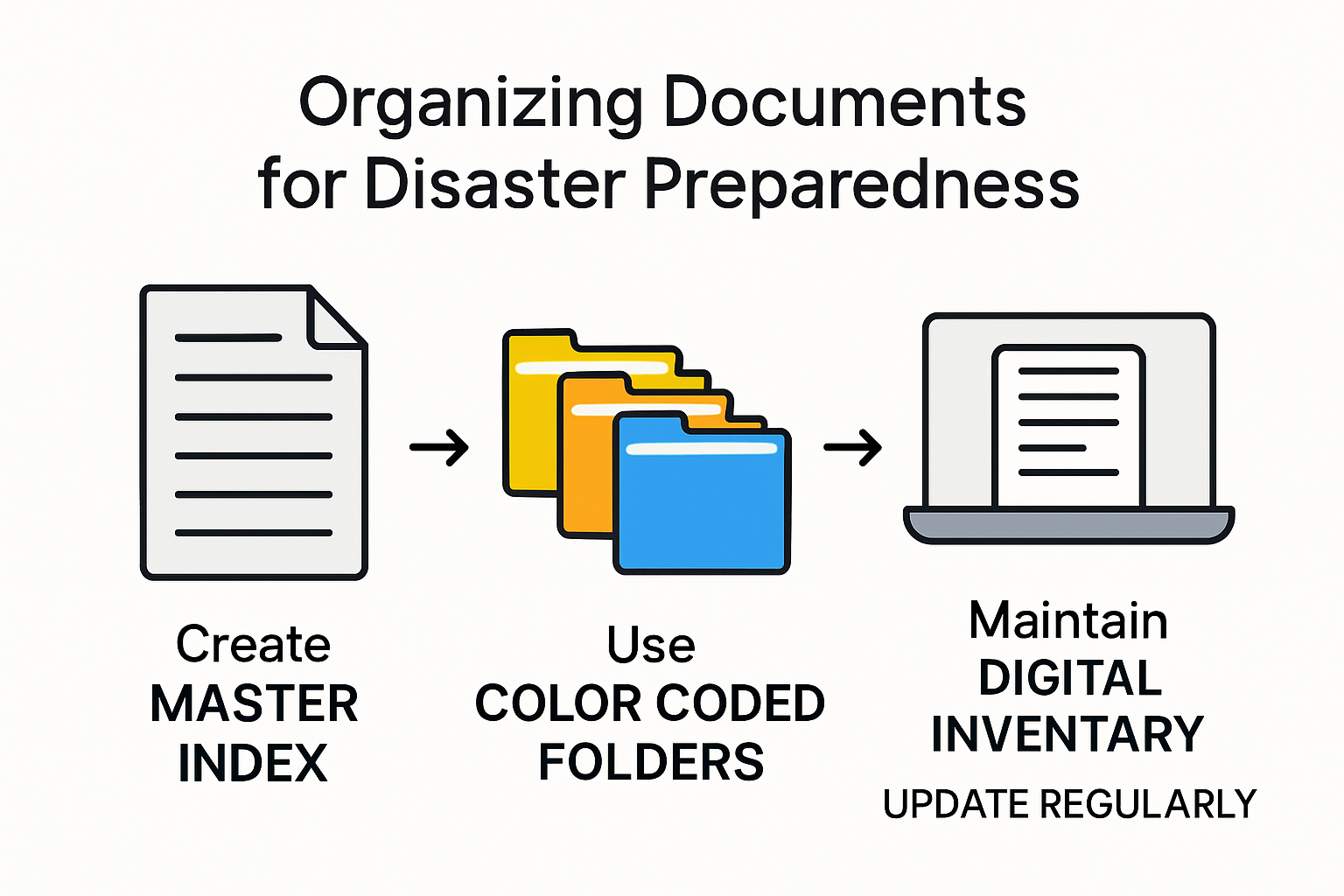
Effective organization methods include:
- Create a Master Index: Develop a comprehensive list of all important documents
- Color Coding: Use color-coded folders for quick identification
- Digital Inventory: Maintain a detailed spreadsheet tracking document locations
- Regular Updates: Review and refresh documents quarterly
Consider creating both physical and digital inventories. Include details like document type, last updated date, storage location, and any special preservation notes. This systematic approach ensures you can quickly locate critical documents during emergencies.
Secure Storage and Accessibility
According to ICF disaster management experts, implementing best practices for document storage is critical for rapid recovery.
Recommended storage practices include:
- Waterproof Containers: Use sealed, portable containers for physical documents
- Secure Cloud Storage: Select reputable services with strong encryption
- Redundant Backups: Store copies in multiple secure locations
- Emergency Access Plan: Ensure trusted family members know document locations
Consider creating an emergency document kit that can be quickly grabbed during evacuation. Include copies of critical identification, insurance, and medical records. Store this kit in an easily accessible location known to all household members.
By implementing these comprehensive document preparation strategies, you create a resilient system that protects your critical information and facilitates faster recovery during unexpected emergencies.
The following table outlines and compares physical and digital document preservation approaches, highlighting their benefits and considerations:
| Preservation Method | Key Benefits | Main Considerations |
|---|---|---|
| Physical Copies | Immediate access, no tech required | Vulnerable to water/fire; needs safe storage |
| Digital Backups | Easy to duplicate, remote accessibility | Potential hacking risk, needs passwords |
| External Storage Devices | Portable, offline, added backup | Can be lost/stolen, needs updating |
| Cloud Storage | Secure, accessible anywhere, auto-backup | Requires internet, choose trusted provider |
Best Practices for Organizing and Storing Records
Effective document organization and storage can significantly impact your ability to recover quickly during emergencies. Implementing strategic record management techniques protects your critical information and ensures accessibility when you need it most. Explore our comprehensive guide to document recovery for additional insights.
Creating a Comprehensive Household Inventory
According to the Federal Trade Commission, developing a detailed household inventory is fundamental to disaster preparedness. This systematic documentation serves as a critical reference point during recovery efforts.

Key components of a comprehensive household inventory include:
- Detailed Asset Documentation: Photograph and list valuable personal property
- Serial Number Tracking: Record identification numbers for electronics and valuables
- Purchase Information: Include receipts, warranty details, and original purchase dates
- Appraisal Records: Maintain professional valuation documents for high-value items
Digital tools and spreadsheet applications can streamline this process, allowing you to create a comprehensive and easily updatable record of your belongings.
Secure Physical and Digital Storage Strategies
FEMA recommends implementing multi-layered storage approaches to protect critical documents from potential damage or loss. This involves creating both physical and digital backup systems.
Recommended storage methods include:
- Fireproof and Waterproof Containers: Invest in high-quality storage solutions designed to protect documents
- Secure Cloud Storage: Use encrypted online platforms with robust security features
- External Hard Drives: Maintain offline backups with password protection
- Safe Deposit Boxes: Store original documents in bank-secured locations
Ensure that digital copies are saved in multiple formats and locations to maximize accessibility and protection. Consider using PDF and image formats for versatility.
Emergency Preparedness Document Management
The University of Minnesota Extension emphasizes the importance of creating a readily accessible emergency document file. This preparation can dramatically reduce stress during unexpected situations.
Critical elements of an emergency document file include:
- Contact Information: Emergency contacts, family members, insurance providers
- Medical Documentation: Health insurance cards, prescription lists, medical history
- Financial Records: Bank account details, insurance policy numbers, recent statements
- Identification Documents: Copies of driver’s licenses, passports, social security cards
Store this emergency file in a waterproof, portable container that can be quickly grabbed during evacuation. Ensure multiple family members know its location and contents.
By implementing these comprehensive document organization and storage strategies, you create a robust system that protects your critical information and provides peace of mind during challenging times. Regular review and updating of your document management approach will help maintain its effectiveness and relevance.
Tips for Digital Documentation and Easy Access
In the digital age, effective electronic document management is crucial for disaster preparedness and quick recovery. Modern technology offers unprecedented opportunities to secure and access critical information during emergencies. Discover advanced document preservation techniques to protect your most important records.
Secure Digital Storage Solutions
According to Freddie Mac’s recommendations, implementing robust digital storage strategies is essential for protecting important documents. Digital storage goes beyond simple file saving, requiring comprehensive security and accessibility planning.
Key digital storage considerations include:
- Encrypted Cloud Storage: Use services with military-grade encryption
- Multi Factor Authentication: Enable additional security layers
- Regular Backup Protocols: Automatically sync and update document copies
- Offline Backup Options: Maintain external hard drives with encrypted files
Choose cloud storage platforms that offer end-to-end encryption and provide geographically distributed data centers. This approach ensures your documents remain safe even if one server location experiences issues.
Advanced Digital Organization Techniques
Effective digital document management requires more than simple file storage. Developing a systematic approach to digital organization maximizes efficiency and accessibility during critical moments.
Recommended digital organization strategies:
- Consistent Naming Conventions: Create standardized file names
- Folder Hierarchies: Develop logical document categorization
- Metadata Tagging: Add searchable keywords to documents
- Version Control: Track document updates and modifications
Utilize digital tools that offer advanced search capabilities, allowing you to quickly locate specific documents during high-stress scenarios. Consider using document management software that integrates scanning, indexing, and retrieval functions.
Accessibility and Recovery Planning
Digital documentation strategies must balance security with quick accessibility. Designing a comprehensive digital recovery plan ensures you can access critical information rapidly during emergencies.
Essential accessibility considerations:
- Shared Access: Grant limited document access to trusted contacts
- Offline Access Strategies: Download critical documents for offline viewing
- Mobile Compatibility: Ensure documents are viewable across devices
- Emergency Access Protocols: Create contingency access methods
Develop a clear communication plan with trusted family members or emergency contacts about document location and access methods. Consider creating a secure digital vault with instructions for emergency document retrieval.
By implementing these comprehensive digital documentation strategies, you create a resilient system that protects your critical information while ensuring swift access during unexpected situations. Regular review and updating of your digital document management approach will help maintain its effectiveness and relevance in an ever-changing technological landscape.
Frequently Asked Questions
What documents do I need to prepare for disaster relief?
You should prepare essential personal identification documents like government-issued ID, proof of residency, financial records including insurance policies, and medical documentation such as health insurance cards and vaccination records.
How can I store my important documents securely for emergencies?
It’s best to use a combination of physical and digital storage. Keep physical copies in waterproof and fireproof containers and create digital backups using encrypted cloud storage or external hard drives.
How can I quickly access my documents during a disaster?
Develop an emergency access plan by storing your critical documents in a designated emergency document kit, ensuring all family members know where to find and how to access them.
What is a household inventory and why is it important for disaster recovery?
A household inventory is a detailed list of your possessions, including photographs and receipts. It is important for disaster recovery as it supports insurance claims and helps with the recovery process after a disaster.
Protect What Matters Most: Move From Preparedness to Real Support
You now understand how critical it is to have your disaster relief documents ready. Even with all the tips in this guide, gathering records is just the first step. When disaster strikes and precious papers are lost or inaccessible, families are pushed into uncertainty and fear, unsure of how to recover quickly. The moment you need help most is when confusion and red tape feel overwhelming. This is the problem so many face—the gap between preparation and action in real crisis.
At DisasterVictimServices.com, our experts help you bridge that gap. We know the pain of searching for proof of residency or insurance information in the middle of an emergency because we see it every day in our work with displaced families. Our team uses your documentation to connect you instantly with temporary housing, immediate relief, and direct coordination with insurance carriers and government agencies. When every minute counts, let us guide you from paperwork to actual recovery. Visit our main service page now and see how our compassionate support and 24/7 expertise can turn your disaster plan into real action. If you need help replacing lost documents or want to learn more about recovery logistics, take the next step by exploring how to replace documents after a disaster. Take control of your recovery. Connect with DisasterVictimServices.com today.
Recommended
- How to Replace Documents After a Disaster: 2025 Guide – Disaster Victim Services | Helping You Recover After Disaster
- Disaster Safety Checklist 2025: Essential Steps for Every Family and Organization – Disaster Victim Services | Helping You Recover After Disaster
- Disaster Preparedness Checklist 2025: Essential Guide for All Responders – Disaster Victim Services | Helping You Recover After Disaster
- How to Access Aid in 2025: A Guide for Disaster Victims and Responders – Disaster Victim Services | Helping You Recover After Disaster