

Emergency housing steps in when families face sudden disasters that leave them without a home. Most people think emergency housing is just about finding a bed for the night, but that barely scratches the surface. Nearly 500000 American families experience homelessness or sudden displacement each year, according to HUD, and emergency housing programs now include coordinated entry, mental health services, and financial guidance. Families are not just receiving shelter, they are getting a life-changing bridge toward stability.
Table of Contents
- What Is The Emergency Housing Process And Its Purpose?
- Why Is The Emergency Housing Process Critical For Disaster Recovery?
- How Does The Emergency Housing Process Function In Different Contexts?
- Key Concepts And Terms In The Emergency Housing Process
- Real-World Examples Of Effective Emergency Housing Solutions
Quick Summary
| Takeaway | Explanation |
|---|---|
| Emergency housing addresses immediate needs | It provides rapid shelter for families during crises, ensuring safety and dignity. |
| Holistic support is essential | The process involves case management, social services, and financial assistance to help families transition smoothly. |
| Psychological stability is a key focus | Emergency housing helps reduce trauma and restores normalcy, aiding emotional recovery for displaced families. |
| Community collaboration enhances effectiveness | Successful emergency housing models leverage partnerships between government and nonprofits for comprehensive support. |
| Adaptability is crucial in different contexts | The housing process must adjust to various emergencies, whether natural disasters or urban displacement. |
What is the Emergency Housing Process and Its Purpose?
The emergency housing process is a critical support system designed to provide immediate shelter and temporary living arrangements for families facing sudden displacement due to disasters, emergencies, or critical life disruptions. This comprehensive approach goes beyond simply finding a roof over one’s head and involves a coordinated response to address the complex needs of vulnerable populations.
Understanding the Core Purpose
The primary purpose of the emergency housing process is to ensure rapid, safe, and dignified housing solutions for families experiencing unexpected housing crises. According to the U.S. Department of Housing and Urban Development, the core objectives include:
- Providing immediate temporary shelter
- Preventing homelessness
- Stabilizing families during challenging transitions
- Connecting families with additional support services
These objectives recognize that housing insecurity can have profound psychological, economic, and social impacts on families, making swift intervention crucial.
Holistic Support Beyond Physical Shelter
Emergency housing is not merely about finding a temporary place to stay. It represents a comprehensive support system that addresses multiple dimensions of family well-being. The process typically involves coordination between government agencies, nonprofits, and social service organizations to provide a network of support.
Key components include:
- Immediate housing placement
- Case management
- Connection to social services
- Financial assistance guidance
- Mental health support
To help families navigate this complex process more effectively, read our comprehensive guide on emergency housing workflow.
This process recognizes that each family’s situation is unique and requires personalized, compassionate assistance to help them transition from crisis to stability.
Why is the Emergency Housing Process Critical for Disaster Recovery?
The emergency housing process serves as a fundamental pillar in disaster recovery, providing far more than temporary shelter. It represents a strategic intervention that helps communities and families rebuild their lives after catastrophic events, addressing both immediate survival needs and long-term resilience.
Psychological and Social Stabilization
Disasters create profound psychological disruptions that extend beyond physical displacement. Immediate housing support acts as a critical psychological anchor, helping families maintain a sense of security and hope during traumatic transitions. According to the Administration for Children and Families, stable housing is essential for survivors to begin emotional and practical recovery.
Key psychological benefits include:
- Reducing trauma-induced stress
- Restoring a sense of normalcy
- Preventing long-term mental health complications
- Supporting family unit cohesion
- Creating a foundation for future rebuilding
Economic Recovery and Community Resilience
Emergency housing is not just about individual family recovery but plays a crucial role in broader economic and community restoration. By quickly re-establishing housing stability, communities can prevent cascading economic challenges such as prolonged unemployment, educational disruptions, and increased social service dependencies.
Critical economic impacts include:
- Minimizing workforce displacement
- Maintaining local economic productivity
- Preventing extended financial hardship
- Accelerating community recovery timelines
- Reducing long-term social welfare costs
To better understand how emergency housing supports comprehensive disaster recovery, explore our detailed housing placement workflow. The emergency housing process represents a strategic investment in human and community resilience, transforming immediate crisis response into sustainable recovery pathways.
How Does the Emergency Housing Process Function in Different Contexts?
The emergency housing process is a dynamic system that adapts to various disaster scenarios, recognizing that each emergency presents unique challenges requiring specialized approaches. Understanding how this process functions across different contexts is crucial for effective disaster response and family support.
Natural Disaster Response
In natural disaster scenarios such as hurricanes, floods, or wildfires, the emergency housing process operates with heightened urgency and complexity. Immediate evacuation and temporary shelter become the primary objectives. According to FEMA, the response typically involves:
- Rapid assessment of damage and housing availability
- Coordinating emergency shelters
- Providing temporary housing options like hotel vouchers
- Facilitating potential rebuilding or relocation support
These interventions aim to quickly transition families from immediate danger to safe, temporary living arrangements while preparing for long-term recovery.
Urban Displacement and Social Emergencies
In urban contexts, emergency housing processes address more systemic challenges like economic displacement, domestic violence, or sudden homelessness. The approach becomes more holistic, focusing not just on shelter but comprehensive social support. Key strategies include:
- Immediate safe housing placement
- Connection to legal and social services
- Financial assistance and counseling
- Trauma-informed support mechanisms
- Pathway to permanent housing solutions
To understand the nuanced referral process for different emergency scenarios, explore our emergency housing referral workflow. The emergency housing process demonstrates remarkable adaptability, transforming from an immediate rescue mechanism to a comprehensive recovery support system across diverse challenging contexts.
Below is a comparison table outlining how the emergency housing process adapts to natural disasters versus urban social emergencies, highlighting their focus and unique strategies.
| Context | Primary Focus | Key Strategies and Interventions |
|---|---|---|
| Natural Disaster Response | Immediate evacuation and shelter | Rapid damage assessment, emergency shelters, hotel vouchers, rebuilding support |
| Urban Displacement/Social Emergencies | Holistic, long-term stability | Safe housing placement, legal/social services, financial counseling, trauma support |
Key Concepts and Terms in the Emergency Housing Process
Navigating the emergency housing landscape requires understanding a complex set of specialized terminology and conceptual frameworks. These terms are not mere bureaucratic language but critical tools that help professionals and families effectively manage housing crises and transition toward stability.
Foundational Housing Assistance Terminology
Emergency housing involves a specialized set of concepts that define how support is structured and delivered. According to research from the National Institutes of Health, key foundational terms include:
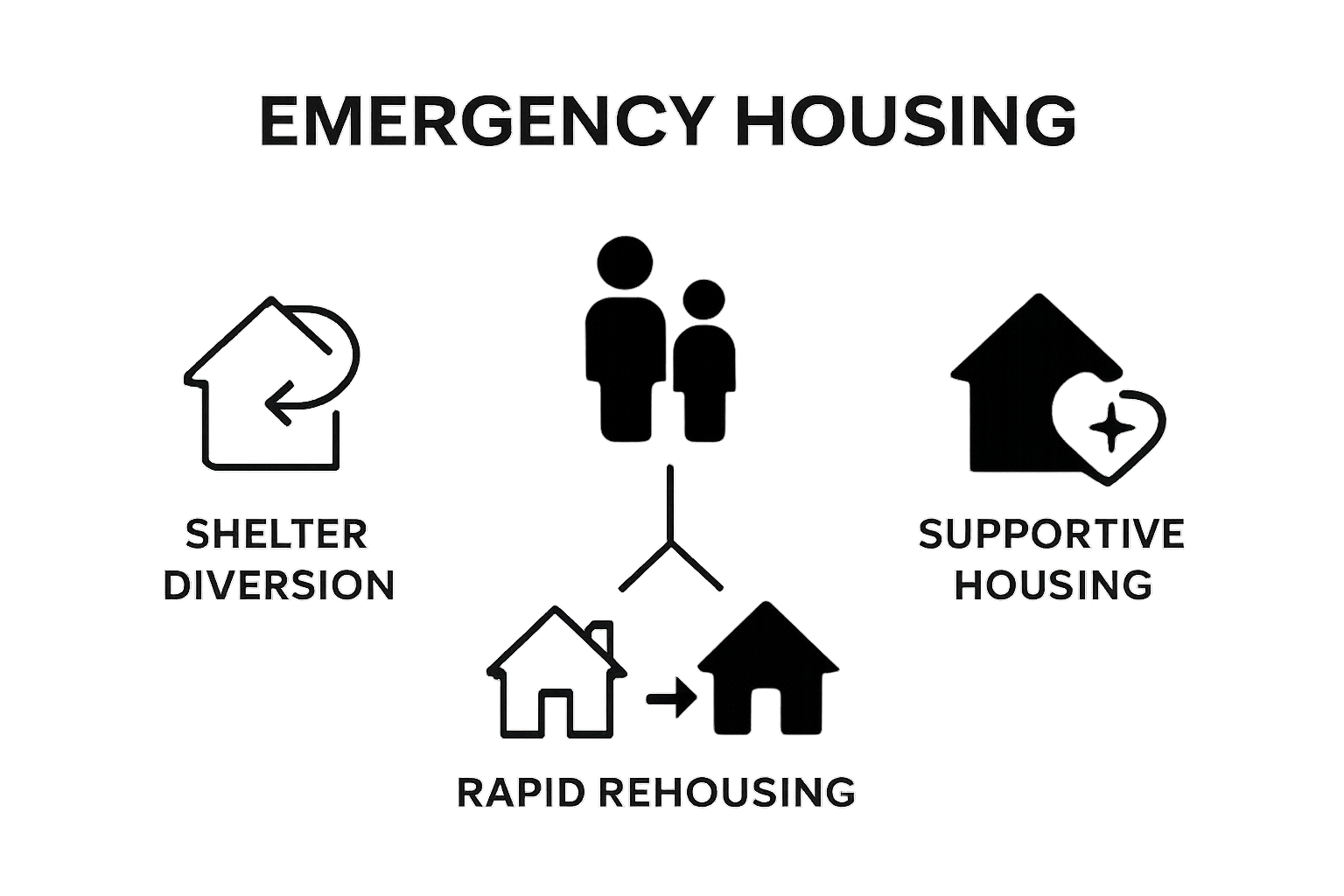
- Coordinated Entry: A standardized process for accessing emergency housing services
- Shelter Diversion: Strategies preventing unnecessary shelter entry
- Housing First: An approach prioritizing immediate permanent housing
- Rapid Rehousing: Quick transition from emergency to stable housing
- Supportive Housing: Combining affordable housing with comprehensive support services
These terms represent more than definitions. They embody philosophical approaches to addressing housing insecurity, emphasizing dignity, individual agency, and holistic support.
Here is a table summarizing foundational emergency housing assistance terminology and what each term means in practice to help readers quickly understand the core language of the field.
| Term | Definition |
|---|---|
| Coordinated Entry | Standardized process for accessing emergency housing services |
| Shelter Diversion | Strategies that prevent unnecessary shelter entry |
| Housing First | Approach that prioritizes immediate permanent housing over other interventions |
| Rapid Rehousing | Fast transition from emergency shelter to stable housing |
| Supportive Housing | Combines affordable housing with wraparound support services |
Critical Classification and Assessment Frameworks
Emergency housing professionals utilize sophisticated classification systems to match families with appropriate resources. Vulnerability assessment plays a crucial role in determining housing interventions. Key classification frameworks help prioritize assistance based on multiple risk factors:
- Family composition
- Income levels
- Previous housing stability
- Presence of children or vulnerable individuals
- Medical or psychological support needs
For a comprehensive understanding of how these frameworks guide housing referrals, explore our emergency housing workflow guide. These intricate systems ensure that limited resources are allocated strategically, supporting those most in need while maintaining an efficient, compassionate response to housing emergencies.
Real-World Examples of Effective Emergency Housing Solutions
Emergency housing solutions are not theoretical concepts but dynamic, practical interventions that transform lives during critical moments. By examining successful approaches, we can understand how comprehensive support systems effectively address complex housing challenges across different scenarios.
Urban Community Collaborative Models
Innovative community partnerships have emerged as powerful strategies for addressing emergency housing needs. In major metropolitan areas, these collaborative models leverage multiple institutional resources to create comprehensive support networks. According to urban housing research, successful approaches typically involve:
- Integrated government and nonprofit coordination
- Flexible funding mechanisms
- Personalized case management
- Rapid assessment and placement protocols
- Comprehensive wraparound services
These models demonstrate that effective emergency housing requires more than temporary shelter. They create holistic pathways toward sustainable housing stability.
Disaster Recovery Housing Initiatives
In regions frequently impacted by natural disasters, specialized emergency housing solutions have been developed to address unique challenges. Resilient housing strategies focus on quick, adaptable responses that balance immediate shelter needs with long-term community reconstruction. Key innovations include:
- Modular housing units
- Adaptive reuse of existing structures
- Community-driven reconstruction programs
- Mobile support infrastructure
- Trauma-informed relocation strategies
For deeper insights into emerging housing accessibility trends, explore our comprehensive guide. These real-world examples highlight the critical importance of adaptable, compassionate emergency housing solutions that prioritize human dignity and community resilience.

Secure Immediate Support for Your Family’s Emergency Housing Needs
When disaster hits, families face overwhelming uncertainty—finding safe emergency housing is the first step to recovery. The article spotlights the urgent challenges of displacement, from rapid shelter placement to coordinated social services. You want compassionate professionals who understand the complexities of vulnerability assessments, coordinated entry, and the transition from crisis to stability.
At DisasterVictimServices.com, we are experts in helping families navigate the emergency housing process during their most vulnerable moments. We work closely with government agencies, insurance companies, and disaster response teams to deliver fast, tailored solutions that put your family first. For even more guidance, explore our Uncategorized – Emergency Housing Support for resources that align with your immediate needs. Do not wait for uncertainty to grow—visit DisasterVictimServices.com now to connect with our devoted team and take the next step toward safe, reliable housing for your loved ones.
Frequently Asked Questions
What is the purpose of the emergency housing process?
The emergency housing process aims to provide immediate, safe, and dignified housing solutions for families facing sudden displacement due to disasters or emergencies, ensuring rapid assistance and connecting them with necessary support services.
How does emergency housing support psychological well-being during crises?
Emergency housing serves as a psychological anchor, helping families maintain a sense of security, reduce trauma-induced stress, and restore normalcy during traumatic transitions, which is essential for their emotional recovery.
What support services are typically offered through the emergency housing process?
The emergency housing process generally includes immediate housing placement, case management, connection to social services, financial assistance guidance, and mental health support to ensure comprehensive family well-being.
How does the emergency housing process differ in natural disasters compared to urban social emergencies?
In natural disaster scenarios, the focus is on immediate evacuation and temporary shelter. In contrast, urban social emergencies emphasize a holistic approach that includes legal assistance, financial counseling, and pathways to permanent housing in addition to immediate shelter.
Recommended
- Emergency Housing Referral Workflow: A 2025 Guide for Disaster Relief – Disaster Victim Services | Helping You Recover After Disaster
- Emergency Housing Workflow Guide 2025: Steps and Solutions – Disaster Victim Services | Helping You Recover After Disaster
- Direct Housing Process Guide 2025: Steps, Eligibility & Tips – Disaster Victim Services | Helping You Recover After Disaster
- Safe Housing Placement Steps for Disaster Response 2025 – Disaster Victim Services | Helping You Recover After Disaster