

When disaster strikes, the first few moments can determine everything. In emergencies, acting quickly and making smart decisions can literally save lives. Over 60 percent of disaster-related injuries happen within the first hour, highlighting how urgent it is to know exactly what steps to take. This guide cuts through confusion and provides practical, step by step actions to protect people, mobilize help, and lay the groundwork for recovery when it matters most.
Table of Contents
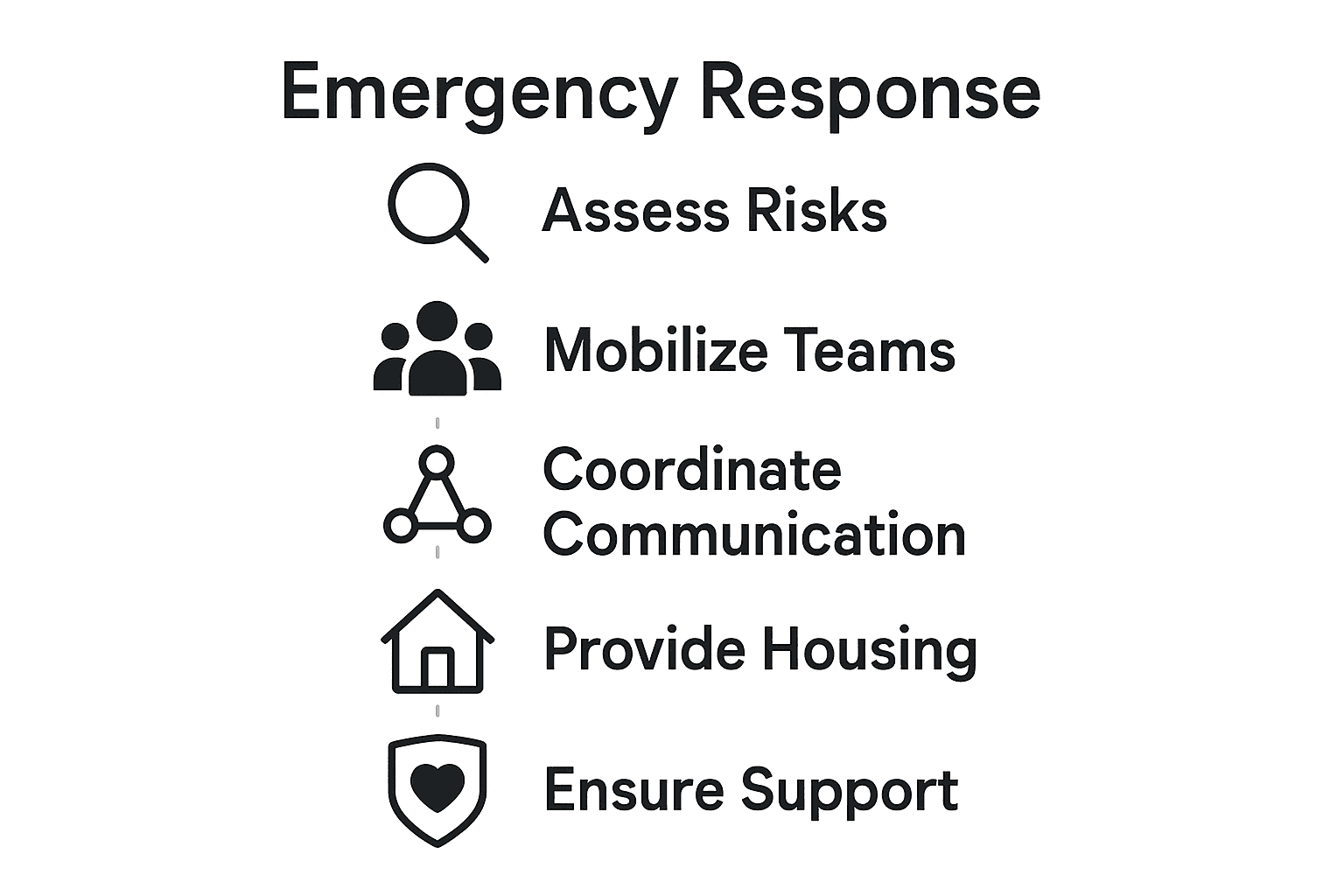
- Step 1: Assess Immediate Risks And Needs
- Step 2: Mobilize Critical Response Teams
- Step 3: Coordinate Multi-Agency Communication
- Step 4: Implement Emergency Housing Solutions
- Step 5: Verify Safety And Ensure Ongoing Support
Quick Summary
| Key Point | Explanation |
|---|---|
| 1. Conduct thorough risk assessments | Assess your surroundings for hazards like structural damage and potential fire risks before taking further action. |
| 2. Mobilize a coordinated response team | Designate team leaders and establish clear roles to ensure effective communication during emergencies. |
| 3. Implement robust multi-agency communication | Create a centralized hub for real-time information exchange to manage multi-agency responses efficiently. |
| 4. Develop dynamic emergency housing solutions | Assess available shelters and prioritize resource allocation to provide immediate housing for displaced individuals. |
| 5. Verify safety and provide ongoing support | Regularly assess safety and monitor the needs of survivors to ensure their well-being throughout recovery. |
Step 1: Assess immediate risks and needs
When disaster strikes, the first critical step is rapidly evaluating the safety landscape around you. According to Ready.gov, conducting a swift and thorough risk assessment determines your immediate survival strategy.
Your primary goal is identifying potential dangers that could threaten human life or cause further damage. Begin by systematically scanning your environment for hazards like structural damage, exposed electrical wires, gas leaks, unstable surfaces, potential fire risks, or contaminated water sources. The EPA recommends creating a quick mental checklist that prioritizes immediate life safety concerns.
Quick warning: Never assume an area is safe without a careful personal inspection. Potential risks can be invisible yet deadly. Move cautiously and methodically. If you are uncertain about a specific hazard, wait for professional emergency responders who have specialized training and equipment to assess complex dangerous scenarios.
Once you have completed your initial risk assessment, you will be ready to move to the next critical phase: securing immediate medical and survival resources.
Step 2: Mobilize critical response teams
Quick and coordinated action is crucial when mobilizing emergency response teams. According to Ready.gov, establishing clear roles and communication protocols is the foundation of an effective emergency response strategy.
Begin by rapidly identifying key personnel with specialized skills. Select Agent Program recommends designating a team lead who can quickly coordinate different experts and resources. Your response team should include members with diverse capabilities such as medical professionals, safety experts, communication specialists, and logistics coordinators. Create a clear chain of command and ensure each team member understands their specific responsibilities and reporting structure.
Warning: Communication breakdowns can cripple emergency response efforts. Implement a robust communication system using multiple channels like radio, mobile phones, and backup satellite communication to ensure team members can connect even if primary networks fail.
Once your critical response teams are assembled and communication channels established, you will be prepared to execute your emergency action plan with precision and speed.

Step 3: Coordinate multi-agency communication
Effective emergency response demands seamless communication across multiple agencies and organizations. According to the Biden-Harris Administration, successful multi-agency coordination requires a structured three-step approach involving incident assessment, establishing a clear response coordination structure, and operationalizing a unified leadership strategy.
Ready.gov recommends developing robust communication protocols that connect first responders, management teams, and public emergency services. Begin by creating a centralized communication hub where representatives from different agencies can share real-time information. This hub should have redundant communication systems including secure digital platforms, radio networks, and backup satellite communications to ensure continuous information exchange even if primary networks fail.
Warning: Communication gaps can severely compromise emergency response effectiveness. Develop a standardized communication template that allows rapid information sharing across different agencies, ensuring everyone understands critical updates, resource needs, and action priorities.
With clear multi-agency communication channels established, your emergency response team will be prepared to execute a coordinated and efficient intervention strategy.
Step 4: Implement emergency housing solutions
Implementing emergency housing solutions requires swift and strategic action to provide immediate shelter for displaced individuals and families. Understanding the critical nature of housing during disasters is essential for effective disaster response.
Begin by rapidly assessing available housing resources through local shelters, government facilities, hotels, and temporary housing networks. Emergency Housing Workflow Guide 2025 recommends creating a comprehensive inventory of potential housing options that can quickly accommodate different family sizes and special needs. Prioritize locations with basic amenities such as electricity, running water, and communication capabilities. Consider both congregate shelter environments and individual unit options to provide maximum flexibility for survivors.
Warning: Housing needs can change rapidly during emergencies. Develop a dynamic housing allocation system that allows for quick reallocation and reassignment based on emerging needs and changing family circumstances.
Once emergency housing solutions are implemented, you will be prepared to support disaster victims during their most vulnerable moments and begin their path toward recovery and stabilization.
Step 5: Verify safety and ensure ongoing support
The final critical phase of emergency response involves thoroughly verifying safety conditions and establishing comprehensive ongoing support for disaster victims. Ready.gov emphasizes the importance of conducting meticulous safety assessments and accounting for all individuals impacted by the emergency.
EPA guidelines recommend implementing a systematic approach to verify safety. Begin by conducting comprehensive site assessments to identify potential hazards and document current conditions. Create detailed tracking mechanisms to monitor the physical and emotional well being of displaced individuals. This process includes regular health screenings, mental health support evaluations, and continuous communication with survivors to understand their evolving needs.
Warning: Recovery is not a linear process. Develop flexible support strategies that can adapt to changing circumstances and individual survivor experiences. Some individuals may require extended support beyond initial emergency phases.
With safety verified and ongoing support mechanisms established, you will have created a robust foundation for helping survivors transition from immediate crisis to long term recovery and rebuilding.
Prepare with Confidence: Navigate Emergency Response with Expert Support
Emergencies demand quick action and clear coordination. This step-by-step guide highlights the intense challenges of assessing risks, mobilizing teams, and securing emergency housing all while maintaining seamless multi-agency communication. If you are facing these pressures or planning ahead, you understand the critical need for trusted partners who can provide compassionate, efficient support in chaotic moments.
At DisasterVictimServices.com, we specialize in connecting disaster victims with immediate emergency housing and logistical assistance. Our team works closely with first responders, insurance carriers, and government agencies to streamline the complex recovery process. By visiting our New – Disaster Victim Services | Helping You Recover After Disaster category, you can explore the latest insights and proven approaches tailored for urgent disaster response.
Do not wait until crisis strikes. Learn how our expert guidance and collaborative approach can ease the burden and accelerate your path to recovery. Take the next step now by visiting Disaster Victim Services and discover how we can help you and your community rebuild with confidence.
For additional resources and updates, check out our Uncategorized – Disaster Victim Services | Helping You Recover After Disaster page to stay informed and prepared.
Frequently Asked Questions
How do I assess immediate risks after a disaster?
To assess immediate risks, systematically scan your environment for potential dangers like structural damage, gas leaks, and unstable surfaces. Create a mental checklist to prioritize life safety concerns and confirm safety with a thorough personal inspection before moving forward.
What steps should I take to mobilize critical response teams?
Begin mobilizing critical response teams by identifying key personnel with specialized skills and designating a team lead to coordinate efforts. Establish clear roles and communication protocols, ensuring each team member understands their responsibilities and can connect using multiple communication channels.
How can I improve multi-agency communication during an emergency?
To improve multi-agency communication, develop a centralized communication hub where representatives can share real-time information. Implement redundant systems like digital platforms and radio networks to ensure seamless communication, even if primary systems fail.
What considerations should I keep in mind when implementing emergency housing solutions?
When implementing emergency housing solutions, rapidly assess available resources like local shelters and temporary housing. Create a comprehensive inventory that accommodates various family sizes and needs, ensuring access to basic amenities like electricity and water.
How do I verify safety and provide ongoing support to disaster victims?
To verify safety, conduct thorough site assessments and monitor the well-being of displaced individuals through regular health screenings. Establish flexible support strategies that adapt to the evolving needs of survivors, ensuring they have the necessary resources for recovery.
What is the importance of creating a dynamic housing allocation system?
A dynamic housing allocation system is crucial because housing needs can rapidly change during emergencies. Develop a mechanism that allows for quick reallocation based on emerging circumstances to ensure that all individuals receive the appropriate support.
Recommended
- Emergency Response Basics for 2025: A Practical Guide – Disaster Victim Services | Helping You Recover After Disaster
- 7 Essential Tips for Your Emergency Response Checklist 2025 – Disaster Victim Services | Helping You Recover After Disaster
- Responder Safety Protocols: Essential Steps for 2025 Emergencies – Disaster Victim Services | Helping You Recover After Disaster
- Emergency Response Step by Step for Effective Assistance – Disaster Victim Services | Helping You Recover After Disaster