

Every year, devastating disasters force thousands of families from their homes, putting communities under huge strain to find safe places fast. Yet most people do not realize that a precise housing capacity assessment is far more than just counting spare rooms or beds. The real power lies in how it shapes recovery—families are more likely to regain stability when matched to housing based on social, structural, and geographic data, not guesswork. This hidden process can mean the difference between chaos and compassionate support after a crisis.
Table of Contents
- What Is Housing Capacity Assessment And Its Purpose?
- Why Housing Capacity Assessment Matters For Families And Communities
- How Housing Capacity Assessment Works In Disaster Response
- Key Concepts And Factors In Housing Capacity Assessment
- Real-World Applications Of Housing Capacity Assessment
Quick Summary
| Takeaway | Explanation |
|---|---|
| Housing assessments are vital during emergencies. | They help identify available housing resources for displaced families in crises such as natural disasters. |
| Assess structural integrity and infrastructure. | Evaluating housing safety, utilities, and community access ensures effective shelter solutions for affected populations. |
| Understand the unique needs of displaced families. | Tailoring housing options to family sizes, cultural contexts, and special requirements enhances recovery outcomes for individuals. |
| Coordinate efforts among multiple stakeholders. | Collaborative strategies between government, agencies, and organizations minimize disruption and maintain community connections during housing placements. |
| Use advanced technologies for efficient assessments. | Geospatial mapping and data collection enhance the speed and effectiveness of identifying potential housing solutions in emergencies. |
What is Housing Capacity Assessment and Its Purpose?
A housing capacity assessment represents a critical analytical process that evaluates the available housing resources and potential accommodations for displaced families during emergency situations. This systematic approach helps emergency responders, government agencies, and relief organizations understand the precise housing infrastructure required to support individuals who have lost their homes due to disasters.
Defining Housing Capacity Assessment
Housing capacity assessment involves a comprehensive evaluation of residential spaces, temporary shelter options, and community resources that can be mobilized to provide immediate and transitional housing for affected populations. The primary objective is to quickly determine the number of individuals and families that can be safely and effectively housed within a specific geographical area.
Learn more about our housing placement strategies to understand how we systematically approach emergency housing solutions.
Key Components of Housing Capacity Assessment
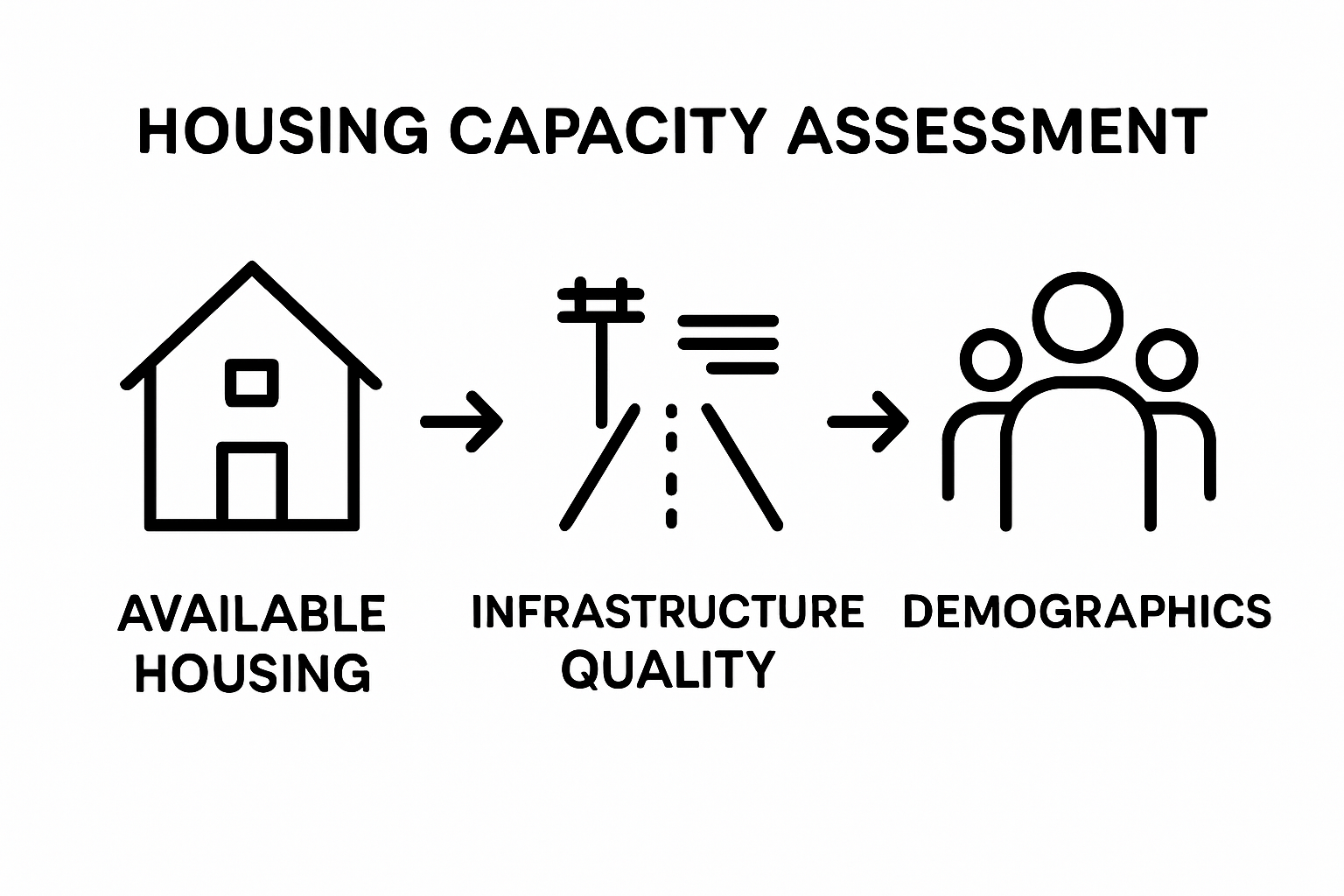
The assessment process encompasses several critical elements that provide a holistic view of housing capabilities
The following table outlines the key components included in a housing capacity assessment, summarizing each element and its primary focus during disaster response.
| Component | Description |
|---|---|
| Structural Inventory | Catalogs available residential spaces, including vacant homes, shelters, and temporary facilities. |
| Infrastructure Evaluation | Reviews utilities, sanitation, water supply, and accessibility of potential housing sites. |
| Demographic Analysis | Assesses family sizes, special needs, and cultural considerations of displaced populations. |
 :
:
-
Structural Inventory: Detailed documentation of available residential spaces, including vacant properties, government facilities, hotels, dormitories, and potential temporary shelter locations.
-
Infrastructure Evaluation: Analysis of existing infrastructure such as utilities, sanitation, water supply, and accessibility to ensure the selected housing can support displaced families.
-
Demographic Analysis: Understanding the specific needs of displaced populations, including family sizes, special requirements for vulnerable groups like elderly or disabled individuals, and cultural considerations.
By conducting a thorough housing capacity assessment, emergency response teams can develop targeted strategies that address immediate shelter needs while maintaining the dignity and safety of displaced families. According to FEMA’s National Disaster Recovery Framework, such assessments are fundamental in creating effective, compassionate emergency housing solutions that support community resilience during challenging times.
Why Housing Capacity Assessment Matters for Families and Communities
Housing capacity assessment transcends mere logistical planning by providing a critical lifeline for families and communities experiencing disaster displacement. This comprehensive process addresses urgent human needs while simultaneously supporting broader community resilience and recovery strategies.
Immediate Human Impact
For displaced families, a precise housing capacity assessment represents hope and stability during traumatic circumstances. By rapidly identifying suitable housing options, emergency responders can minimize the emotional and psychological strain associated with losing one’s home. The assessment ensures that families are not just relocated, but strategically placed in environments that support their immediate and long-term recovery.
Explore our safe housing placement strategies to understand how we prioritize family well-being during challenging times.
Community Resilience and Recovery
Beyond individual family support, housing capacity assessments play a pivotal role in community restoration. These assessments help local governments and relief organizations understand the broader displacement landscape by providing critical insights into:
-
Resource Allocation: Precise data on housing needs allows for targeted resource distribution
-
Economic Stabilization: By facilitating quick housing solutions, communities can prevent prolonged economic disruption
-
Social Infrastructure Preservation: Maintaining community cohesion by keeping displaced residents within proximity of their original neighborhoods
According to the National Low Income Housing Coalition, comprehensive housing capacity assessments are fundamental in developing strategic recovery frameworks that address both immediate shelter requirements and long-term community rebuilding efforts. These assessments transform emergency response from reactive measures to proactive, holistic recovery strategies that support families and strengthen community bonds during challenging times.
How Housing Capacity Assessment Works in Disaster Response
Housing capacity assessment operates as a sophisticated, multiphased process that transforms complex disaster response challenges into actionable housing solutions. This systematic approach enables emergency management teams to quickly analyze, strategize, and implement housing strategies for displaced populations.
Data Collection and Initial Mapping
The first critical stage involves comprehensive data gathering and spatial analysis. Emergency responders utilize advanced geospatial technologies and real time mapping to rapidly identify available housing resources, infrastructure conditions, and potential shelter locations. Geospatial mapping allows teams to visualize housing capacity instantaneously, enabling swift decision making during crisis scenarios.
Learn more about our housing placement workflow to understand the intricate details of our disaster response strategies.
Rapid Assessment and Verification
Once initial data is collected, housing capacity assessment teams conduct rapid verification processes that encompass multiple critical evaluation parameters:
-
Structural Integrity Assessment: Detailed inspection of potential housing units for safety and livability
-
Utility Infrastructure Evaluation: Comprehensive analysis of water, electricity, and sanitation capabilities
-
Accessibility Analysis: Determining proximity to essential services, medical facilities, and community resources
These verification steps ensure that identified housing options meet stringent safety and humanitarian standards. According to FEMA’s Disaster Housing Strategy, successful housing capacity assessments require dynamic, flexible approaches that can adapt to rapidly changing disaster landscapes.
Coordination and Implementation
The final phase transforms assessment data into actionable housing placement strategies. Multidisciplinary teams collaborate across government agencies, relief organizations, and local authorities to match displaced families with appropriate housing solutions. This coordinated approach minimizes disruption, maintains community connections, and provides immediate stability for affected populations.
Key Concepts and Factors in Housing Capacity Assessment
Housing capacity assessment requires a nuanced understanding of multiple interconnected factors that extend far beyond simple spatial calculations. This comprehensive approach integrates technical analysis, human needs assessment, and strategic planning to create effective disaster response solutions.
Demographic and Social Considerations
Successful housing capacity assessments recognize that displaced populations are not homogeneous groups. Each family or individual carries unique needs, challenges, and cultural backgrounds that significantly impact housing placement strategies. Emergency responders must consider complex social dynamics such as family structure, age distribution, disability requirements, and cultural preferences when evaluating potential housing options.
Explore our guide on understanding occupancy standards to gain deeper insights into the intricacies of housing placement.
Technical and Infrastructure Evaluation
Beyond social considerations, housing capacity assessment involves rigorous technical evaluation of potential housing environments. Critical factors include:
-
Structural Resilience: Assessing buildings for safety, damage resistance, and compliance with local building codes
-
Utility Infrastructure: Evaluating water, electricity, sewage, and communication systems to ensure sustainable living conditions
-
Environmental Risk Assessment: Analyzing potential exposure to future natural disasters or environmental hazards
These technical evaluations ensure that housing solutions are not just immediate but also sustainable and protective of displaced families’ long term well being. According to the US Government Accountability Office, comprehensive risk assessment is fundamental to developing resilient disaster housing strategies.
Strategic Resource Allocation
Housing capacity assessment ultimately serves as a critical strategic tool for resource management. By providing precise data on housing needs, emergency management teams can optimize resource distribution, minimize economic disruption, and support community recovery. The process transforms raw data into actionable insights that guide policy making, funding allocation, and targeted support for displaced populations.
Real-World Applications of Housing Capacity Assessment
Housing capacity assessment transcends theoretical frameworks, delivering tangible solutions in complex disaster scenarios across diverse geographic and social landscapes. These practical applications demonstrate the critical role of systematic housing evaluation in supporting displaced populations and rebuilding community infrastructure.
Hurricane and Coastal Disaster Response
Coastal communities face unique housing challenges during catastrophic weather events that require sophisticated housing capacity assessment strategies. Emergency management teams utilize advanced geospatial technologies and demographic mapping to rapidly identify sustainable housing options for families displaced by hurricanes, flooding, and severe storm damage. By analyzing infrastructure resilience, utility availability, and regional housing stock, responders can create targeted relocation strategies that minimize community disruption.
Learn more about our housing accessibility approaches to understand how we adapt to complex disaster scenarios.
Wildfire and Climate Emergency Displacement
In regions experiencing increased climate related emergencies, housing capacity assessment becomes a critical predictive and responsive tool. Key applications include:
-
Rapid Relocation Planning: Identifying alternative housing options before mandatory evacuations
-
Long Term Community Resilience: Developing sustainable housing strategies that account for recurring environmental risks
-
Infrastructure Adaptation: Mapping potential housing solutions that withstand evolving environmental challenges
These approaches transform housing capacity assessment from a reactive measure to a proactive community protection strategy. According to the US Government Accountability Office, comprehensive housing assessment models are essential for developing resilient disaster response frameworks.

Pandemic and Public Health Emergency Housing
The COVID-19 pandemic highlighted housing capacity assessment’s versatility in public health emergencies. Emergency management teams utilized these assessment techniques to rapidly identify isolation spaces, create quarantine housing, and support vulnerable populations. By integrating health infrastructure analysis with housing capacity evaluation, communities could develop nuanced, adaptable housing solutions that protected public health while maintaining individual family needs.
This table compares the implementation of housing capacity assessment across different real-world disaster contexts, highlighting distinct challenges and response strategies for each scenario.
| Disaster Context | Unique Challenge | Assessment Response Strategy |
|---|---|---|
| Hurricane and Coastal Disaster Response | Sudden mass displacement, flood-damaged housing | Geospatial mapping, infrastructure analysis, targeted relocation planning |
| Wildfire and Climate Emergency | Rapid evacuations, recurring environmental risks | Predictive relocation planning, resilience-based housing solutions |
| Pandemic/Public Health Emergency | Need for isolation/quarantine, public health risk | Health infrastructure analysis, adaptive use of housing for isolation/quarantine |
Take Immediate Action: Secure Safe Housing for Your Family
Worried about where your loved ones will stay after a disaster? Understanding housing capacity assessment shows how complex and urgent this process can be. If you are facing displacement or need quick housing solutions, you do not have to navigate the uncertainty alone. Our team at DisasterVictimServices.com applies the same detailed strategies described in this article to place your family in secure, comfortable housing as fast as possible.
We handle every step from assessing safe locations to managing logistics and paperwork. Our experts work directly with insurance companies, government agencies, and relief organizations to streamline your recovery. Ready to experience personal support rather than bureaucratic delays? Contact us now so you can focus on your family while we focus on your safety. For a closer look at how we guide you through each phase, visit our housing placement workflow guide. Let us help you move from crisis to comfort starting today.
Frequently Asked Questions
What is a housing capacity assessment?
A housing capacity assessment is an analytical process that evaluates the available housing resources and potential accommodations for displaced families during emergencies, helping responders understand the housing infrastructure needed to support those affected by disasters.
Why is housing capacity assessment important for families?
Housing capacity assessment is crucial for families as it provides a structured approach to identify suitable housing options rapidly, thereby minimizing the emotional strain of displacement and ensuring that families are placed in environments that support their recovery.
How does a housing capacity assessment work in disaster response?
The assessment works through a multiphased process that includes data collection and mapping, rapid assessment and verification of housing options, and coordination for implementation with government agencies and relief organizations to effectively house displaced families.
What factors are considered in a housing capacity assessment?
Key factors include structural integrity, utility infrastructure, accessibility to essential services, demographic needs, and environmental risk assessments. This comprehensive evaluation helps ensure that proposed housing solutions are safe, sustainable, and suitable for displaced families.