


Disaster recovery housing placement is about more than roofs and walls. Think about this. After a major disaster, over 60 percent of families struggle to find safe housing in the first two weeks. Yet, technology and interagency coordination are now transforming what used to be a slow, chaotic scramble into a much more targeted and humane process. Most surprising of all, the real breakthrough is not just the tech, but the shift toward trauma-informed approaches and comprehensive support networks that put family resilience at the heart of every decision.
Table of Contents
- Key Stages In Housing Placement Workflow
- Coordinating Between Agencies And Stakeholders
- Technology And Tools For Improving Placement
- Best Practices For Supporting Displaced Families
Quick Summary
| Takeaway | Explanation |
|---|---|
| Initial Damage Assessment is Critical | Comprehensive evaluations of housing infrastructure and community impacts are essential to inform effective housing placement strategies following disasters. |
| Robust Interagency Coordination is Essential | Establishing clear communication frameworks and resource allocation strategies between agencies ensures a cohesive response to housing placement needs. |
| Technology Enhances Disaster Response | Utilizing advanced technologies, such as data mapping and artificial intelligence, improves the efficiency and effectiveness of housing placement efforts. |
| Trauma-Informed Approaches are Vital | Recognizing the emotional challenges faced by displaced families leads to more responsive and effective recovery planning, prioritizing emotional safety and individual resilience. |
| Support Strategies Must Be Comprehensive | Integrating social services and focusing on child-specific support strategies help restore stability and promote long-term recovery for displaced families. |
Key Stages in Housing Placement Workflow
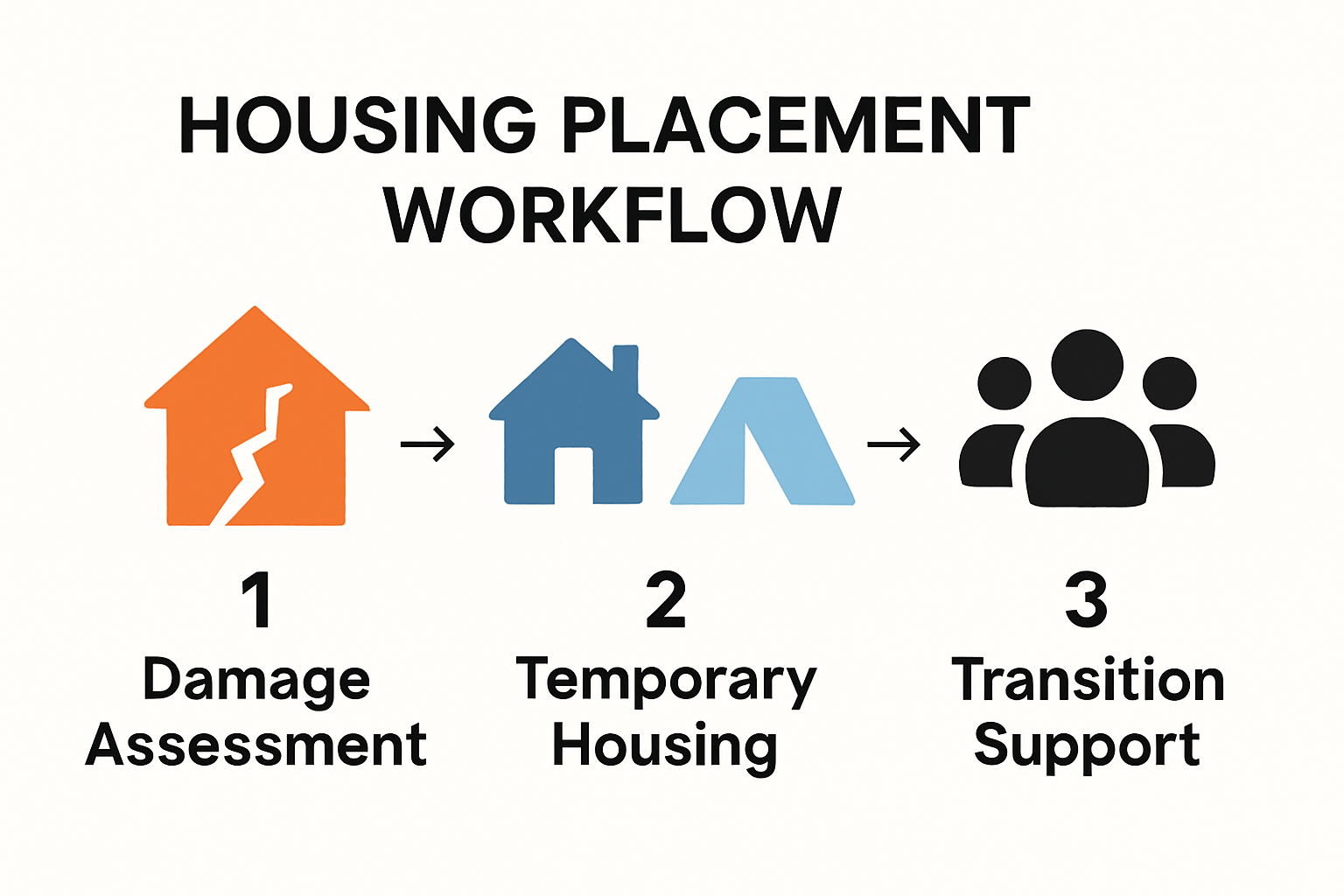
Disaster recovery demands a strategic and compassionate approach to housing placement. The housing placement workflow represents a critical lifeline for individuals and families displaced by unexpected catastrophic events. Understanding the key stages helps emergency responders, government agencies, and relief organizations coordinate effective support.
Initial Damage and Impact Assessment
The first crucial stage in the housing placement workflow involves comprehensive damage assessment. According to FEMA’s Recovery Support Framework, this process requires detailed evaluation of housing infrastructure and community impacts. Experts conduct systematic inspections to determine the extent of damage, categorize housing units as uninhabitable, repairable, or completely destroyed.
Specialized teams utilize advanced assessment protocols to document:
- Structural integrity of existing housing
- Utility system damages
- Environmental hazards
- Population displacement metrics
These assessments provide critical data that informs subsequent housing placement strategies. By understanding the precise nature and scale of damage, relief organizations can develop targeted intervention plans.
Institutional Coordination and Resource Allocation
The original content continues here…
Effective housing placement requires robust institutional arrangements and strategic resource coordination. Research from disaster management experts highlights the importance of establishing a central reconstruction authority that can streamline communication between multiple stakeholders.
Key coordination elements include:
- Interagency communication protocols
- Resource mapping and allocation
- Temporary housing identification
- Vulnerable population prioritization
This stage involves complex logistical planning where government agencies, insurance providers, and relief organizations work collaboratively to develop comprehensive housing solutions. The goal is to create a flexible yet structured approach that can adapt to varying disaster scenarios and community needs.
Emergency Housing Placement and Transition Support

The final critical stage focuses on actual housing placement and transition support for displaced individuals and families. This phase goes beyond merely providing temporary shelter. It involves creating holistic support systems that address immediate housing needs while preparing for long term recovery.
Transition support includes:
- Immediate temporary housing assignment
- Mental health and counseling resources
- Connection to financial assistance programs
- Ongoing case management
Successful housing placement requires a compassionate, personalized approach that recognizes the emotional and psychological challenges faced by disaster victims. By combining systematic workflow management with human centered support, relief organizations can help communities rebuild and recover more effectively.
The housing placement workflow is not just a technical process but a critical humanitarian response that bridges the gap between crisis and recovery. Each stage demands precision, empathy, and strategic coordination to restore hope and stability for those impacted by disaster.
To help clarify the stages in the housing placement workflow, the following table summarizes the three key stages, their main activities, and typical outcomes.
| Stage | Main Activities | Typical Outcomes |
|---|---|---|
| Initial Damage and Impact Assessment | Evaluate housing/utility damage, document hazards & displacement | Data for planning, needs identified |
| Institutional Coordination and Resource Allocation | Coordinate agencies, map resources, prioritize vulnerable groups | Temporary housing options, resource sharing |
| Emergency Housing Placement and Transition Support | Place families, provide social & mental health support | Safe shelter, transition to long-term recovery |
Coordinating Between Agencies and Stakeholders
Effective disaster recovery hinges on seamless coordination between multiple agencies and stakeholders. The complexity of housing placement requires a sophisticated network of communication, resources, and collaborative strategies that transcend traditional organizational boundaries.
Establishing Multi Agency Communication Frameworks
Successful disaster response demands robust communication protocols. According to the National Disaster Recovery Framework, effective inter agency coordination is fundamental to successful housing placement. The U.S. Department of Housing and Urban Development (HUD) plays a critical role in leading the Housing Recovery Support Function, facilitating communication between federal, state, local, and territorial partners.
Key communication strategies include:
- Real time information sharing platforms
- Unified incident reporting systems
- Collaborative decision making protocols
- Integrated emergency management technologies
These frameworks ensure that critical information flows smoothly between government agencies, relief organizations, and community support networks. By creating transparent and efficient communication channels, stakeholders can respond more quickly and effectively to housing displacement challenges.
Resource Allocation and Collaborative Planning
Resource coordination represents a critical aspect of inter agency collaboration. Research from the Government Accountability Office emphasizes the importance of strategic resource mapping and allocation, particularly for vulnerable populations during disaster recovery. This process involves comprehensive assessment of available housing, financial resources, and support services.
Effective resource coordination requires:
- Comprehensive needs assessment
- Centralized resource tracking
- Flexible funding mechanisms
- Prioritization of high risk communities
Stakeholders must develop adaptive strategies that can quickly respond to changing disaster scenarios. Our guide on disaster response coordination provides deeper insights into these complex planning processes.
Integrated Support and Continuous Improvement
The final stage of inter agency coordination focuses on creating holistic support systems that extend beyond immediate disaster response. This approach recognizes that effective housing placement is an ongoing process requiring continuous assessment and improvement.
Integrated support mechanisms include:
- Joint training and skill development programs
- Regular inter agency performance reviews
- Shared data analysis and reporting
- Collaborative policy development
By fostering a culture of cooperation and continuous learning, agencies can develop more resilient and responsive housing placement workflows. This approach transforms disaster recovery from a fragmented response to a unified, compassionate support system.
Coordination between agencies is not just a logistical challenge but a critical humanitarian imperative. Each interaction, each shared resource, and each collaborative effort represents a lifeline for communities struggling to rebuild after disaster.
Technology and Tools for Improving Placement
Technology has revolutionized disaster recovery housing placement, offering unprecedented capabilities for rapid response, precise resource allocation, and comprehensive support. Modern technological solutions transform traditional approaches, enabling more efficient and compassionate assistance for displaced individuals and communities.
Advanced Data Mapping and Assessment Technologies
Geospatial technologies and data analytics have become critical tools in housing placement workflows. According to research from the National Center for Disaster Preparedness, innovative mapping technologies enable emergency responders to quickly assess damage, identify available housing resources, and prioritize recovery efforts.
Key technological capabilities include:
- Real time satellite damage assessment
- Geographic information system (GIS) mapping
- Drone based infrastructure evaluation
- Machine learning damage prediction models
These advanced technologies provide unprecedented insight into disaster impacts, allowing relief organizations to make data driven decisions with remarkable speed and accuracy. By transforming complex spatial data into actionable intelligence, technology bridges the gap between assessment and effective housing placement.
Digital Coordination and Communication Platforms
The U.S. Department of Homeland Security’s Science and Technology Directorate emphasizes the importance of integrated digital platforms in disaster response. Modern communication technologies enable seamless coordination between multiple agencies, streamlining information exchange and resource allocation.
Critical digital coordination tools include:
- Centralized disaster management dashboards
- Secure inter agency communication networks
- Mobile application tracking systems
- Cloud based resource management platforms
These digital solutions eliminate traditional communication barriers, creating a more responsive and adaptive housing placement ecosystem. Learn more about our innovative response coordination strategies to understand how technology transforms disaster recovery.
Artificial Intelligence and Predictive Support Systems
Artificial intelligence represents the next frontier in housing placement technology. Advanced AI systems can analyze complex datasets, predict potential housing needs, and recommend optimal placement strategies with remarkable precision.
AI driven support mechanisms include:
- Automated vulnerability risk assessment
- Personalized housing recommendation algorithms
- Predictive resource allocation models
- Intelligent case management systems
By leveraging machine learning and advanced analytics, these technologies provide a more nuanced and personalized approach to housing placement. They transform disaster response from a reactive process to a proactive, intelligent support system that anticipates and addresses community needs.
Technology is not merely a tool but a transformative force in disaster recovery housing placement. As digital solutions continue to evolve, they promise increasingly sophisticated, compassionate, and effective support for communities facing unprecedented challenges.
The table below compares the major technology tools and methods used to improve disaster recovery housing placement, highlighting their key benefits and main applications.
| Technology Tool/Approach | Main Benefit | Example Application |
|---|---|---|
| Real time satellite assessment | Rapid disaster area evaluation | Assess housing/area damage |
| GIS mapping | Visualizes resource & impact locations | Locate available housing units |
| Drone-based infrastructure evaluation | Detailed structure inspection | Inspect hard-to-reach damage |
| Disaster management dashboards | Centralizes communication & status | Coordinate agency actions |
| AI predictive resource allocation | Anticipates future housing needs | Plan placement strategies |
| Mobile application tracking | Real-time field updates | Track family placements |
Best Practices for Supporting Displaced Families
Disaster recovery extends far beyond physical infrastructure restoration. Supporting displaced families requires a holistic, compassionate approach that addresses immediate survival needs while nurturing long term psychological and social recovery.
Trauma Informed Recovery Planning
Trauma informed recovery represents a critical framework for supporting displaced families. According to research from the National Institutes of Health, effective recovery planning must understand community history with traumatic events and ensure equitable access for all population groups.
Key trauma informed principles include:
- Prioritizing emotional safety
- Recognizing individual resilience
- Creating transparent support processes
- Empowering community leadership
This approach acknowledges that each family experiences disaster differently. By centering human dignity and individual experiences, relief organizations can develop more responsive and meaningful support strategies.
Comprehensive Social Service Integration
Research from the National Academies of Sciences emphasizes the importance of developing integrated post disaster social service frameworks. Effective support requires coordinated efforts that link current and future funding sources, policies, and comprehensive human services strategies.
Critical components of integrated support include:
- Holistic needs assessment
- Continuous case management
- Multi generational support programs
- Financial counseling and assistance
Our comprehensive guide on managing displacement provides deeper insights into creating supportive recovery ecosystems.
Child and Family Specific Support Strategies
Children represent a particularly vulnerable population during disaster recovery. According to pediatric disaster response experts, establishing specialized children’s task forces can significantly improve recovery outcomes by prioritizing child specific needs.
Child and family support strategies include:
- Educational continuity programs
- Child friendly temporary housing solutions
- Mental health counseling services
- Family reunification support
These targeted interventions recognize that family stability is fundamental to successful disaster recovery. By providing comprehensive support that addresses both immediate survival needs and long term psychological well being, relief organizations can help families navigate the complex journey of post disaster reconstruction.
Supporting displaced families is not simply about providing shelter. It is about restoring hope, rebuilding community connections, and creating pathways for resilience and recovery. Each compassionate interaction represents a critical step toward healing and renewal.
Frequently Asked Questions
What is the initial damage assessment in the housing placement workflow?
The initial damage assessment involves a comprehensive evaluation of housing infrastructure and community impacts. Experts inspect housing units to categorize them as uninhabitable, repairable, or destroyed, gathering critical data to inform recovery strategies.
Why is interagency coordination important for housing placement during disaster recovery?
Interagency coordination is essential for creating a cohesive response to housing needs. It establishes communication frameworks and resource allocation strategies, ensuring that all stakeholders work together efficiently to support displaced families.
How does technology improve the housing placement process after a disaster?
Technology enhances disaster recovery housing placement by utilizing advanced data mapping, digital communication platforms, and artificial intelligence. These tools improve efficiency, allowing for rapid assessment and distribution of housing resources.
What are trauma-informed approaches in disaster recovery housing placement?
Trauma-informed approaches prioritize the emotional safety and resilience of displaced families. They ensure that recovery planning acknowledges individual experiences and challenges, leading to more effective and compassionate support during the recovery process.
Move from Uncertainty to Stability with the Right Housing Placement Support
When disaster takes away your home, you are left to face urgent questions about safety, shelter, and how your family will recover. The article highlighted how vital it is to move quickly through the housing placement workflow, from initial damage assessment to coordinated emergency support. But even with solid planning, families can feel overwhelmed by the complex steps, gaps in communication, and the challenge of finding secure solutions fast.
You do not have to face these challenges alone. Our team at Disaster Victim Services specializes in guiding you through every stage of disaster recovery. We collaborate with agencies, insurance providers, and first responders to make sure you find immediate, reliable shelter and support. Explore how our Developing – Disaster Victim Services solutions provide fast, compassionate assistance aligned with the best practices outlined in your workflow guide. Ready to ensure a smooth transition for your household? Connect now for expert help and put your recovery plan into action without delay.
Recommended
- How to Manage Displacement: Practical Steps for Disaster Recovery 2025 – Disaster Victim Services | Helping You Recover After Disaster
- How to Handle Relocations in 2025: A Guide for Disaster Relief Teams – Disaster Victim Services | Helping You Recover After Disaster
- how to manage displacement – Disaster Victim Services | Helping You Recover After Disaster
- How to handle relocations – Disaster Victim Services | Helping You Recover After Disaster
- disaster recovery phases – Disaster Victim Services | Helping You Recover After Disaster
- Home Safety Tips 2025: Essential Guide for Disaster Recovery – Disaster Victim Services | Helping You Recover After Disaster