

Emergency response teams are facing more challenges and higher expectations than ever before. Some roles are so critical that 45 percent of emergency response job postings now demand specialized skills in emergency management, preparedness, and incident command. Most people think it’s all about first responders racing to the scene and rushing into action. In reality, the real power comes from how these different roles work together and keep adapting as disasters grow more complex.
Table of Contents
- Key Emergency Response Roles Explained
- How Different Groups Coordinate In Emergencies
- Essential Skills For Effective Response Teams
- Improving Emergency Response For Better Results
Quick Summary
| Takeaway | Explanation |
|---|---|
| Incident Command is Crucial | The Incident Commander leads emergency response, setting objectives and coordinating actions among agencies. Proper leadership is essential for effective response strategies. |
| Emphasize Interagency Collaboration | Collaboration between local and federal agencies ensures efficient resource sharing and operational coordination during crises, enhancing overall emergency effectiveness. |
| Adopt Technology for Coordination | Utilizing advanced technologies like GIS and cloud-based systems improves real-time information sharing, enabling faster and more effective emergency responses. |
| Develop Psychological Resilience | Response teams require emotional intelligence and resilience to manage high-stress situations, enhancing team dynamics and decision-making under pressure. |
| Commit to Continuous Training | Continuous skill development and simulation training prepare emergency responders for evolving challenges and improve their adaptability in diverse scenarios. |
Key Emergency Response Roles Explained
Emergency response professionals play a critical role in managing and mitigating disasters, protecting communities, and ensuring rapid, coordinated action during crisis situations. Understanding the specific responsibilities and interactions between different emergency response roles becomes increasingly crucial as we approach 2025.
Incident Command and Leadership Roles
At the core of effective emergency response is the incident command structure. Learn more about first responder coordination According to the Federal Emergency Management Agency, the Incident Commander holds the most critical position, responsible for setting overall objectives and maintaining comprehensive situational awareness. This role requires exceptional decision making skills and the ability to coordinate multiple agencies and resources simultaneously.
The Incident Commander works closely with several key supporting roles. The Public Information Officer serves as the primary communication conduit, managing public messaging and ensuring transparent, accurate information dissemination during emergencies. The Liaison Officer acts as a critical interface between different responding agencies, facilitating smooth interagency communication and resource allocation.
Specialized Emergency Response Professionals
Beyond leadership roles, emergency response teams comprise specialized professionals with distinct responsibilities. Occupational Safety and Health Administration guidelines emphasize the importance of designated emergency coordinators who assess situations, direct evacuations, and ensure proper protocols are followed.
Medical emergency response teams play a crucial role in providing immediate healthcare interventions. These professionals include paramedics, emergency medical technicians, and specialized healthcare providers trained to deliver rapid medical support in high-stress environments. Their responsibilities extend beyond immediate treatment, encompassing triage, stabilization, and coordinating patient transport to appropriate medical facilities.
Technical and Support Roles in Emergency Response
Technical support professionals are increasingly important in modern emergency response strategies. These roles include emergency communications specialists who manage complex communication networks, geographic information system (GIS) experts who provide critical spatial analysis, and logistics coordinators who ensure resources and personnel are efficiently deployed.
As emergency response continues to evolve, interdisciplinary collaboration becomes more critical. Professionals must not only excel in their specific roles but also understand the broader ecosystem of emergency management. This requires continuous training, adaptive communication skills, and a commitment to protecting communities during their most vulnerable moments.
The landscape of emergency response is dynamic and complex, demanding professionals who can think quickly, work collaboratively, and maintain composure under extreme pressure. By understanding these key roles and their interconnections, communities can build more resilient and effective emergency response systems.
To help clarify the responsibilities of various emergency response roles mentioned above, the following table summarizes key roles and their primary duties.
| Role | Main Responsibilities |
|---|---|
| Incident Commander | Sets objectives, maintains situational awareness, coordinates multiple agencies |
| Public Information Officer | Manages public communication, ensures information accuracy and transparency |
| Liaison Officer | Facilitates interagency communication, coordinates resource allocation |
| Emergency Coordinator | Assesses situations, directs evacuations, enforces emergency protocols |
| Paramedic/EMT | Provides immediate medical care, triage, stabilization, coordinates patient transport |
| Emergency Communications Specialist | Manages complex communication networks |
| GIS Expert | Provides spatial analysis for incident locations and resource deployment |
| Logistics Coordinator | Ensures efficient deployment of personnel and resources |
How Different Groups Coordinate in Emergencies
Effective emergency response relies on seamless coordination between multiple agencies, organizations, and professional groups. Explore our comprehensive disaster response guide The complexity of modern emergencies demands sophisticated communication and collaboration strategies that transcend traditional organizational boundaries.
Standardized Communication Frameworks
The National Incident Management System (NIMS) provides a critical foundation for interagency coordination. This standardized approach establishes clear protocols for communication, resource allocation, and operational coordination during emergencies. NIMS introduces three primary operational systems that enable efficient multi-agency responses: the Incident Command System (ICS), Multiagency Coordination System (MACS), and Emergency Operations Center (EOC).
These systems ensure that different groups can communicate effectively, share critical information, and maintain a unified approach to emergency management. Key principles of NIMS include interoperability, which allows diverse agencies to work together seamlessly, and scalability, enabling response mechanisms to adapt to incidents of varying complexity and scale.
Interagency Collaboration Strategies
Successful emergency coordination requires more than standardized communication protocols. According to the National Academies Press, effective emergency management depends on establishing clear roles, prioritizing resources, and creating flexible communication channels between different groups.
Typical collaborating groups include local emergency services, state and federal agencies, healthcare providers, nonprofit organizations, and private sector emergency response teams. Each group brings unique capabilities and perspectives. For instance, local fire departments might handle immediate rescue operations, while federal agencies provide broader logistical support and long-term recovery resources.
Technology-Enabled Coordination
Advancing technologies are revolutionizing how different groups coordinate during emergencies. Digital platforms now enable real-time information sharing, geographic tracking, and resource management. Geographic Information System (GIS) technologies allow responders to map incident locations, track resource deployment, and make data-driven decisions quickly.
Cloud-based communication systems and mobile applications have transformed interagency coordination, allowing instant communication across different organizational structures. These technologies break down traditional communication barriers, enabling faster, more integrated emergency responses.
The future of emergency coordination lies in continued technological innovation, comprehensive training programs, and a commitment to building flexible, adaptive response systems. By fostering a culture of collaboration and investing in advanced communication technologies, different groups can work together more effectively to protect communities and minimize disaster impacts.
Essential Skills for Effective Response Teams
Emergency response teams in 2025 require a sophisticated blend of technical expertise, interpersonal skills, and adaptive capabilities. Explore our comprehensive emergency response guide The complexity of modern disaster scenarios demands professionals who can navigate challenging environments with precision, empathy, and strategic thinking.
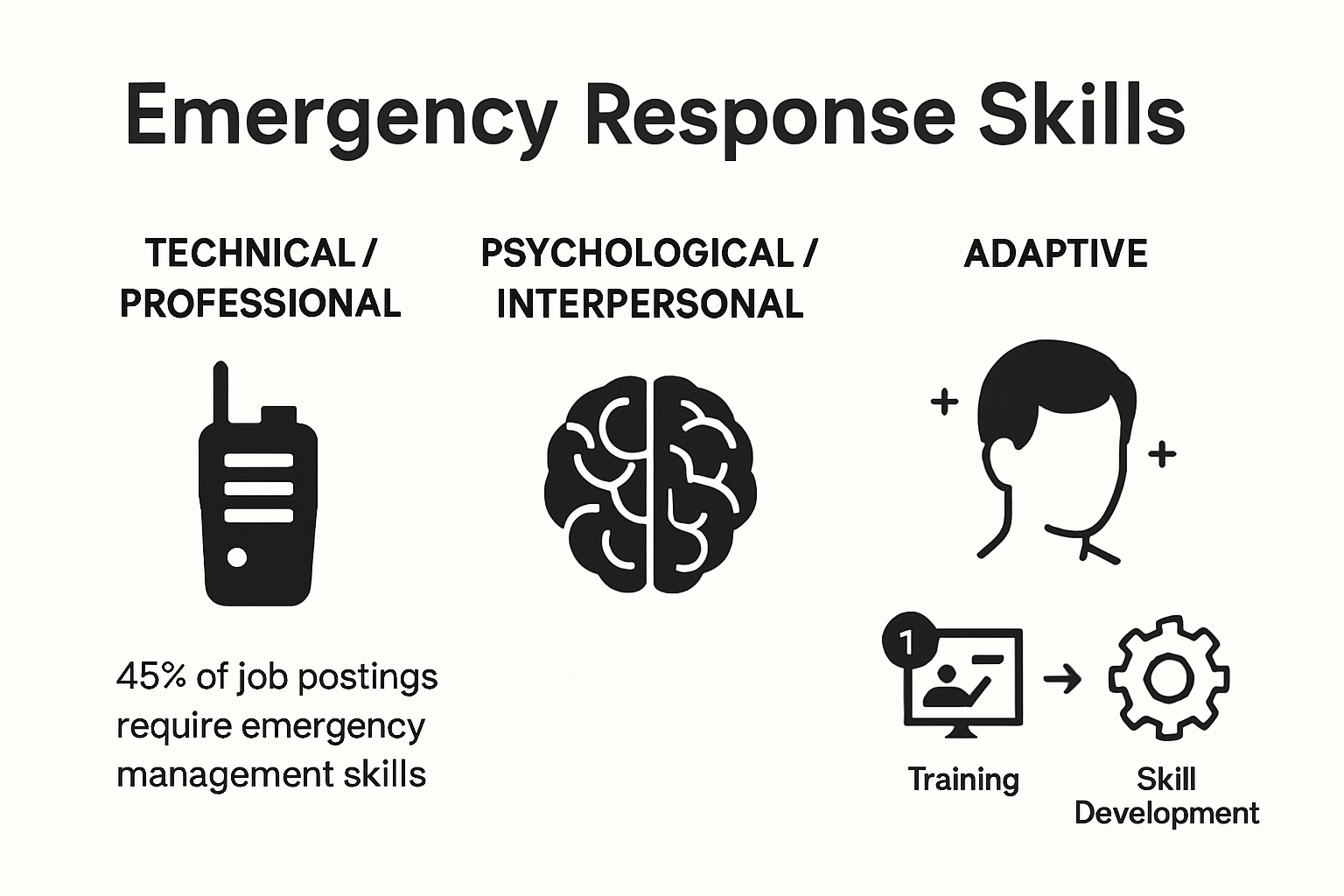
Below is a table outlining three critical skill categories for emergency response teams in 2025, with descriptions for each.
| Skill Category | Description |
|---|---|
| Technical & Professional Competencies | Mastery of ICS/NIMS, operational planning, GIS, data analytics, digital communication, emerging technologies |
| Psychological & Interpersonal Capabilities | Emotional intelligence, resilience, calm under pressure, clear communication, empathy, psychological first aid |
| Adaptive Learning & Continuous Development | Ongoing training, cross-disciplinary learning, scenario-based simulation, flexible problem solving |
Technical and Professional Competencies
According to Northeastern University, emergency management professionals must master ten critical skills that form the foundation of effective response. These include comprehensive knowledge of incident command systems (ICS), national incident management systems (NIMS), operational planning, and advanced communication strategies.
Franklin University research reveals that 45% of emergency response job postings specifically seek professionals with demonstrated skills in emergency management, preparedness, and incident command. This highlights the increasing complexity and professionalization of emergency response roles.
Technical skills now extend beyond traditional emergency management. Professionals must be proficient in geographic information systems (GIS), data analytics, digital communication platforms, and emerging technologies that support rapid decision making and resource allocation.
Psychological and Interpersonal Capabilities
Beyond technical skills, effective emergency response teams require extraordinary psychological resilience and interpersonal capabilities. The ability to remain calm under extreme pressure, communicate clearly during chaotic situations, and make critical decisions with limited information becomes paramount.
Emotional intelligence plays a crucial role in team dynamics. Professionals must demonstrate empathy, active listening, and the capacity to support both colleagues and disaster victims through traumatic experiences. This requires a nuanced understanding of human behavior and psychological first aid techniques.
Adaptive Learning and Continuous Development
The Pan American Health Organization emphasizes the critical importance of ongoing training and skill development for emergency response professionals. Modern response teams must embrace a culture of continuous learning, regularly updating their knowledge about emerging technologies, evolving disaster scenarios, and innovative response strategies.
This commitment to adaptive learning involves cross-disciplinary training, simulation exercises, and exposure to diverse emergency scenarios. Professionals must develop flexible mental frameworks that allow them to quickly assess unique challenges and implement creative solutions.
As emergency response continues to evolve, the most successful teams will be those that combine cutting-edge technical skills with profound human understanding. By investing in comprehensive skill development that addresses both technological and interpersonal dimensions, response teams can build the resilience and effectiveness needed to protect communities in an increasingly complex world.
Improving Emergency Response for Better Results
Effective emergency response demands continuous evolution and strategic improvement across multiple dimensions. Discover our latest emergency response optimization strategies As challenges become more complex and unpredictable, organizations must develop innovative approaches to enhance their emergency management capabilities.
Technology-Driven Performance Enhancement
According to RAND Corporation research, emerging technologies are revolutionizing emergency response strategies. Artificial intelligence and advanced data integration tools now enable more precise situational awareness, allowing response teams to make faster, more informed decisions during critical moments.
Advanced predictive analytics can now model potential disaster scenarios with unprecedented accuracy. These technologies help emergency managers anticipate resource needs, identify potential vulnerabilities, and develop more robust response protocols. Machine learning algorithms can analyze historical emergency data, identifying patterns and potential improvements in response strategies.
Digital platforms now provide real-time communication and resource tracking, breaking down traditional information silos between different response agencies. These technological innovations enable more coordinated, efficient emergency management approaches that can adapt quickly to changing circumstances.
Comprehensive Training and Simulation Strategies
Improving emergency response requires more than technological investments. Organizations must develop comprehensive training programs that simulate increasingly complex and dynamic scenarios. Advanced simulation technologies now allow emergency responders to practice decision making in highly realistic virtual environments.
These training approaches go beyond traditional classroom learning, incorporating immersive experiences that challenge professionals to think critically under pressure. Scenario-based training helps teams develop adaptive problem solving skills, improve communication strategies, and build psychological resilience.
Holistic Performance Evaluation and Continuous Improvement
Successful emergency response organizations implement rigorous performance evaluation frameworks that extend beyond traditional metrics. These comprehensive assessment approaches examine not just immediate response effectiveness, but also long-term community recovery and psychological support outcomes.
Data-driven performance reviews allow organizations to identify systemic improvements, address skill gaps, and develop more nuanced response strategies. By creating a culture of continuous learning and adaptive improvement, emergency response teams can become more responsive, efficient, and effective in protecting communities.
The future of emergency response lies in breaking down traditional boundaries between technology, human expertise, and organizational structures. By embracing innovative approaches that combine advanced technologies with human-centered strategies, organizations can build more resilient, adaptive emergency management systems that are prepared to address the complex challenges of an increasingly unpredictable world.
Frequently Asked Questions
What are the key roles in emergency response teams in 2025?
Emergency response teams in 2025 include several critical roles such as Incident Commander, Public Information Officer, Emergency Coordinator, medical professionals (like paramedics and EMTs), GIS experts, and logistics coordinators. Each role carries specific responsibilities essential for effective emergency management.
How do incident command and leadership roles function in emergencies?
The Incident Commander leads the emergency response, setting overall objectives and coordinating actions among various agencies. They work closely with supporting roles like the Public Information Officer and Liaison Officer to ensure efficient communication and resource allocation during a crisis.
What skills are essential for emergency response professionals?
Essential skills for emergency response professionals include technical and professional competencies, psychological resilience, emotional intelligence, and the ability to adapt through continuous learning and training. Mastery of incident command systems, advanced communication strategies, and empathy are crucial for effective performance.
How does technology enhance emergency response coordination?
Technology enhances emergency response coordination by enabling real-time information sharing, geographic tracking, and improved communication through digital platforms. Innovations like GIS technology and cloud-based systems facilitate better situational awareness, faster decision-making, and efficient resource management during emergencies.
Get Expert Support for Every Emergency Response Challenge
Understanding the changing landscape of emergency response roles is crucial for keeping your team and community safe. While the article highlights the growing need for specialized skills, adaptable leadership, and seamless multi-agency collaboration, it also reveals a key pain point: the stress and confusion that can arise when disaster strikes and you are left navigating a complex web of communication and resource coordination.
You do not have to face these uncertainties alone. At DisasterVictimServices.com, we work directly with first responders, insurance carriers, and government agencies to provide displaced individuals and families with immediate emergency housing and logistical support. Visit our Developing page to see how we bring the concepts of incident command, interagency coordination, and streamlined recovery from the article into real-world action. Ready to strengthen your emergency planning or get direct assistance now? Take the next step by connecting with Disaster Victim Services today and let us help you move forward with confidence.
Recommended
- First Responder Roles Explained: Key Duties and Impact in 2025 – Disaster Victim Services | Helping You Recover After Disaster
- Responder Safety Protocols: Essential Steps for 2025 Emergencies – Disaster Victim Services | Helping You Recover After Disaster
- Emergency Response Workflows: 2025 Guide for Recovery and Support – Disaster Victim Services | Helping You Recover After Disaster
- Emergency Response Basics for 2025: A Practical Guide – Disaster Victim Services | Helping You Recover After Disaster