


When disaster strikes, finding safe shelter becomes a race against time. Here is a surprising fact. FEMA’s direct housing assistance is not capped by standard financial aid limits, making it a rare exception among federal relief programs. Most people focus only on the paperwork, but the real game is understanding how eligibility and timing can mean the difference between weeks of uncertainty and immediate help. Get ready to uncover the lesser-known strategies that make all the difference.
Table of Contents
- Understanding The Direct Housing Process
- Who Qualifies For Direct Housing Assistance
- Step-By-Step Guide To Application And Approval
- Tips For Agencies, Adjusters, And Relief Workers
Quick Summary
| Takeaway | Explanation |
|---|---|
| Understand Eligibility Requirements | Applicants must be U.S. citizens, non-citizen nationals, or qualified aliens, and their primary residence must be in a declared disaster area deemed uninhabitable. |
| Gather Comprehensive Documentation | Essential documents include proof of residence, damage documentation, personal identification, and income verification. Accurate and complete submissions can expedite the approval process. |
| Follow Structured Application Process | The application involves initial preparation, comprehensive submission, and ongoing follow-up. Each step is crucial for obtaining housing assistance efficiently. |
| Utilize Available Resources | Engage with local emergency management agencies and utilize FEMA’s disaster assistance options to enhance understanding and streamline the application process. |
| Balance Technical and Emotional Support | When assisting disaster victims, provide logistical support while also addressing their emotional needs to foster a smoother recovery process. |
Understanding the Direct Housing Process
The direct housing process represents a critical lifeline for disaster victims facing immediate housing challenges. When catastrophic events disrupt lives and destroy homes, understanding the nuanced steps of securing temporary or alternative housing becomes paramount for recovery and stability.
The Core Components of Direct Housing Assistance
Direct housing assistance provides comprehensive support for individuals and families displaced by disasters. FEMA’s Individuals and Households Program offers multiple housing solutions tailored to different disaster scenarios. These solutions include Multi-Family Lease and Repair, Transportable Temporary Housing Units, Direct Lease, and Permanent Housing Construction.
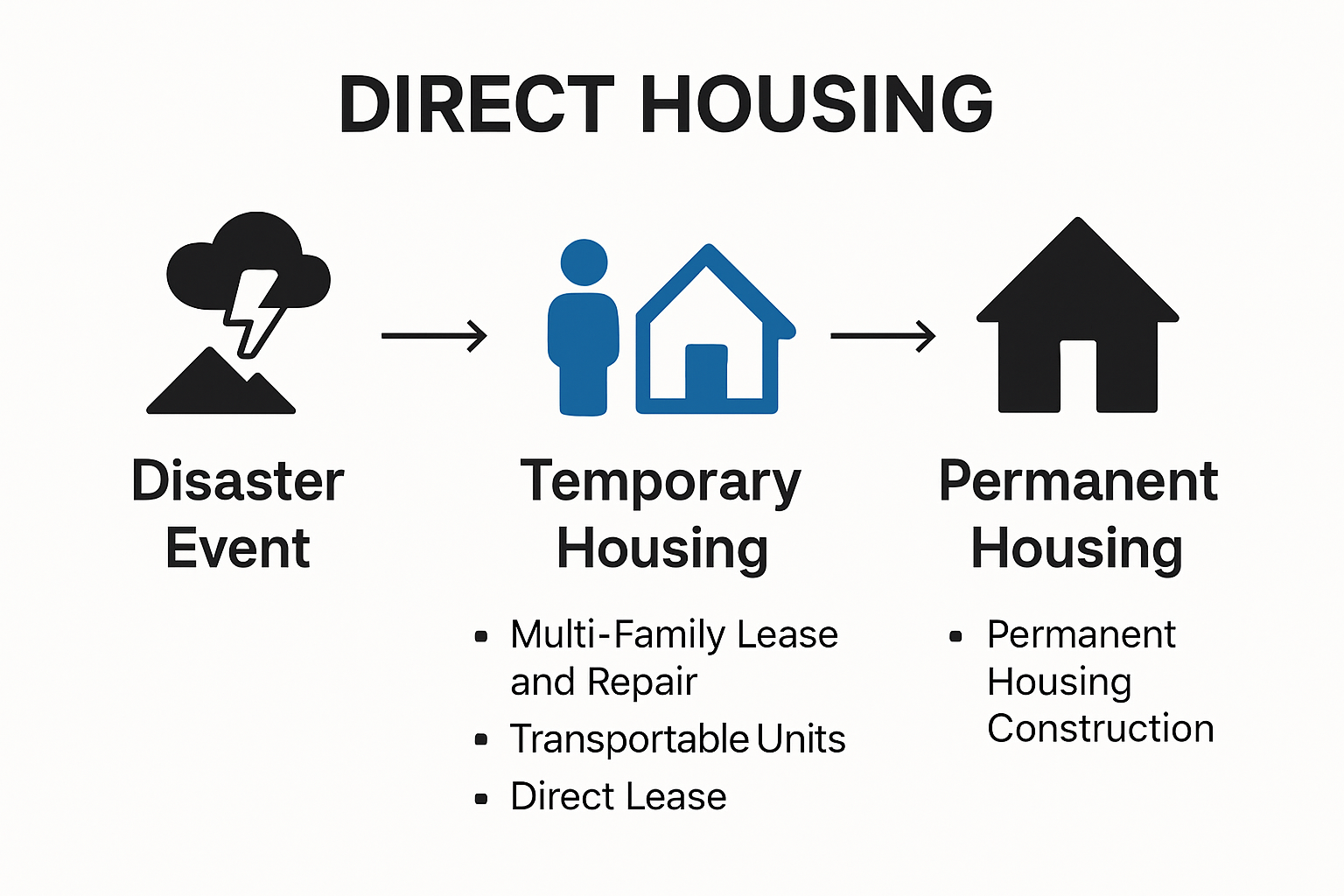
The process begins with a critical assessment of housing needs. Not all disaster victims qualify automatically. Eligibility requirements mandate that applicants must be U.S. citizens, non-citizen nationals, or qualified aliens. Verification of identity, occupancy, and disaster impact are fundamental steps in determining potential assistance.
Navigating Eligibility and Application Procedures
To qualify for direct housing assistance, applicants must demonstrate specific criteria. The primary residence must be located in a Presidentially declared disaster area and deemed uninhabitable. Documentation proving home damage, displacement, and lack of alternative housing resources becomes crucial during the application process.
Interestingly, Congressional research reveals that direct housing assistance is not subject to standard financial assistance limits. However, programmatic restrictions and specific eligibility parameters still apply. This nuance highlights the complexity of the direct housing process and underscores the importance of thorough documentation and precise application.
Strategic Considerations for Applicants
Successful navigation of the direct housing process requires proactive preparation. Applicants should gather comprehensive documentation including proof of residence, income verification, disaster impact statements, and personal identification. Working closely with local emergency management agencies and understanding the specific housing options available can significantly streamline the application process.
Understanding the direct housing process is more than completing paperwork. It represents a critical pathway to recovery for disaster victims. By comprehending the intricate details of assistance programs, individuals can access vital resources that bridge the gap between displacement and rebuilding. Each step requires careful attention, persistence, and a clear understanding of available support mechanisms.
The journey through direct housing assistance is complex but not insurmountable. With accurate information, strategic preparation, and a thorough understanding of available resources, disaster victims can effectively navigate this challenging process and move toward stability and recovery.
Who Qualifies for Direct Housing Assistance
Qualifying for direct housing assistance involves navigating a complex set of requirements designed to support disaster victims most in need. Understanding these eligibility criteria is crucial for individuals seeking emergency housing support during challenging times.
Core Eligibility Requirements
The fundamental qualification for direct housing assistance centers on citizenship and disaster impact status. FEMA guidelines specify that applicants must be U.S. citizens, non-citizen nationals, or qualified aliens. This stipulation ensures that assistance reaches those legally authorized to receive federal support.
Beyond citizenship, geographic location plays a critical role. The primary residence must be situated within a Presidentially declared disaster area. This means the location must be officially recognized as significantly impacted by a catastrophic event. Applicants need to demonstrate that their home is uninhabitable due to disaster damage, which becomes a key determinant in the qualification process.
Specific Qualification Criteria
Documentation becomes the cornerstone of proving eligibility. Applicants must provide comprehensive evidence including:
- Proof of Residence: Official documents verifying primary residence in the disaster zone
- Damage Documentation: Detailed assessment of property damage
- Personal Identification: Valid government issued identification
- Occupancy Verification: Evidence of current housing displacement
Congressional research reveals that direct housing assistance is uniquely positioned. It becomes available when standard rental assistance proves insufficient due to extreme housing resource limitations. This means the program serves as a critical safety net for those facing extraordinary housing challenges.
Advanced Qualification Considerations
Interestingly, qualification extends beyond individual circumstances. Read our comprehensive guide on accessing disaster aid to understand the nuanced application process. State, territory, and tribal governments must also request direct housing assistance, adding another layer of administrative complexity to the qualification process.
Financial status does not automatically disqualify applicants. Unlike some assistance programs, direct housing support focuses more on disaster impact and housing need rather than strict income thresholds. However, applicants must demonstrate a genuine inability to secure alternative housing through personal resources or standard insurance claims.
The qualification process demands patience, meticulous documentation, and proactive engagement with emergency management agencies. Each application undergoes thorough review to ensure resources reach those experiencing the most significant housing disruption. While the process might seem daunting, it represents a critical lifeline for disaster victims seeking to rebuild and recover.
Ultimately, qualifying for direct housing assistance is about more than meeting bureaucratic requirements. It represents a pathway to stability for individuals and families whose lives have been dramatically altered by unexpected catastrophic events. Understanding and meeting these qualifications can make the difference between prolonged displacement and the first steps toward recovery.
To help applicants better understand the required documentation and qualification considerations, the following checklist table summarizes the key eligibility criteria referenced above:
A checklist table to summarize the main eligibility and documentation requirements for direct housing assistance.
| Requirement | Description | Status/Proof Needed |
|---|---|---|
| Citizenship/Status | U.S. citizen, non-citizen national, or qualified alien | Valid ID/passport/alien card |
| Disaster Zone Residence | Primary home in Presidentially declared disaster area | Utility bill/lease/deed |
| Home Uninhabitable | Residence is unlivable due to disaster | Inspection or damage report |
| Proof of Residence | Verifies primary residence in disaster area | Lease, deed, or statement |
| Damage Documentation | Detailed evidence of disaster-related home damage | Photos, insurance claim, inspection |
| Occupancy Verification | Evidence of current displacement | Letter from landlord, eviction, etc. |
| Lack of Alternative Housing | No access to other suitable housing | Statement or supporting evidence |
Step-by-Step Guide to Application and Approval
Navigating the direct housing assistance application process requires strategic preparation and careful attention to detail. Disaster victims must understand each critical stage to maximize their chances of securing essential housing support.
Initial Application Preparation
Before beginning the application, gather comprehensive documentation. FEMA guidelines indicate that applicants must demonstrate substantial property damage, with verified loss amounts of at least $12 per square foot. Essential documents include:
- Proof of primary residence ownership or rental agreement
- Detailed property damage assessment
- Government issued identification
- Insurance claim documentation
- Income verification statements
The application process typically begins online or through FEMA’s dedicated disaster assistance centers. Learn more about accessing emergency aid resources to streamline your initial registration.
Comprehensive Application Submission
Submitting a complete and accurate application is crucial. Applicants must provide precise information about their housing situation, including:
- Exact location of damaged property
- Current living arrangements
- Extent of property damage
- Household composition
- Contact information
Federal Emergency Management Agency experts recommend double-checking all submitted information to prevent potential delays. Incomplete or inaccurate applications can significantly extend processing times and potentially jeopardize assistance eligibility.
Approval and Follow-Up Process

After submission, applications undergo thorough review by housing assistance specialists. This evaluation typically involves:
- Verifying applicant eligibility
- Assessing property damage documentation
- Confirming residence in a designated disaster area
- Determining appropriate housing assistance options
Applicants should maintain open communication channels and promptly respond to any additional information requests. The approval process can take several weeks, depending on the complexity of the disaster and volume of applications.
Successful navigation of the direct housing assistance application requires patience, meticulous documentation, and proactive communication. Each step represents a critical pathway toward rebuilding and recovery for disaster-impacted individuals and families.
Remember that while the process might seem complex, numerous support resources are available. Government agencies, disaster relief organizations, and local emergency management teams stand ready to guide applicants through each stage of the housing assistance journey.
Below is a process table outlining each step of the direct housing assistance application and approval journey, along with key actions required at each stage.
| Stage | Key Actions | Important Notes/Reminders |
|---|---|---|
| Documentation Gathering | Collect proof of residence, damage, ID, income, insurance | Ensure all docs are accurate and up-to-date |
| Initial Application Submission | Register online or at FEMA center | Double-check all entered information |
| Detailed Application Review | FEMA reviews eligibility and documentation | Respond quickly to any requests for more info |
| Formal Damage Assessment | Home inspection or detailed review | Provide access to inspectors if needed |
| Approval Determination | FEMA decides eligibility and options | Approval times vary depending on case |
| Communication/Follow-Up | Stay in contact, track application | Use provided application IDs and contacts |
| Housing Placement | Accept assigned housing solution | Prepare for move-in, finalize paperwork |
Tips for Agencies, Adjusters, and Relief Workers
Professionals involved in direct housing assistance play a crucial role in supporting disaster victims during their most vulnerable moments. Effective coordination, strategic approach, and compassionate service define successful disaster relief efforts.
Strategic Assessment and Resource Allocation
Congressional research highlights that FEMA follows a specific sequence when determining direct housing assistance options. Professionals must understand this hierarchy to optimize resource deployment. The priority sequence includes:
- Multi-Family Lease and Repair
- Transportable Temporary Housing Units
- Direct Lease Options
- Permanent Housing Construction
Permanent housing construction is considered only when other options prove unavailable, infeasible, or cost-ineffective. Learn more about advanced relocation strategies to enhance your disaster response capabilities.
Comprehensive Documentation and Communication
Accurate documentation serves as the backbone of effective housing assistance. Agencies and adjusters must prioritize:
- Detailed damage assessment reports
- Precise applicant eligibility verification
- Clear communication protocols
- Consistent inter-agency information sharing
- Rapid response documentation systems
FEMA guidelines emphasize the importance of thorough, timely documentation. Each record can potentially expedite housing assistance for disaster victims.
Technical and Emotional Support Strategies
Beyond logistical considerations, relief workers must provide holistic support. This involves:
- Maintaining empathetic communication
- Understanding psychological impacts of displacement
- Offering clear, compassionate guidance
- Connecting victims with additional support resources
- Facilitating seamless transition processes
Professionals must recognize that direct housing assistance transcends mere logistics. It represents a critical lifeline for individuals experiencing traumatic displacement. Each interaction should balance technical precision with genuine human compassion.
Successful direct housing assistance requires a multifaceted approach. By combining strategic resource allocation, meticulous documentation, and empathetic support, agencies and relief workers can transform a challenging recovery process into a pathway of hope and rebuilding.
Ultimately, the most effective professionals in this field understand that their work is about more than housing. They are architects of recovery, helping disaster victims reconstruct not just their living spaces, but their sense of security and optimism for the future.
Frequently Asked Questions
What is the Direct Housing Process?
The Direct Housing Process is a FEMA program that provides temporary or alternative housing solutions for individuals and families who have been displaced due to disasters.
Who is eligible for Direct Housing Assistance?
Eligibility requires that applicants are U.S. citizens, non-citizen nationals, or qualified aliens, with their primary residence in a Presidentially declared disaster area that is deemed uninhabitable.
What documentation is needed for the Direct Housing application?
Applicants must provide proof of residence, damage documentation, personal identification, and income verification. Comprehensive documentation can significantly expedite the approval process.
How can I apply for Direct Housing Assistance?
To apply, gather all necessary documentation and submit an application online or in-person at FEMA disaster assistance centers. Ensure all information is accurate to prevent delays in processing.
Take Control of Your Disaster Recovery Journey
The article above covers the complex steps and stressful decisions involved in securing direct housing after a disaster. When paperwork and red tape delay your ability to find a safe place to live, every hour counts. The need for timely support and reliable guidance becomes urgent, especially when you are managing eligibility requirements, documentation, and emotional uncertainty from sudden displacement. At Disaster Victim Services, we understand how overwhelming it can be to navigate the direct housing process while simply trying to regain stability. Our expert team specializes in connecting disaster victims with emergency housing, supporting insurance claims, and coordinating logistics so you can focus on your family and recovery.
Start rebuilding your life today. Visit our New Construction Services page if your disaster has created the need for something more permanent, or explore our main support hub for tailored emergency assistance. Act now to access the resources and individualized support proven to move families from crisis to comfort. Your next steps to a safer tomorrow are just a click away.
Recommended
- How to Access Aid in 2025: A Guide for Disaster Victims and Responders – Disaster Victim Services | Helping You Recover After Disaster
- how to access aid – Disaster Victim Services | Helping You Recover After Disaster
- How to Handle Relocations in 2025: A Guide for Disaster Relief Teams – Disaster Victim Services | Helping You Recover After Disaster
- how to manage displacement – Disaster Victim Services | Helping You Recover After Disaster
- How to handle relocations – Disaster Victim Services | Helping You Recover After Disaster
- Home Safety Tips 2025: Essential Guide for Disaster Recovery – Disaster Victim Services | Helping You Recover After Disaster