

Over 90 percent of American communities face significant communication breakdowns during disaster response, leading to slower aid and greater confusion. For every American insurance adjuster and emergency management professional, mastering clear and rapid messaging can make all the difference when lives are at stake. This guide lays out practical strategies to strengthen agency coordination, deliver accurate updates, and support disaster victims with confidence in the most urgent moments.
Table of Contents
- Core Functions of Communication During Emergencies
- Types of Crisis Communication Methods
- How Effective Messaging Impacts Disaster Response
- Coordination Between Agencies and Stakeholders
- Common Communication Pitfalls to Avoid
Key Takeaways
| Point | Details |
|---|---|
| Effective Communication Saves Lives | Strategic communication during emergencies enhances public safety and ensures coordinated response efforts. |
| Utilize Multiple Channels | A diverse range of communication methods, including digital platforms and traditional media, is crucial for effective information dissemination. |
| Messaging Must Be Clear and Timely | Clear, concise, and timely messaging fosters public trust and motivates protective actions among citizens. |
| Avoid Common Pitfalls | To maintain credibility, avoid overly technical language, incomplete information, and sugarcoating bad news in communications. |
Core Functions of Communication During Emergencies
Effective communication is the critical backbone of successful emergency response, serving multiple essential functions that can ultimately save lives and minimize disaster impact. Crisis and emergency risk communication requires strategic coordination across multiple agencies and stakeholders to ensure rapid, accurate information dissemination.
The primary functions of communication during emergencies center around three core objectives: protecting human life, facilitating coordinated response efforts, and maintaining public trust. These objectives demand a multifaceted approach that involves rapid information sharing, clear messaging, and synchronized efforts between emergency management professionals, first responders, and community leaders. Public safety communication strategies emphasize the importance of creating seamless communication channels that enable quick decision-making and resource allocation.
Key communication functions include providing real-time situational updates, directing public safety instructions, coordinating rescue and relief efforts, managing potential panic, and supporting psychological resilience among affected populations. Emergency communication must be transparent, timely, and actionable, ensuring that individuals receive precise guidance about evacuation routes, emergency shelters, medical resources, and potential hazards. This requires sophisticated communication infrastructure that can rapidly disseminate critical information across multiple platforms and communication channels.
Pro tip: Develop a comprehensive emergency communication plan that includes backup communication methods like satellite phones and ham radio networks to ensure information flow during infrastructure disruptions.
Types of Crisis Communication Methods
Crisis communication strategies encompass a diverse range of methods designed to effectively transmit critical information during emergencies. Crisis communication approaches require a sophisticated, multi-channel approach that adapts to rapidly changing circumstances and diverse audience needs.
The primary communication methods can be categorized into several key channels: digital platforms, traditional media, direct communication, and interpersonal networks. Digital platforms like social media, emergency alert systems, and mobile applications provide rapid, widespread information dissemination. Traditional media channels including television, radio, and print remain crucial for reaching populations with limited digital access. Direct communication methods such as emergency hotlines, text message alerts, and public address systems offer immediate, targeted messaging for specific geographic areas or population segments.
Effective crisis communication demands a strategic blend of these methods, ensuring redundancy and accessibility. Interpersonal communication networks involving first responders, community leaders, and local officials play a critical role in building trust and providing contextual, localized information. Each communication method requires careful calibration to address the specific needs of different demographic groups, considering factors like language barriers, technological access, and cultural sensitivities.
Here’s a summary of key crisis communication channels and their unique strengths:
| Communication Channel | Main Benefit | Ideal Use Case |
|---|---|---|
| Social Media | Rapid mass outreach | Breaking news and urgent alerts |
| Emergency Alert Systems | Reliable instant notification | Geo-targeted warnings |
| Radio/TV Broadcast | Broad, traditional coverage | Reaching remote or offline audiences |
| Public Address Systems | Immediate on-site updates | Crowds in public venues |
| Community Leaders | Trusted local guidance | Culturally tailored messaging |
Pro tip: Develop a comprehensive communication matrix that maps multiple communication channels and identifies backup communication strategies to ensure information reaches all population segments during emergencies.
How Effective Messaging Impacts Disaster Response
Effective messaging plays a critical role in transforming disaster response from reactive to proactive, directly influencing public safety and organizational preparedness. Systematic research on disaster risk communication demonstrates that strategic communication can significantly improve community knowledge, behavior, and resilience during emergency situations.

The impact of messaging extends far beyond simple information transmission. Well-crafted communication strategies can motivate protective actions, reduce panic, and create a coordinated response across multiple stakeholder groups. By providing clear, actionable information, emergency communicators can help individuals make informed decisions about personal safety, evacuation procedures, and resource management. Risk communication principles emphasize the importance of building trust through transparent, consistent, and timely messaging that addresses both immediate safety concerns and long-term recovery strategies.
Successful disaster messaging requires a nuanced approach that considers psychological, cultural, and technological factors. This means developing communication strategies that are accessible across different demographic groups, utilizing multiple communication channels, and tailoring messages to specific community needs. The most effective communication approaches create a sense of collective responsibility, empowering individuals to take proactive steps while maintaining calm and preventing the spread of misinformation.
Pro tip: Develop a multilingual, multi-channel communication plan that includes redundant messaging systems to ensure critical information reaches all community members during emergencies.
Coordination Between Agencies and Stakeholders
Multi-agency collaboration represents the cornerstone of effective disaster response, transforming fragmented efforts into a unified, powerful approach to crisis management. Humanitarian coordination principles emphasize the critical need for seamless communication and resource sharing across diverse organizational boundaries, ensuring that emergency interventions are strategic, efficient, and comprehensive.
Successful stakeholder coordination requires sophisticated communication infrastructure and shared operational frameworks. Emergency management professionals must develop robust mechanisms for real-time information exchange, role clarification, and collaborative decision-making. Interagency coordination skills involve creating flexible communication protocols that allow rapid adaptation to evolving disaster scenarios, enabling first responders, government agencies, nonprofit organizations, and community leaders to work as a cohesive, responsive unit.
The complexity of modern disaster response demands a holistic approach that transcends traditional organizational silos. This means establishing clear communication channels, developing shared technological platforms, conducting joint training exercises, and creating memorandums of understanding that outline precise roles and responsibilities. By prioritizing mutual understanding, trust-building, and continuous information sharing, agencies can minimize response delays, eliminate redundant efforts, and maximize the efficiency of limited resources during critical emergency situations.
Pro tip: Implement quarterly interagency coordination drills that simulate complex disaster scenarios to test and refine collaborative communication strategies across multiple organizational platforms.
Common Communication Pitfalls to Avoid
Crisis communication demands precision and strategic clarity, making it crucial to recognize and proactively prevent common communication mistakes that can escalate confusion and undermine response effectiveness. Crisis communication research consistently highlights several critical pitfalls that emergency management professionals must carefully navigate to maintain public trust and operational integrity.
One of the most significant communication challenges involves managing information complexity and transparency. Overly technical language, information overload, and delayed messaging can create significant barriers to understanding and cooperation. Leadership communication strategies emphasize the importance of delivering clear, concise updates that provide essential information without overwhelming recipients. This requires carefully calibrating communication to balance technical accuracy with accessibility, ensuring that messages are comprehensible across diverse demographic groups.
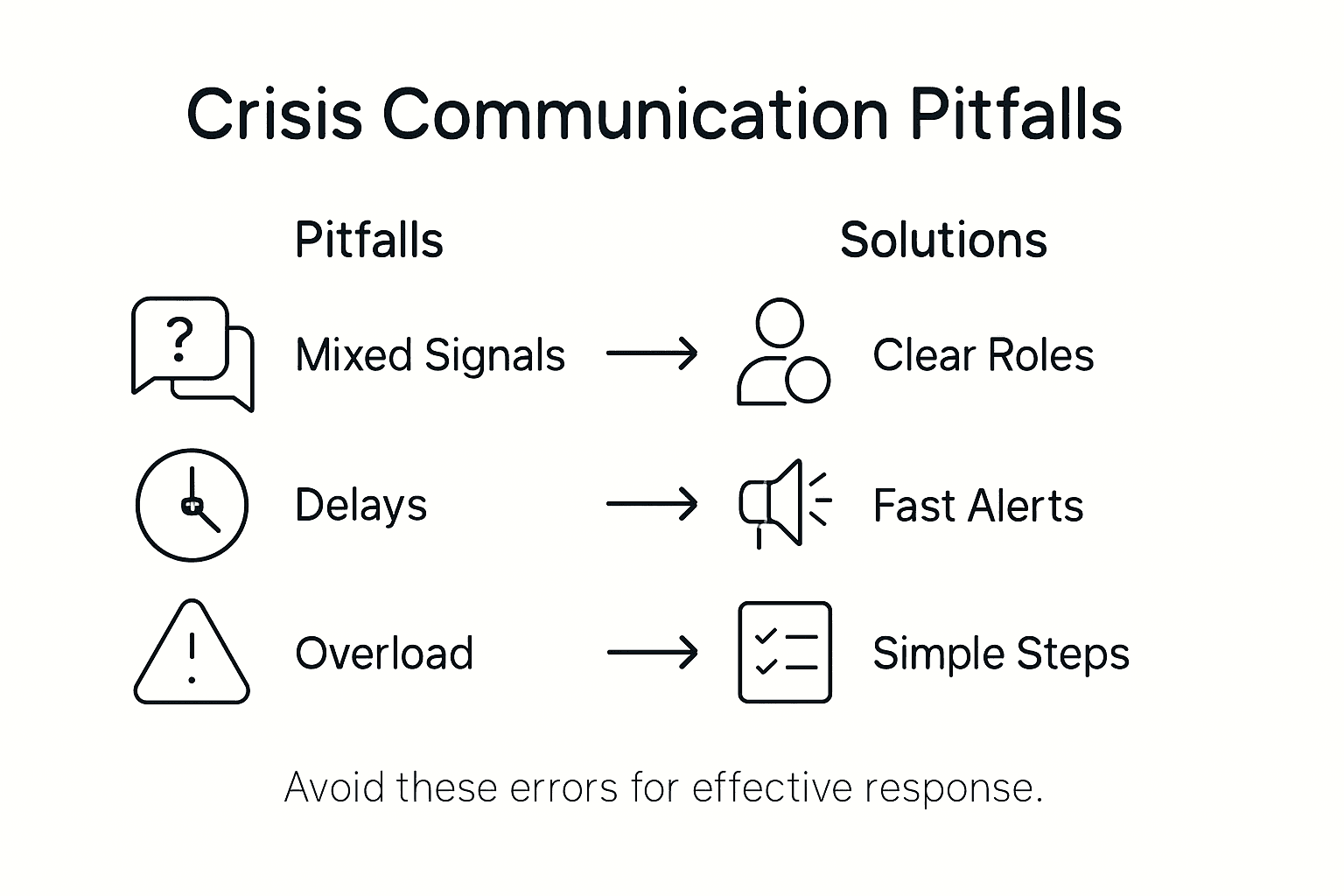
Emergency communicators must also avoid several critical missteps, including sugarcoating difficult news, making premature promises, and presenting incomplete information as definitive. Successful communication requires a delicate balance of honesty, empathy, and factual precision. Organizations must establish robust communication protocols that prioritize transparency, admit uncertainty when appropriate, and provide regular, predictable updates that help maintain public confidence during challenging circumstances.
The following table compares common pitfalls in crisis communication and their recommended solutions:
| Common Pitfall | Why It’s Harmful | Practical Solution |
|---|---|---|
| Overly Technical Language | Decreases comprehension | Use plain, accessible terms |
| Information Overload | Creates confusion | Prioritize and clarify key messages |
| Delayed Messaging | Erodes public trust | Send timely, frequent updates |
| Sugarcoating Bad News | Undermines credibility | Address facts honestly and openly |
| Premature Promises | Signals unreliability | Communicate only confirmed details |
Pro tip: Develop a communication triage system that categorizes information by urgency and clarity, ensuring that critical messages are distilled into simple, actionable language before distribution.
Strengthen Crisis Communication to Ensure Faster Recovery
Effective communication during emergencies is essential to protect lives and coordinate response efforts. The challenges of delivering timely, clear, and actionable messages are critical pain points described in the article. At DisasterVictimServices.com, we understand how vital seamless communication and collaboration between victims, first responders, insurers, and agencies are to navigating disaster recovery smoothly.
Our team specializes in providing immediate emergency housing and logistical support while working closely with multiple stakeholders to streamline the process. To learn more about the holistic approach needed during crisis communication, explore our Uncategorized – Disaster Victim Services | Helping You Recover After Disaster. When every second matters, trust us to be your reliable partner. Visit DisasterVictimServices.com now to connect with compassionate, expert support designed to help you move forward confidently.
Frequently Asked Questions
What are the core functions of communication during emergencies?
The core functions include protecting human life, facilitating coordinated response efforts, and maintaining public trust through rapid information sharing and clear messaging.
What types of crisis communication methods are most effective?
Effective methods include digital platforms like social media, traditional media such as radio and TV, direct communication like emergency hotlines, and interpersonal networks involving community leaders.
How does effective messaging impact disaster response?
Effective messaging transforms disaster response by motivating protective actions, reducing panic, and providing clear, actionable information that helps individuals make informed decisions.
What are some common pitfalls to avoid in crisis communication?
Common pitfalls include using overly technical language, providing information overload, delaying messages, sugarcoating bad news, and making premature promises. It’s important to communicate clearly, timely, and transparently.
Recommended
- Communication After Disasters: Complete Essential Guide – Disaster Victim Services | Helping You Recover After Disaster
- How to Coordinate Response in Disasters: A Guide for 2025 – Disaster Victim Services | Helping You Recover After Disaster
- Emergency Response Basics for 2025: A Practical Guide – Disaster Victim Services | Helping You Recover After Disaster
- How to Connect With First Responders for Disaster Help – Disaster Victim Services | Helping You Recover After Disaster