


Emergency housing referrals are the first line of defense for people suddenly displaced by disaster. Here is the shocking part. Optimized workflow strategies can reduce shelter wait times by about one full day and lower abandonment rates by 13 percent. That means the right system could be the deciding factor between chaos and actual comfort during a crisis.
Table of Contents
- Understanding The Emergency Housing Referral Workflow
- Key Steps In Coordinating Emergency Housing Referrals
- Roles Of Agencies And Professionals In The Workflow
- Tips To Improve The Emergency Housing Referral Process
Quick Summary
| Takeaway | Explanation |
|---|---|
| Establish Collaborative Partnerships | Building strong interagency partnerships is crucial for effective emergency housing referrals, requiring defined roles, comprehensive communication protocols, and shared decision-making frameworks. |
| Implement Comprehensive Case Management | Systematic support through detailed needs assessments and personalized recovery plans enables effective assistance for survivors, ensuring access to essential services. |
| Leverage Federal Housing Assistance Programs | Strategically utilizing federal programs like LIHEAP, TANF, and CSBG can provide vital housing support, necessitating careful navigation of the specific requirements of each program. |
| Develop a Standardized Coordinated Entry System | A Coordinated Entry System ensures fair and equal access to housing services, requiring uniform intake protocols, centralized management, and transparent tracking of referrals. |
| Improve Referral Accessibility | Simplifying information sharing and establishing clear communication channels enhances the efficiency of the referral process, ultimately supporting disaster victims more effectively. |
Understanding the Emergency Housing Referral Workflow
Emergency housing referral workflows represent the critical lifeline connecting disaster victims with immediate shelter and support. These complex systems demand precision, speed, and compassion to effectively address the urgent needs of individuals displaced by catastrophic events.
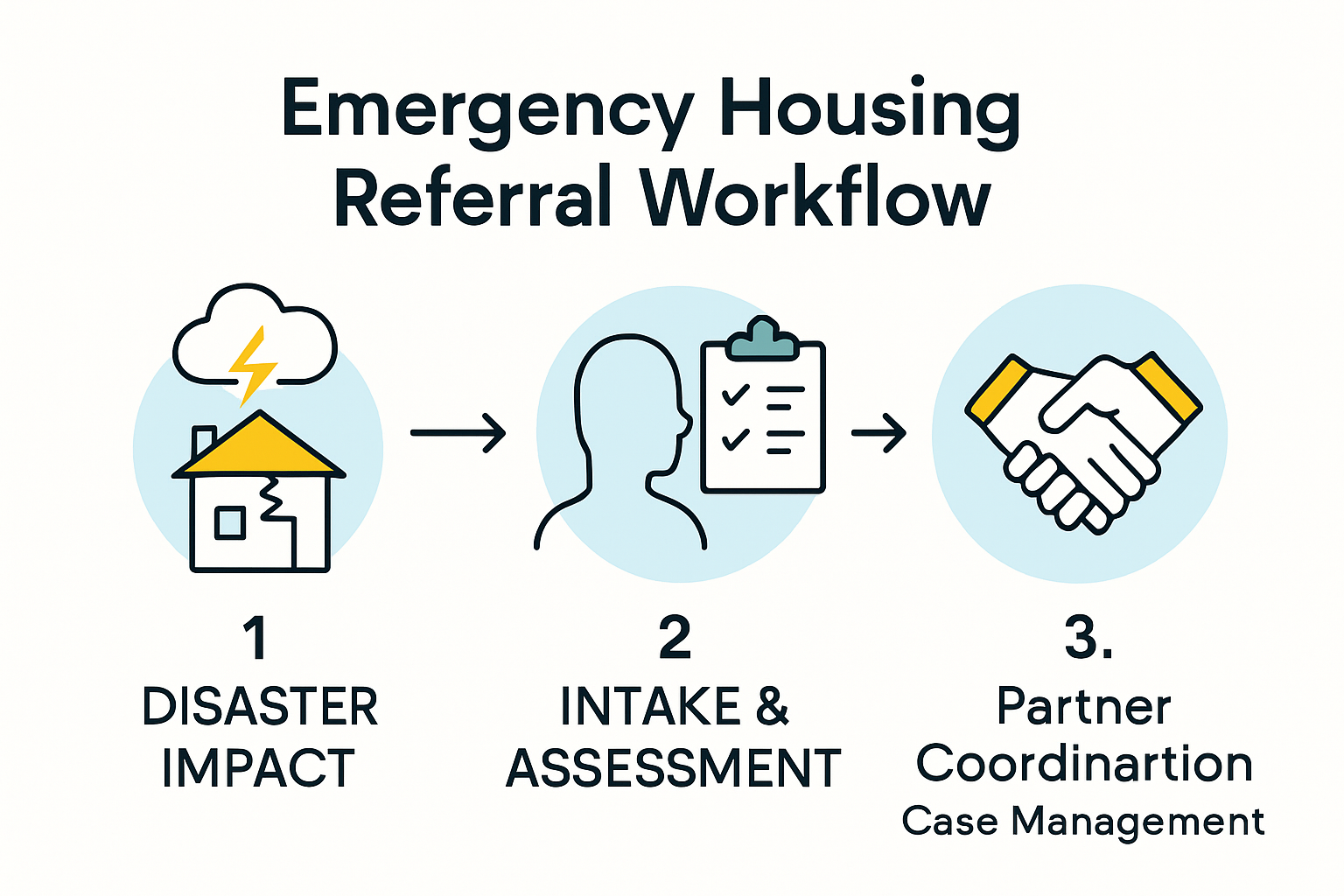
The Core Components of Emergency Housing Referral Systems
At its foundation, an emergency housing referral workflow involves a multi-step process designed to rapidly assess, match, and place individuals into temporary housing solutions. Learn more about our emergency housing support for comprehensive insights into this critical process.
The workflow typically begins with initial intake and assessment, where disaster victims provide critical information about their immediate housing needs. Research from the Journal of Public Health Management and Practice highlights the importance of creating an inclusive emergency management system that considers diverse population needs, especially for vulnerable groups.
Routing and Placement Strategies
Effective routing is paramount in emergency housing referrals. A groundbreaking study analyzing queue routing strategies revealed that strategic modifications can significantly improve housing coordination efficiency. Research from advanced queuing analysis demonstrated that optimized routing can reduce average wait times by approximately one day and decrease shelter abandonment rates by 13%.
Key routing considerations include:
- Proximity Assessment: Matching individuals with shelters closest to their original community
- Capacity Management: Real-time tracking of available shelter spaces
- Special Needs Accommodation: Ensuring specialized support for vulnerable populations
Technology and Coordination in Modern Referral Workflows
Modern emergency housing referral workflows leverage advanced technologies and interagency collaboration. These systems integrate multiple communication channels, including digital platforms, emergency hotlines, and direct agency connections to streamline the placement process.
The goal is creating a seamless, rapid response mechanism that transforms chaos into structured support. By developing robust referral workflows, emergency response teams can provide immediate relief, reducing the psychological and physical stress experienced by disaster victims during their most vulnerable moments.
Understanding these workflows is not just about logistics. It’s about human-centered design that recognizes each referral represents a person or family in crisis, deserving compassionate and efficient assistance.
Key Steps in Coordinating Emergency Housing Referrals
Coordinating emergency housing referrals requires a strategic, multifaceted approach that goes beyond simple placement. Effective coordination demands comprehensive planning, robust communication networks, and a deep understanding of survivors’ complex needs.
Establishing Collaborative Partnerships
Successful emergency housing referrals fundamentally depend on building strong interagency partnerships. Learn more about coordinating disaster response to understand the intricate network required for effective support.
Research from collaborative disaster management studies emphasizes the critical importance of defining clear roles and responsibilities among partner agencies. This involves creating comprehensive communication protocols, determining decision-making processes, and maintaining ongoing relationships through strategic planning.
Key partnership elements include:
- Identifying potential housing and support service providers
- Developing memorandums of understanding
- Creating shared communication platforms
- Establishing clear escalation and decision-making frameworks
Implementing Comprehensive Case Management
Research from the National Academies highlights disaster case management as a crucial mechanism for addressing survivors’ diverse recovery needs. This process involves a systematic approach to supporting individuals and families through their recovery journey.
Comprehensive case management requires:
- Conducting detailed initial needs assessments
- Developing personalized recovery plans
- Reconnecting survivors with essential services
- Providing targeted support for vulnerable populations
Leveraging Federal Housing Assistance Programs
Effective emergency housing referral coordination involves strategically utilizing federal assistance programs. Official guidance from the Administration for Children and Families outlines several critical programs that can provide essential housing support:
- LIHEAP: Low Income Home Energy Assistance Program
- TANF: Temporary Assistance for Needy Families
- CSBG: Community Services Block Grant
- SSBG: Social Services Block Grant
These programs offer various forms of assistance, including temporary shelter, rental support, utility reconnection, and housing search services. Each program has specific requirements and focuses, necessitating careful navigation and strategic implementation.
Ultimately, coordinating emergency housing referrals is a complex, dynamic process that requires flexibility, compassion, and a holistic approach to supporting individuals during their most vulnerable moments. Success depends on seamless collaboration, comprehensive planning, and a genuine commitment to helping survivors rebuild their lives with dignity and support.

To help readers compare key features and types of federal housing assistance programs mentioned above, the table below summarizes their purpose and primary support offered.
| Program | Full Name | Primary Support Provided |
|---|---|---|
| LIHEAP | Low Income Home Energy Assistance Program | Temporary shelter, utility cost support, utility reconnection |
| TANF | Temporary Assistance for Needy Families | Rental support, short-term housing assistance |
| CSBG | Community Services Block Grant | Housing search help, community-based housing resources |
| SSBG | Social Services Block Grant | Flexible social services, including housing and recovery support |
Roles of Agencies and Professionals in the Workflow
The emergency housing referral workflow relies on a complex network of agencies and professionals working in seamless coordination. Each entity plays a critical role in transforming crisis into recovery, ensuring disaster victims receive comprehensive support during their most vulnerable moments.
Federal and Government Agencies
Research from the Federal Emergency Management Agency reveals that the U.S. Department of Housing and Urban Development (HUD) leads the Housing Recovery Support Function. These agencies coordinate across multiple levels of government to develop strategic housing recovery plans.
Key federal agency responsibilities include:
- Comprehensive Planning: Developing holistic disaster response strategies
- Resource Allocation: Distributing federal funds and emergency housing resources
- Technical Assistance: Providing expert guidance to affected communities
- Policy Implementation: Ensuring consistent and equitable support mechanisms
Professional Support and Direct Intervention
Social workers play a pivotal role in disaster relief efforts, extending far beyond traditional support models. Their expertise encompasses not just housing placement but holistic community recovery.
Critical professional interventions include:
- Assisting individuals with long-term housing applications
- Navigating disaster relief fund processes
- Providing trauma-informed mental health support
- Connecting survivors with comprehensive recovery resources
Collaborative Ecosystem of Response Professionals
Successful emergency housing referrals demand intricate collaboration between multiple professional groups. Learn more about our disaster response coordination to understand the interconnected nature of disaster response.
Key professional collaborators include:
- Insurance adjusters
- Emergency management specialists
- Mental health counselors
- Community outreach coordinators
- Legal aid professionals
- Local government representatives
Each professional brings unique expertise, creating a multidisciplinary approach that addresses the complex needs of disaster survivors. Their collective effort transforms a potentially overwhelming experience into a structured, supportive recovery pathway.
The emergency housing referral workflow is not just a logistical process. It represents a human-centered approach that recognizes each survivor’s unique journey, combining systematic efficiency with profound compassion. By understanding and respecting the diverse roles of agencies and professionals, we create a resilient support system capable of guiding individuals from crisis to recovery.
To clarify the distinct responsibilities of agencies and professionals in emergency housing referrals, the following table summarizes key roles and interventions at each level.
| Entity/Professional | Key Responsibilities |
|---|---|
| Federal/Government Agencies | Planning, resource allocation, technical assistance, policy implementation |
| Social Workers | Case management, long-term housing support, mental health and trauma support |
| Insurance Adjusters | Assessing damages, coordinating claims related to housing loss |
| Emergency Management Specialists | Disaster response coordination, resource deployment |
| Mental Health Counselors | Trauma support, emotional resilience programs |
| Community Outreach Coordinators | Connecting survivors to services, public information |
| Legal Aid Professionals | Assisting with documentation, tenant rights, legal recovery processes |
| Local Government Representatives | Local housing coordination, policy enforcement |
Tips to Improve the Emergency Housing Referral Process
Improving the emergency housing referral process requires strategic approaches that prioritize efficiency, compassion, and systematic support for disaster victims. By implementing targeted improvements, agencies can significantly enhance their ability to provide timely and effective housing solutions.
Developing a Standardized Coordinated Entry System
Research on crisis response systems highlights the critical importance of implementing a Coordinated Entry System (CES). This approach ensures fair and equal access to crisis housing and services through a standardized assessment and referral process.
Key components of an effective CES include:
- Uniform intake and assessment protocols
- Centralized information management
- Transparent referral tracking
- Equitable service allocation
Learn more about optimizing disaster response strategies to understand the nuanced approach required for effective housing referrals.
Enhancing Assessment and Matching Processes
Comprehensive research from housing coordination experts emphasizes the importance of developing robust assessment mechanisms. Creating detailed intake forms that capture the full spectrum of a client’s housing barriers enables more precise and effective service matching.
Critical assessment considerations include:
- Documenting specific housing challenges
- Identifying unique support requirements
- Mapping available resources to individual needs
- Creating flexible matching algorithms
Improving Referral Accessibility and Information Sharing
Government guidance on referral mechanisms underscores the importance of creating accessible and transparent referral processes. Simplifying information sharing and establishing clear communication channels can dramatically improve the efficiency of emergency housing referrals.
Strategies for improved accessibility include:
- Developing user-friendly online referral platforms
- Creating clear, concise referral documentation
- Establishing multi-channel communication options
- Implementing real-time tracking systems
- Providing comprehensive yet simplified information guides
The ultimate goal of improving the emergency housing referral process extends beyond mere logistical efficiency. It represents a profound commitment to supporting individuals during their most vulnerable moments. By implementing these strategic improvements, agencies can transform a potentially overwhelming experience into a compassionate, structured pathway to recovery.
Successful emergency housing referrals are not just about finding a temporary shelter. They are about restoring hope, providing stability, and creating a foundation for individuals to rebuild their lives with dignity and support.
Frequently Asked Questions
What is an emergency housing referral workflow?
Emergency housing referral workflows are structured processes designed to connect individuals displaced by disaster with immediate shelter and support. They coordinate assessment, routing, and placement to ensure timely assistance for disaster victims.
How can optimizing an emergency housing referral workflow help disaster victims?
Optimizing these workflows can significantly reduce shelter wait times by about one day and lower abandonment rates by 13%, transforming chaotic situations into organized support systems for individuals in need.
What are the core components of emergency housing referral systems?
The core components include initial intake and assessment, routing strategies, and effective communication among agencies to ensure timely and appropriate housing placements for displaced individuals.
How can I find information on federal housing assistance programs?
Information on federal housing assistance programs can be found on official government websites, such as the U.S. Department of Housing and Urban Development (HUD) and the Administration for Children and Families, which detail available programs and how to access them.
Navigate Emergency Housing Challenges With Trusted Support
Sudden displacement from disaster can leave you overwhelmed and in desperate need of direction. This guide showed how a streamlined emergency housing referral workflow reduces delays and confusion while providing relief right when it matters most. If you are searching for a partner who can put these urgent strategies into action, Disaster Victim Services is here for you. Our team specializes in connecting disaster victims with immediate housing solutions by working closely with insurance carriers, agencies, and first responders. We use a collaborative approach to take the stress out of finding shelter and managing the complex process from initial referral to recovery.
Do not wait while uncertainty increases the burden. If your next concern is not just finding a safe place but moving forward into the rebuilding process, explore our Renovation solutions or contact us for round-the-clock guidance. Visit Disaster Victim Services now for fast, compassionate help and take your first step toward stability and restoration.
Recommended
- How to Handle Relocations in 2025: A Guide for Disaster Relief Teams – Disaster Victim Services | Helping You Recover After Disaster
- How to handle relocations – Disaster Victim Services | Helping You Recover After Disaster
- How to Access Aid in 2025: A Guide for Disaster Victims and Responders – Disaster Victim Services | Helping You Recover After Disaster
- how to access aid – Disaster Victim Services | Helping You Recover After Disaster
- How to Deploy Aid: Effective Strategies for Disaster Response 2025 – Disaster Victim Services | Helping You Recover After Disaster
- how to deploy aid – Disaster Victim Services | Helping You Recover After Disaster