

HUD Section 8 helps millions of American families keep a roof over their heads every year. More than 2.3 million households rely on these vouchers to pay affordable rent each month. Most people think Section 8 is just government money for rent and little else. The real surprise is how it fuels chances for families to break out of poverty, land better jobs, and give their kids a stronger shot at a brighter future.
Table of Contents
- Defining Hud Section 8 And Its Purpose
- Importance Of Hud Section 8 Qualifications
- Eligibility Criteria For Hud Section 8 Assistance
- The Application Process For Hud Section 8 Programs
- Exploring The Benefits And Impacts Of Hud Section 8
Quick Summary
| Takeaway | Explanation |
|---|---|
| HUD Section 8 aids low-income families | The program provides financial support for rent, helping families afford safe housing options. |
| Participants choose their own housing | HUD Section 8 allows families to select homes in the private market, promoting freedom and independence. |
| Eligibility criteria focus on genuine need | The program screens applicants thoroughly to ensure assistance reaches the most vulnerable populations. |
| Housing assistance promotes economic stability | Securing stable housing can lead to better educational outcomes and increased employment opportunities. |
| The application process involves local agencies | Beginning the application for Section 8 assistance requires contacting local Public Housing Agencies for guidance and requirements. |
Defining HUD Section 8 and Its Purpose
HUD Section 8, officially known as the Housing Choice Voucher Program, represents a critical federal initiative designed to support low-income individuals and families in securing safe and affordable housing. Authorized by the Housing and Community Development Act, this program provides essential rental assistance to those struggling to meet market-rate housing costs.
What is HUD Section 8?
The Housing Choice Voucher Program operates as a federal subsidy mechanism that bridges the financial gap between a participant’s income and prevailing rental rates. By providing direct financial support to eligible households, HUD Section 8 enables families to access housing in the private rental market that they would otherwise be unable to afford.
Key Program Characteristics:
- Provides rental assistance to very low-income families
- Allows participants to choose their own housing
- Covers the difference between the participant’s contribution and the actual rental cost
Program Objectives and Impact
The fundamental purpose of HUD Section 8 extends beyond mere financial assistance. This program aims to promote housing stability, reduce poverty, and provide vulnerable populations with opportunities for improved living conditions. Research from the National Conference of State Legislatures demonstrates that such housing assistance programs play a crucial role in supporting economic mobility and family well-being.
By empowering individuals to select housing in various communities, Section 8 helps break cycles of concentrated poverty and provides families with more choices in their living arrangements. Participants typically pay approximately 30% of their adjusted monthly income toward rent, with the voucher covering the remaining balance.
If you want to learn more about housing support options after experiencing a disaster, read our comprehensive guide on housing eligibility requirements.
The program serves multiple demographic groups, including:
- Very low-income families
- Elderly individuals
- People with disabilities
- Veterans
Through this targeted approach, HUD Section 8 provides a lifeline for those most vulnerable in our housing market, ensuring that economic challenges do not prevent access to safe and stable housing.
Importance of HUD Section 8 Qualifications
Understanding HUD Section 8 qualifications represents a critical pathway for low-income families to secure stable, affordable housing. These qualifications serve as a comprehensive screening mechanism that ensures housing assistance reaches those most in need while maintaining program integrity and fairness.
Socioeconomic Impact of Qualification Standards
The qualification process for HUD Section 8 goes far beyond simple income verification. According to the Urban Institute, these standards are designed to address complex social and economic challenges faced by vulnerable populations.
Critical Qualification Considerations:
- Prevents housing discrimination
- Provides targeted support for economically disadvantaged groups
- Creates transparent criteria for housing assistance
Eligibility and Social Mobility
HUD Section 8 qualifications function as a strategic mechanism for promoting social mobility and economic stability. By establishing clear, objective criteria, the program ensures that housing assistance reaches families experiencing genuine financial hardship. Typical qualification parameters include:
- Household income below specific area median levels
- Citizenship or eligible immigrant status
- Passing background and rental history checks
- Commitment to program compliance and reporting
These qualifications create a structured approach to addressing housing insecurity, allowing families to transition toward economic independence. Research from the National Low Income Housing Coalition demonstrates that targeted housing assistance can significantly improve long-term economic outcomes.
Learn more about direct housing support options for disaster victims, which complement HUD Section 8 programs.
The importance of these qualifications extends beyond immediate housing needs. By providing a rigorous yet compassionate framework, HUD Section 8 helps break cycles of poverty, supports family stability, and offers a critical social safety net for millions of Americans facing economic challenges.
Eligibility Criteria for HUD Section 8 Assistance
HUD Section 8 eligibility requires a comprehensive evaluation of an applicant’s financial status, background, and housing needs. According to the Department of Housing and Urban Development, the program establishes clear, structured criteria to ensure housing assistance reaches those most in need.
Income-Based Qualification Parameters
The primary determinant of Section 8 eligibility revolves around household income levels. Applicants must demonstrate that their total annual income falls within specific thresholds relative to their local area median income (AMI). These income limits vary by region and family size, ensuring a nuanced approach to defining financial need.
Key Income Qualification Factors:
- Total household income below 50% of area median income
- Income calculated using gross annual earnings
- Includes all sources of household revenue
Additional Eligibility Requirements
Beyond income considerations, HUD Section 8 evaluates several critical eligibility components. Research from the National Low Income Housing Coalition highlights the multifaceted nature of these qualification criteria.
Comprehensive Eligibility Checklist:
- United States citizenship or eligible immigrant status
- Clean criminal background without drug-related or violent criminal convictions
- Good standing in previous rental agreements
- Willingness to comply with program requirements and participate in required counseling
Explore our guide on direct housing support for disaster victims to understand additional housing assistance options.
The eligibility process is designed to be both rigorous and compassionate.
Below is a table summarizing the main eligibility criteria for HUD Section 8, clarifying each requirement and why it matters for applicants.
| Eligibility Requirement | Description | Rationale for Requirement |
|---|---|---|
| Income below 50% of Area Median Income | Total household earnings must be under threshold for local area | Targets assistance to those in greatest need |
| U.S. citizenship or eligible immigration | At least one household member must meet citizenship requirements | Ensures legal compliance and program focus |
| Clean criminal background | No violent or drug-related convictions in recent history | Promotes community safety |
| Good rental history | Positive references and no recent evictions | Encourages tenant responsibility |
| Compliance with program rules | Willingness to follow reporting and counseling requirements | Maintains program integrity and fairness |
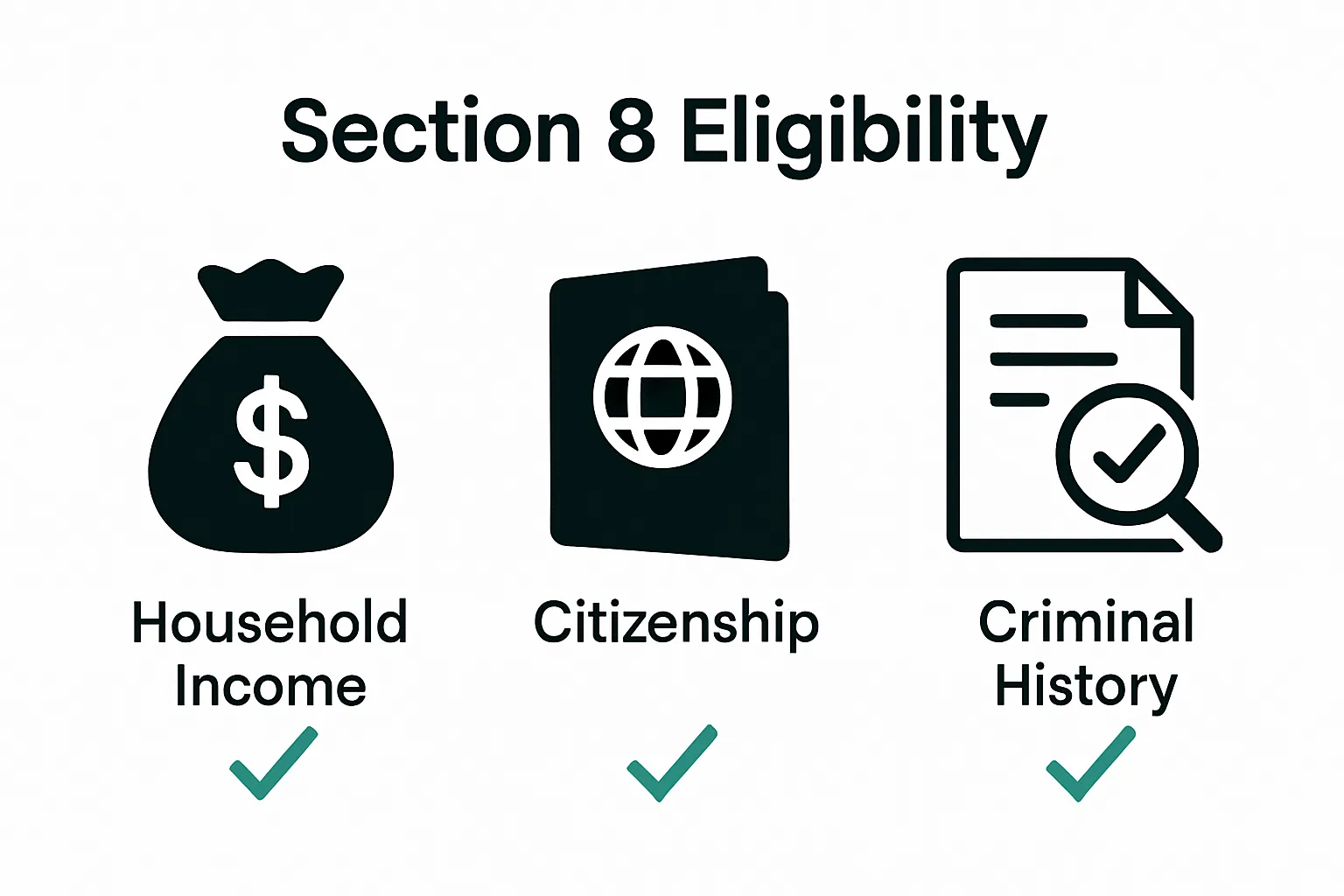 By establishing clear standards, HUD Section 8 ensures that limited housing resources are allocated to families experiencing genuine economic hardship, while simultaneously promoting housing stability and individual economic mobility.
The Application Process for HUD Section 8 Programs
The HUD Section 8 application process represents a structured journey for low-income families seeking affordable housing assistance. According to the Government Accountability Office, navigating this process requires careful preparation and understanding of multiple administrative steps.
Initial Application Requirements
Applicants must begin their Section 8 journey by identifying and contacting their local Public Housing Agency (PHA). This initial step involves gathering comprehensive documentation that demonstrates financial need and personal eligibility. Critical documentation typically includes:
- Proof of total household income
- Social Security numbers for all household members
- Birth certificates and identification documents
- Current rental or residence history
Waiting List and Verification Process
Due to high demand and limited funding, most PHAs maintain extensive waiting lists for Section 8 vouchers. The waiting period can range from several months to multiple years, depending on local housing market conditions and available resources.
Key Waiting List Considerations:
- Prioritization based on local preferences
- Chronological order of application submission
- Potential preferences for veterans, disabled individuals, or families experiencing homelessness
Learn more about housing reimbursement processes for disaster victims to complement your understanding of housing assistance.
Once selected from the waiting list, applicants must complete an in-depth interview and verification process.
This comprehensive review ensures that only eligible households receive housing assistance, maintaining the program’s integrity and fiscal responsibility.
Exploring the Benefits and Impacts of HUD Section 8
HUD Section 8 represents more than a housing assistance program. It serves as a comprehensive social mobility strategy addressing fundamental economic challenges faced by low-income families. According to Urban Institute research, the program’s impact extends far beyond immediate housing relief.
Economic Stabilization and Opportunity
The program creates significant economic advantages for participating families by reducing housing cost burdens and providing financial flexibility. Key economic benefits include:
- Reducing housing expense to approximately 30% of household income
- Enabling families to allocate saved resources toward education and career development
- Preventing housing insecurity and potential homelessness
Community and Personal Transformation
Section 8 vouchers do more than provide affordable housing. They create pathways for personal and community transformation by supporting residential choice and reducing concentrated poverty. Research demonstrates that stable housing correlates directly with improved educational outcomes, reduced healthcare costs, and increased employment opportunities.
Broader Social Impact Areas:
- Enhanced childhood educational performance
- Increased likelihood of parental employment
- Reduced stress and improved mental health outcomes
- Greater residential neighborhood diversity
Learn more about comprehensive rehousing process steps to understand additional support mechanisms.
By addressing housing instability, HUD Section 8 helps break generational cycles of poverty, providing a critical social safety net that supports individual dignity and collective economic resilience.
The following table breaks down the major benefits and broader impacts of the HUD Section 8 program, highlighting its influence on both families and communities.
| Benefit or Impact | Explanation |
|---|---|
| Affordable Housing Stability | Reduces portion of income spent on rent, providing housing security |
| Economic Flexibility | Frees up resources for education, healthcare, and job advancement |
| Enhanced Educational Outcomes | Stable housing supports children[NULL]27s school performance |
| Improved Employment Opportunities | Reliable housing makes job retention and seeking new work easier |
| Reduced Stress and Better Health | Diminished financial pressure lowers family stress and mental health risk |
| Greater Community Diversity | Allows low-income families to live in a wider range of neighborhoods |
 The program recognizes that stable housing is fundamental to personal growth, community development, and national economic strength.
Turn Housing Uncertainty Into Security After Disaster
Struggling to navigate HUD Section 8 qualifications can feel overwhelming, especially in the aftermath of a disaster. When your family is already facing challenges meeting eligibility criteria, coordinating documentation, and searching for safe housing, every hour matters. The stress of waiting lists and income verification only adds to the pressure if you need an immediate solution.
At DisasterVictimServices.com, we work alongside HUD guidelines and focus on helping disaster victims secure rapid, stable housing. Our experts understand the complexities involved in housing assistance and bridge the gap for displaced families. Instantly connect with coordinated emergency housing, insurance support, and recovery logistics without facing this alone. Take action now to move from uncertainty to security—explore how our team can help you find urgent housing support. If you want to learn about direct temporary housing options for those recently affected, review this guide to direct housing support. Reach out today and let us stand with you on the path to rebuilding.
Frequently Asked Questions
What are the eligibility requirements for HUD Section 8?
To qualify for HUD Section 8, applicants must meet specific income thresholds, demonstrate U.S. citizenship or eligible immigrant status, pass background checks, and have a positive rental history. Households typically must earn below 50% of the area median income.
How does the application process for HUD Section 8 work?
The application process involves contacting your local Public Housing Agency (PHA), submitting necessary documentation like income proof and identification, and waiting for a voucher since there is often a long waiting list due to high demand.
What is the significance of HUD Section 8 qualifications?
HUD Section 8 qualifications ensure that housing assistance is targeted to families experiencing true financial hardship, preventing discrimination and promoting social mobility. They create a structured approach for helping low-income households secure affordable housing.
How does HUD Section 8 impact social mobility?
HUD Section 8 provides financial stability by enabling families to access safe housing, which can lead to improved educational outcomes, reduced healthcare costs, and greater employment opportunities, thus enhancing overall social mobility for participants.
Recommended
- Understanding Housing Eligibility Requirements 2025 – Disaster Victim Services | Helping You Recover After Disaster
- Direct Housing Process Guide 2025: Steps, Eligibility & Tips – Disaster Victim Services | Helping You Recover After Disaster
- Understanding Housing Accessibility for Disabled Individuals – Disaster Victim Services | Helping You Recover After Disaster
- Understanding Housing Reimbursement Process Steps – Disaster Victim Services | Helping You Recover After Disaster