

Section 8 income limits decide whether millions of families can get help paying for a safe place to live. Most people think qualifying depends on a single flat number, but the reality is very different. These limits shift by location, family size, and even the local economy, and in some cities income limits can swing by over $40,000 from one county to the next. That might sound complicated, but these details could be the difference between getting support—or missing out entirely.
Table of Contents
- What Are Section 8 Income Limits?
- Why Section 8 Income Limits Matter For Families
- How Section 8 Income Limits Are Determined
- Navigating Section 8 Income Limits In Crisis Situations
- Key Concepts Related To Section 8 Income Limits
Quick Summary
| Takeaway | Explanation |
|---|---|
| Section 8 income limits vary by location | Income thresholds are adjusted based on the geographic area to reflect local economic conditions. |
| Households are categorized into income tiers | Families are classified as Extremely Low-Income, Very Low-Income, or Low-Income based on AMI percentages. |
| Income reassessment is flexible in crises | Families facing income changes can still qualify for assistance through provisional measures. |
| Accurate income calculation is crucial for eligibility | Understanding how gross and adjusted gross incomes are calculated helps families apply successfully. |
| Targeted support prioritizes vulnerable populations | Section 8 limits help direct resources to families experiencing the highest economic challenges. |
What are Section 8 Income Limits?
Section 8 income limits are crucial financial guidelines established by the U.S. Department of Housing and Urban Development (HUD) that determine eligibility for affordable housing assistance programs. These limits define the maximum income a household can earn while still qualifying for housing support, ensuring that low-income families have access to safe and affordable housing options.
Understanding Income Calculation
Section 8 income limits are not uniform across the United States. They are dynamically calculated based on several key factors:
- Location: Income thresholds vary significantly between different geographic areas, reflecting local economic conditions
- Family Size: The maximum allowable income increases with the number of household members
- Area Median Income (AMI): Limits are typically set at a percentage of the local median income, usually 50% to 80%
These nuanced calculations help ensure that housing assistance targets families most in need while accounting for regional economic variations.
This table breaks down the main factors HUD uses to determine Section 8 income limits, helping readers understand what influences their eligibility across different locations and household situations.
| Factor | Description | How It Affects Limits |
|---|---|---|
| Location | Adjusts for local economic conditions and cost of living | Limits can vary widely by city or county |
| Family Size | Considers the number of people in the household | Larger families qualify for higher income limits |
| Area Median Income | Bases limits on a percentage of local median earnings | Core calculation for eligibility tiers |
| Annual Reassessment | Limits are updated each year to reflect economic changes | Helps keep eligibility fair and accurate |
HUD provides detailed income limit calculations that are updated annually to reflect current economic conditions.
Eligibility Tiers
Housing authorities typically categorize Section 8 income limits into three primary tiers:
- Extremely Low-Income: Generally set at 30% of the area median income
- Very Low-Income: Set at approximately 50% of the area median income
- Low-Income: Typically defined as 80% of the area median income
Each tier represents a different level of housing assistance potential, with extremely low-income households receiving the most comprehensive support.
Below is a table summarizing the three main Section 8 income eligibility tiers and their characteristics, providing clarity on how households are grouped for housing assistance.
| Income Tier | % of Area Median Income (AMI) | Typical Recipients | Assistance Level |
|---|---|---|---|
| Extremely Low-Income | 30% | Households with the least resources | Most comprehensive support |
| Very Low-Income | 50% | Households facing significant hardship | Substantial assistance |
| Low-Income | 80% | Families with moderate economic challenges | Limited or targeted support |
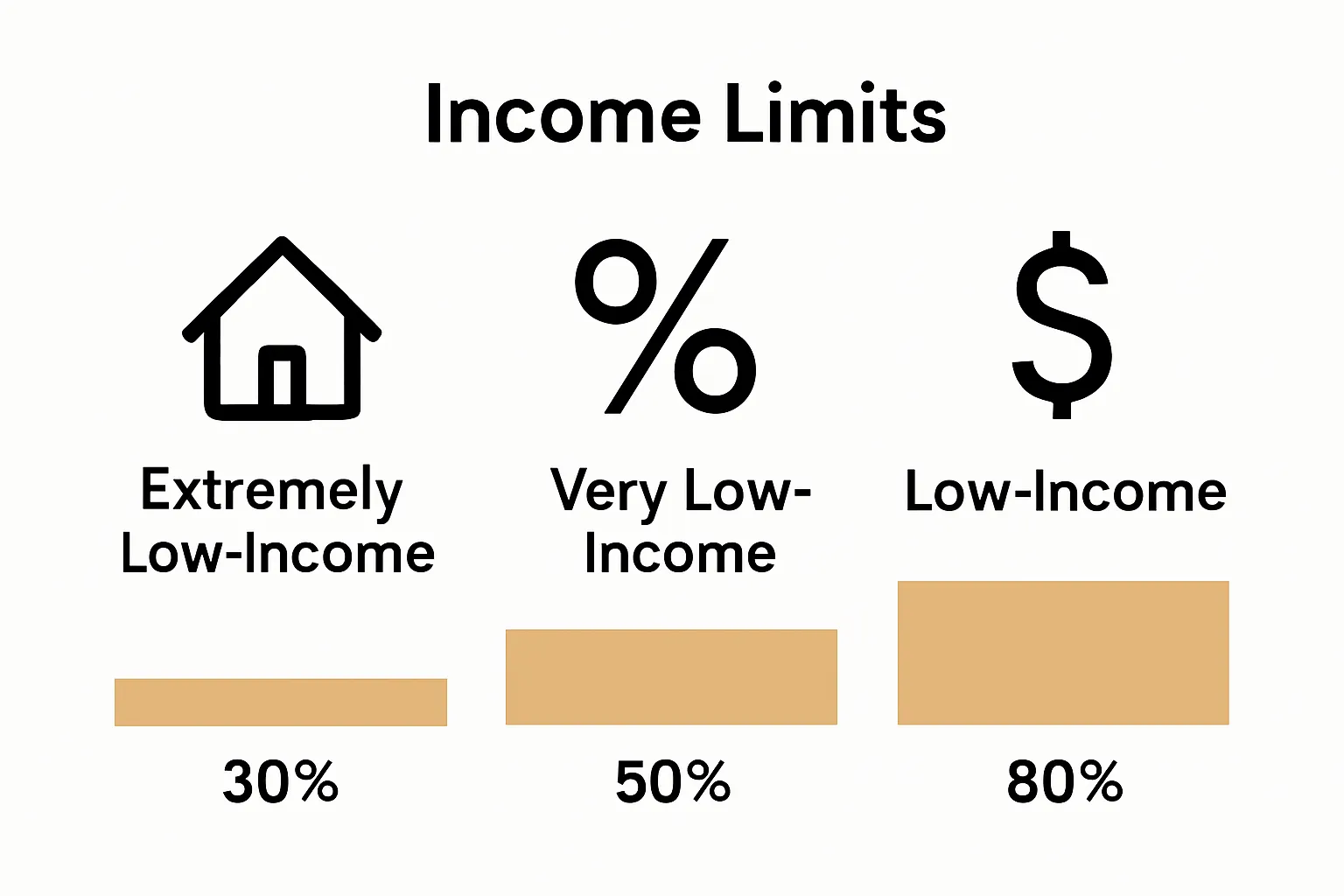 The tiered system allows housing programs to allocate resources strategically and support a broader range of economically vulnerable families.
Understanding Section 8 income limits is essential for families seeking housing assistance. These carefully calculated guidelines ensure that federal housing resources reach the households that need them most, providing a critical safety net for millions of Americans struggling with housing affordability.
Why Section 8 Income Limits Matter for Families
Section 8 income limits serve as a critical lifeline for millions of American families struggling with housing affordability. By establishing clear financial guidelines, these limits help ensure that limited housing resources are directed to those experiencing the most significant economic challenges.
Economic Stabilization and Housing Security
The importance of Section 8 income limits extends far beyond simple financial assistance. For many families, these guidelines represent a pathway to economic stability and improved living conditions. Housing security directly impacts multiple aspects of family well-being, including:
- Educational Opportunities: Stable housing allows children to maintain consistent school enrollment
- Employment Potential: Reduced housing stress enables parents to focus on career development
- Health Outcomes: Safe, affordable housing correlates with better physical and mental health
Research from the Center on Budget and Policy Priorities demonstrates that housing assistance significantly reduces poverty and improves long-term family outcomes.
Targeted Support for Vulnerable Populations
Section 8 income limits are strategically designed to support the most economically vulnerable families. This targeted approach ensures that:
- Low-income households receive priority assistance
- Resources are allocated based on demonstrable need
- Local economic variations are carefully considered
By creating a structured framework for housing assistance, these income limits prevent arbitrary distribution of resources and create a more equitable system of support. Families facing economic challenges can access critical housing support without navigating complex bureaucratic processes.
Ultimately, Section 8 income limits represent more than just financial thresholds. They are a powerful tool for addressing systemic economic inequalities, providing hope and stability for families struggling to maintain safe and affordable housing in an increasingly challenging economic landscape.
How Section 8 Income Limits Are Determined
Section 8 income limits represent a complex calculation process designed to ensure housing assistance reaches families most in need. The U.S. Department of Housing and Urban Development (HUD) uses a sophisticated methodology that accounts for multiple economic variables to establish these critical financial thresholds.
Foundational Calculation Principles
The determination of Section 8 income limits involves several key computational strategies:
- Area Median Income (AMI): The primary baseline for calculating income limits
- Geographic Variations: Adjustments made for different local economic conditions
- Family Size: Income thresholds modified based on household composition
Precise mathematical modeling ensures that income limits reflect current economic realities while maintaining fairness across diverse communities. HUD utilizes comprehensive data sets to generate these nuanced calculations.
Tiered Income Level Determination
HUD establishes income limits across three primary categories:
- Extremely Low-Income: Approximately 30% of area median income
- Very Low-Income: Approximately 50% of area median income
- Low-Income: Approximately 80% of area median income
Each tier represents a different level of economic vulnerability, allowing housing authorities to strategically allocate resources. The granular approach enables targeted support for families experiencing various stages of economic challenges.
The annual recalculation of these limits ensures that housing assistance programs remain responsive to shifting economic landscapes. By continuously refining their computational models, HUD maintains a dynamic system that adapts to changing community needs, providing a robust framework for supporting low-income families across the United States.
Navigating Section 8 Income Limits in Crisis Situations
Crisis situations can dramatically alter a family’s financial landscape, making housing assistance more critical than ever. Section 8 income limits provide flexible mechanisms to support families experiencing unexpected economic challenges, ensuring housing stability during turbulent times.
Emergency Adaptive Mechanisms
During economic disruptions, housing authorities implement special protocols to accommodate families facing sudden income changes. Temporary income fluctuations do not automatically disqualify households from Section 8 assistance. Key adaptations include:
- Provisional Eligibility: Allowing temporary extensions for families experiencing job loss
- Income Recalculation: Adjusting income assessments to reflect current economic realities
- Expedited Application Processing: Streamlining support for families in urgent need
HUD provides specialized guidance for public housing agencies to manage crisis-related housing support.
Critical Documentation and Support
Families navigating Section 8 income limits during crises must focus on comprehensive documentation and proactive communication. Essential steps include:
- Maintaining updated financial records
- Communicating promptly with housing authorities
- Exploring alternative housing support options
The goal is to create a supportive environment that recognizes the unpredictable nature of economic challenges. By understanding these adaptive mechanisms, families can access critical housing resources even when facing significant financial uncertainty.
Navigating Section 8 income limits during crises requires patience, documentation, and understanding of available support systems. Housing authorities recognize that economic disruptions can happen to anyone and have developed flexible frameworks to ensure continued housing stability for vulnerable families.

Key Concepts Related to Section 8 Income Limits
Section 8 income limits encompass a complex network of financial guidelines and regulatory frameworks designed to ensure equitable housing assistance. Understanding these intricate concepts is crucial for families seeking housing support and professionals navigating the assistance landscape.
Fundamental Income Measurement Principles
Several critical components define how Section 8 income limits are interpreted and applied:
- Gross Income Calculation: Includes all monetary earnings before taxes
- Adjusted Gross Income: Accounts for specific deductions like medical expenses
- Annual Income Determination: Comprehensive evaluation of household financial resources
Precise income measurement ensures that housing assistance reaches families with genuine economic need. HUD provides detailed guidelines for accurately calculating household income for Section 8 eligibility.
Strategic Income Targeting Mechanisms
Housing authorities employ sophisticated strategies to allocate resources effectively:
- Extremely Low-Income Targeting: Prioritizing families at 30% of Area Median Income
- Income Preference Categories: Establishing priority groups for assistance
- Geographic Income Variations: Adjusting limits based on local economic conditions
These mechanisms create a nuanced approach to distributing housing resources, ensuring support reaches the most vulnerable populations. Learn more about housing eligibility requirements to gain deeper insights into these complex allocation strategies.
By comprehensively understanding these key concepts, families and housing professionals can navigate the Section 8 income limit landscape more effectively, ensuring that critical housing assistance reaches those who need it most.
Find Emergency Housing Support When Income Limits Hold You Back
Struggling to navigate Section 8 income limits during or after a disaster can feel overwhelming, especially when you need housing now. The article highlights how sudden changes in income or household circumstances may affect your eligibility for federal support, leaving you worried about the future and your family’s stability. If you’re facing urgent housing needs and find that Section 8 guidelines create extra hurdles, you are not alone.
DisasterVictimServices.com specializes in guiding families through these critical moments. We understand that Section 8 income limits do not always fit every situation, especially in times of unexpected crisis. Our team works 24/7, coordinating with insurance carriers, government agencies, and recovery partners to help you secure emergency housing solutions. Do not let eligibility rules delay your safety and recovery.
Take the next step now. Connect with our compassionate team at DisasterVictimServices.com to get immediate support, expert guidance, and real solutions tailored to your unique housing needs.
Frequently Asked Questions
What are Section 8 income limits?
Section 8 income limits are financial guidelines set by the U.S. Department of Housing and Urban Development (HUD) to determine eligibility for housing assistance programs based on household income.
How are Section 8 income limits calculated?
Section 8 income limits are calculated based on several factors including the area median income (AMI), family size, and local economic conditions, with adjustments made accordingly.
What are the different tiers of income eligibility under Section 8?
The different tiers of income eligibility under Section 8 include Extremely Low-Income (approximately 30% of AMI), Very Low-Income (approximately 50% of AMI), and Low-Income (approximately 80% of AMI).
How do crisis situations affect Section 8 income limit eligibility?
During crisis situations, housing authorities can implement adaptive mechanisms such as provisional eligibility and income recalculation to support families experiencing sudden financial changes, without automatically disqualifying them from assistance.
Recommended
- Understanding Housing Eligibility Requirements 2025 – Disaster Victim Services | Helping You Recover After Disaster
- Direct Housing Process Guide 2025: Steps, Eligibility & Tips – Disaster Victim Services | Helping You Recover After Disaster
- Understanding Housing Accessibility for Disabled Individuals – Disaster Victim Services | Helping You Recover After Disaster
- Understanding Housing Reimbursement Process Steps – Disaster Victim Services | Helping You Recover After Disaster