

When disaster strikes or emergencies unfold, quick thinking and the right support can make all the difference. Some teams look for rapid housing while others need better ways to share updates or manage chaos in the field. Plenty of tools and platforms now promise to help in these moments, and their approaches are as varied as the situations they address. Each has unique strengths behind the scenes, whether in communication, data, or hands-on relief. Curious about what sets them apart and how they shape the response in urgent times? The answers may surprise you.
Table of Contents
Disaster Victim Services
At a Glance
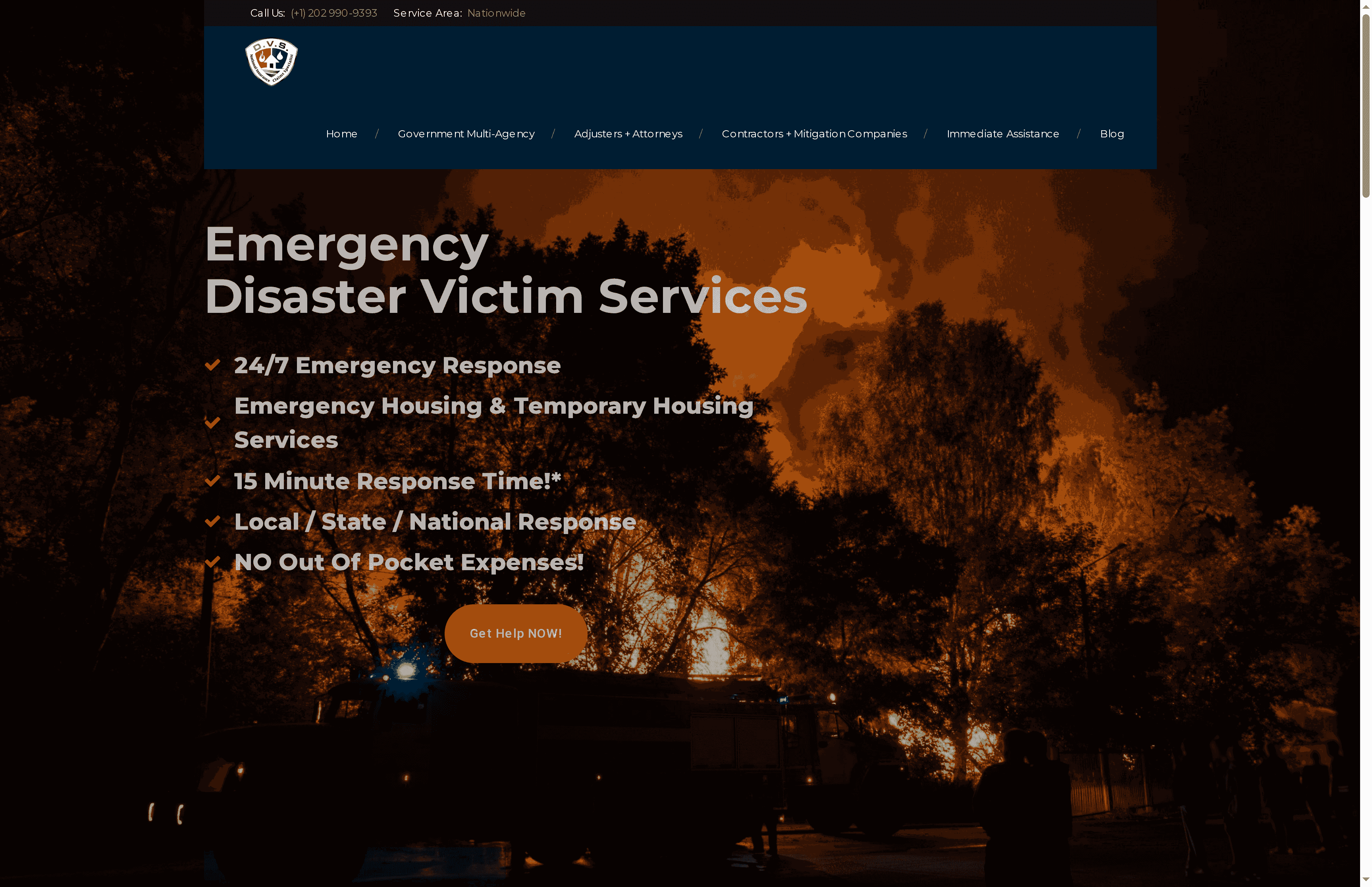
Disaster Victim Services delivers rapid, compassionate emergency housing and coordination for disaster-affected families nationwide. Their team operates 24/7 to connect displaced individuals with temporary residences and to synchronize efforts between insurers, emergency responders, and recovery contractors. Bottom line: if you need immediate, no-out-of-pocket housing and clear multi-agency coordination, this organization is built to act fast and steady when seconds count.
Core Features
Disaster Victim Services provides immediate emergency housing solutions for displaced families, working with insurance carriers and emergency services to ensure stability and support recovery after disasters. They offer 24/7 emergency response and coordinate multi-agency efforts for disaster recovery and housing assistance nationwide. Their mission is to support disaster survivors through quick housing solutions and further recovery resources. Key capabilities include 24/7 emergency response, emergency and temporary housing services, direct coordination with insurance carriers and emergency agencies, documented fast response times (under 15 minutes in some cases), and seamless partner integration so recovery workflows move without needless friction.
Pros
- Rapid assistance with emergency housing (under 1 hour): Clients are placed into safe, temporary housing quickly, minimizing exposure to weather, stress, and instability.
- Nationwide service coverage: Support is available across jurisdictions, reducing gaps when disasters cross region lines.
- No out-of-pocket expenses for clients: The financial barrier to immediate shelter is removed, which is critical for families already impacted by loss.
- Multifaceted support including logistics, coordination, and recovery resources: The team handles phone trees, placement logistics, and partner handoffs so victims and agencies can focus on recovery.
- Experienced team with over a century of combined disaster recovery expertise: Institutional know-how accelerates decisions and improves outcomes in chaotic environments.
Who It’s For
Disaster-affected individuals and families, insurance companies, emergency responders, government agencies, mitigation contractors, and relief organizations will find this service essential. If you need an organization that can both secure immediate shelter and act as the central point of contact between adjusters, attorneys, and responders, this is the match. You want speed, authority, and a single accountable team guiding transitions from crisis to stability.
Unique Value Proposition
Disaster Victim Services combines true 24/7 emergency housing placement with embedded multi-agency coordination—an operational model designed specifically for displaced households. Rather than offering a stand-alone platform or a referral directory, they actively orchestrate logistics: contacting insurers, briefing emergency responders, and placing families into temporary housing within hours. That orchestration reduces duplicate outreach, speeds claims handoffs, and removes financial barriers for survivors. In short: they don’t just find a room; they manage the recovery handoff so families move from chaos to a predictable, supported environment. This integrated, single-team approach is a deliberate design choice that prioritizes speed, accountability, and continuity—qualities that set them apart in high-stakes recovery scenarios.
Real World Use Case
A family displaced by a wildfire calls Disaster Victim Services late at night. Within hours the team confirms placement, coordinates with the family’s insurer and local emergency agency, and secures temporary housing—ensuring safety, access to basic needs, and an organized path toward claims and long-term recovery.
Pricing
No out-of-pocket expenses for clients; specifics not detailed.
Website: https://disastervictimservices.com
IRTH
At a Glance
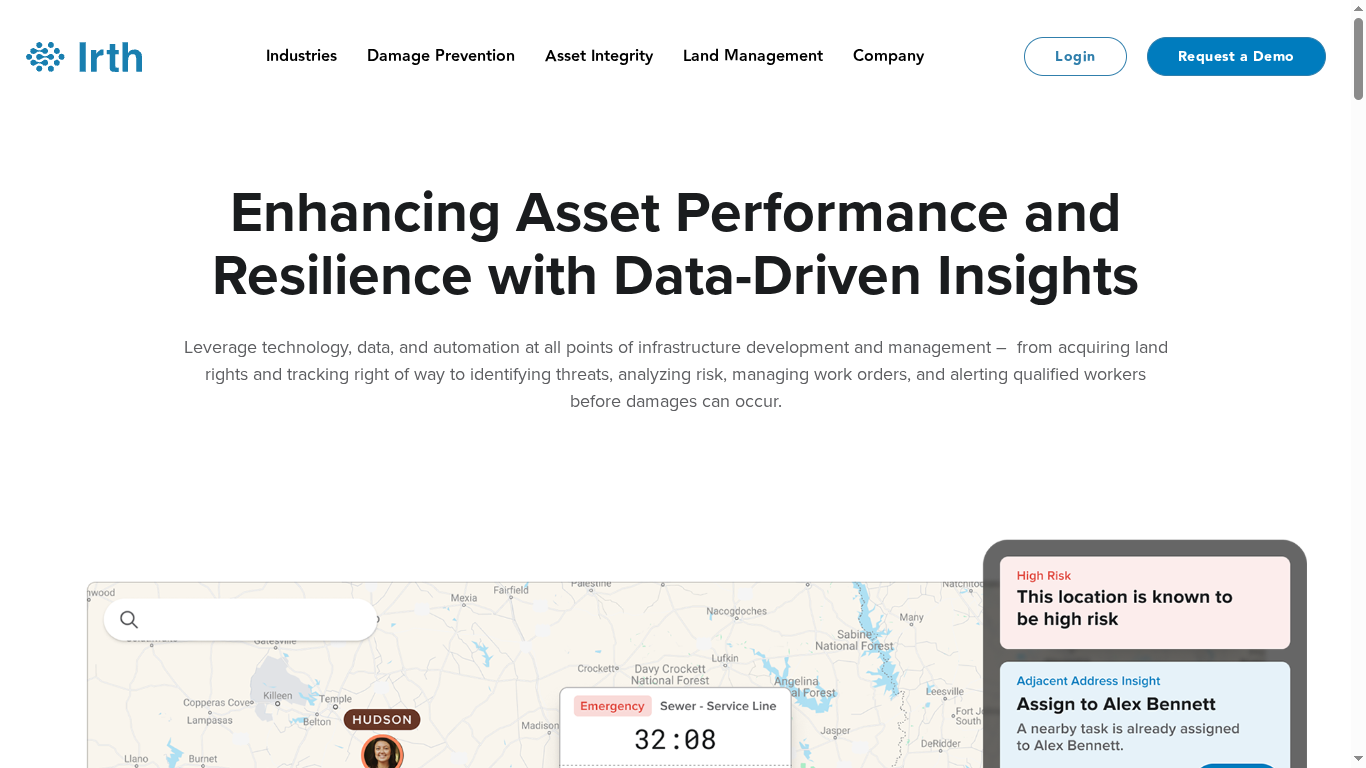
IRTH is a data-driven platform focused on damage prevention, pipeline integrity, and land management for utilities, telecoms, and municipalities. It combines remote monitoring, predictive analytics, and integrated workflows to reduce incidents and speed decision-making. The platform is powerful for organizations that handle high volumes of tickets and assets, though smaller teams may find initial setup and training demanding. Bottom line: IRTH is built for scale and risk reduction, not quick-and-dirty fixes.
Core Features
IRTH bundles damage prevention tools (remote monitoring, locate audits, locator training, and performance evaluation) with 811 ticket management powered by predictive risk models and integrations to North American call centers. Its land management capabilities support online, offline, and mobile tasks—agreements, payments, and project monitoring—while asset integrity modules use machine learning and data science to run risk assessments and produce real-time reports. The platform also merges multiple data sets for holistic asset health analysis and predictive maintenance, giving you operational visibility across silos.
Quick note. This matters in the field.
Pros
- Comprehensive toolset: IRTH delivers an end-to-end suite covering damage prevention, pipeline integrity, and land management in one platform, reducing the need to stitch multiple systems together.
- Proven throughput: The company’s industry experience is demonstrated by large-scale processing (for example, processing over 130 million work orders annually), which signals reliability for high-volume operators.
- Advanced analytics: IRTH applies machine learning and data science to anticipate risk and prioritize interventions, helping teams move from reactive to predictive workflows.
- Flexible deployment: The platform supports remote, on-the-go, and in-office work, so field crews, schedulers, and planners can all use consistent tools and data.
- Call center integration: Native connectivity with numerous North American call centers streamlines 811 ticket workflows and broadens usability across regions.
Cons
- Pricing transparency is limited: The website does not specify pricing, so budgeting and procurement may require direct vendor engagement.
- Implementation complexity: Smaller organizations or those without mature digital infrastructure may face a steep implementation curve and higher initial overhead.
- Unclear support details: Specifics on user support, onboarding timelines, and training packages are not clearly detailed in the available information.
Who It’s For
Organizations in energy, utilities, telecommunications, and municipal sectors that manage extensive physical assets and high ticket volumes will get the most value from IRTH. If you’re responsible for reducing excavation strikes, maintaining pipeline integrity, or coordinating land rights across projects, IRTH is tailored to your operational needs.
Unique Value Proposition
IRTH stands out by combining large-scale operational experience with predictive analytics and multi-source data integration—allowing operators to detect risk earlier, prioritize work intelligently, and simplify coordination across land and asset workflows.
Real World Use Case
A utility company uses IRTH to triage 811 tickets with predictive risk scoring, schedule targeted locates, run pipeline integrity assessments, and manage land agreements—resulting in fewer damages, faster permit processing, and more efficient resource allocation.
Pricing
Not specified
Website: https://irth.com
Veoci
At a Glance
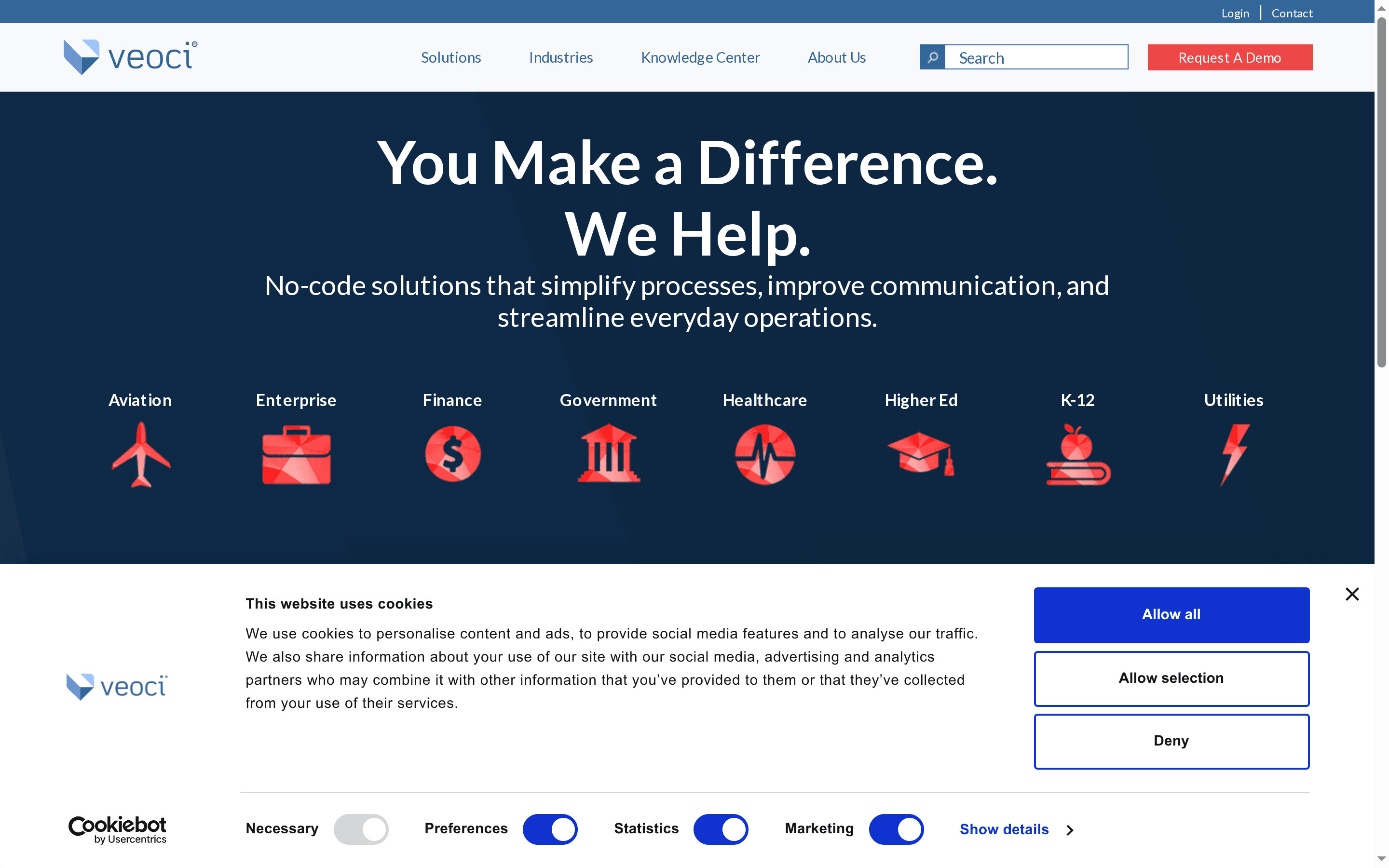
Veoci is a no-code operational platform built to simplify processes, improve communication, and streamline daily and crisis operations across sectors such as emergency management, higher education, government, healthcare, and utilities. It emphasizes real-time information tracking, GIS mapping, and mass notification to give teams situational awareness when seconds matter. Bottom line: Veoci suits organizations that need customizable, always-on coordination tools but expect a meaningful onboarding investment and potential budget planning for larger deployments.
Core Features
Veoci’s core capabilities center on no-code application building so teams can tailor workflows without developers, real-time data tracking to keep everyone aligned, GIS mapping for situational awareness, and mass notification for fast alerts. The platform is described as flexible enough to configure solutions across emergency response, business continuity, pandemic operations, and campus safety, enabling operations teams to centralize communication, visualize incidents on maps, and automate routine processes.
Pros
- Highly customizable no-code platform: Organizations can configure applications and workflows without writing code, reducing reliance on IT for routine changes.
- Real-time data and GIS mapping: Live tracking and mapping improve situational awareness, helping responders visualize incidents and resource locations quickly.
- Strong customer support and ongoing updates: The vendor emphasizes responsive support and continuous improvements driven by user feedback, which helps systems evolve with operational needs.
- Cross-industry applicability: Veoci is built to serve emergency management, higher education, government, healthcare, and utilities, offering templates and flexibility for varied use cases.
- Always-on collaboration focus: Designed for continuous operations, the platform supports sustained coordination during prolonged incidents or daily continuity work.
Cons
- Complex onboarding for new users: The detailed setup and customization options can make initial implementation lengthy and require dedicated staff time to configure effectively.
- Limited public detail on integrations: There is limited information available about specific integrations with other enterprise systems, which may require verification during procurement.
- Potential cost considerations: Pricing isn’t listed publicly and deployment scale can influence cost, so organizations should anticipate quote-based budgeting and factor total cost of ownership into decision-making.
Who It’s For
Veoci is ideal for organizations that need tailored, real-time operational management—especially emergency management teams, university campus safety offices, government agencies, healthcare operations, and utility providers. If you want a no-code platform that adapts to complex workflows and supports mass notification and mapping, Veoci fits—but plan for a structured rollout with stakeholder training.
Unique Value Proposition
Veoci’s unique value lies in combining no-code configurability with real-time tracking, GIS-driven situational awareness, and mass notification in a single platform. That combination lets organizations create purpose-built operational apps fast and keep responders, administrators, and the public informed from one centralized system.
Real World Use Case
A university uses Veoci to coordinate emergency response: administrators configure incident workflows, publish campus maps with live updates, and send targeted notifications to students and staff—streamlining communication and decision-making during campus emergencies.
Pricing
Not specified on the website
Website: https://veoci.com
Juvare
At a Glance
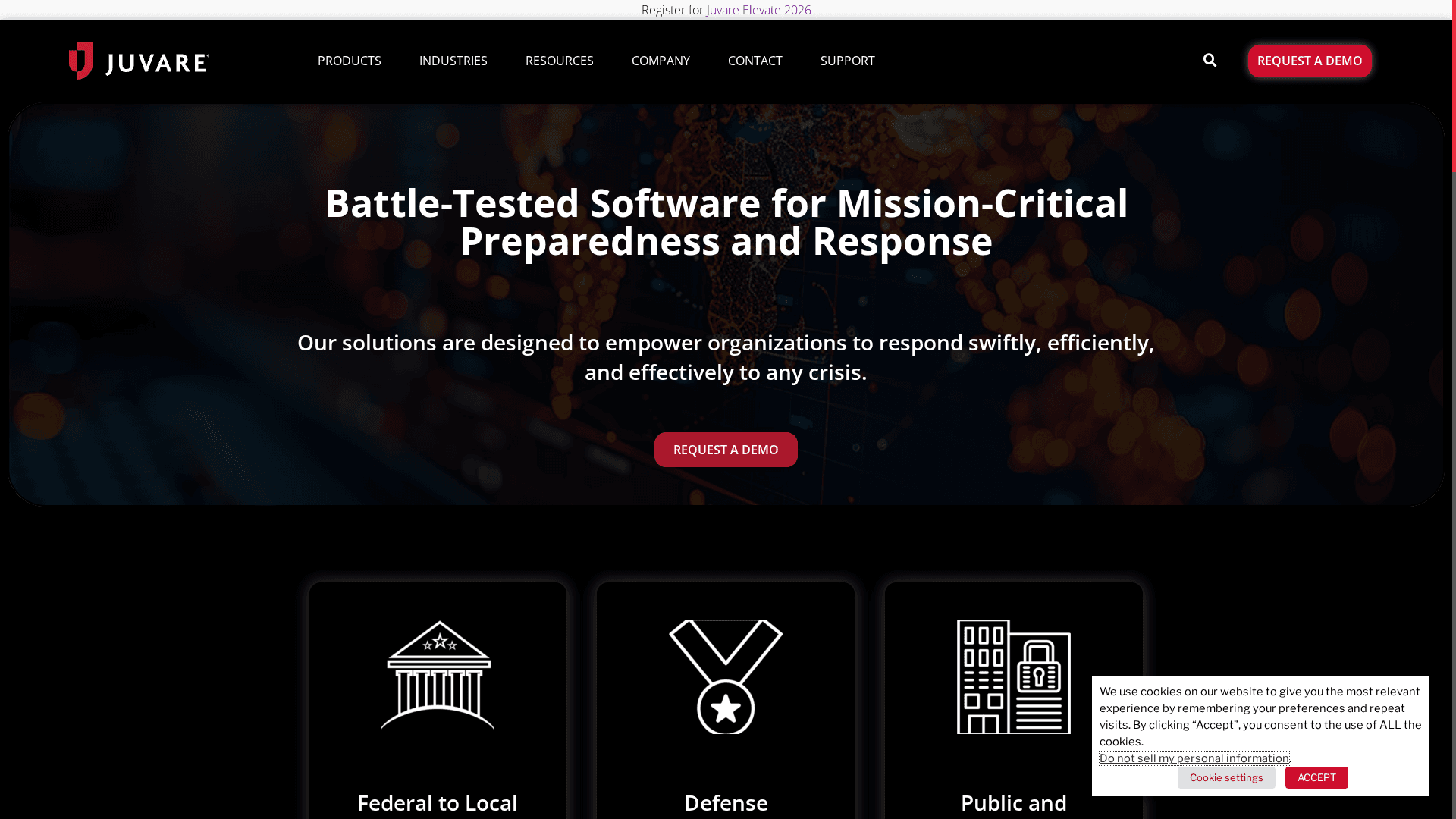
Juvare delivers a battle-tested set of emergency preparedness and response tools designed for mission-critical use across public and private sectors. It combines a Unified Command Platform™, AI-powered assistant (Jai), sector-specific offerings, and proven emergency operations technology like WebEOC to support coordinated action under pressure. The platform emphasizes operational resilience and ongoing professional education through events and certified training. Bottom line: Juvare is a robust, enterprise-oriented solution built for organizations that must manage complex, multi-agency incidents reliably.
Core Features
Juvare centers on an integrated command approach: a Unified Command Platform™ that brings stakeholders together, AI-powered response capabilities via the Jai assistant, and sector-specific solutions tailored for government, healthcare, transportation, and private-sector needs. Its emergency operations technology includes WebEOC and WebEOC Nexus for incident tracking and situational awareness, and the company supplements software with certified training and workshops to raise team readiness. These components work together to shorten decision loops and standardize communications during crises.
Pros
- Comprehensive integrated system: Juvare offers a suite of tightly connected tools that reduce the need to cobble together separate systems during an incident.
- Strong user adoption due to usability: The platform is noted for a user-friendly interface that encourages widespread adoption across agencies and teams.
- Sector-focused solutions: Juvare tailors capabilities to the unique workflows of government, healthcare, transportation, and private organizations, making implementations more relevant.
- Positive customer feedback on support and effectiveness: Client testimonials emphasize reliable support and tangible effectiveness in real incidents.
- Continued education and community building: Events like Juvare Elevate and certified training help teams stay current and practice response plans.
Cons
- Pricing is not transparent on the website, which can slow procurement decisions for budget-constrained organizations.
- Implementation can be complex for smaller organizations that lack dedicated emergency management staff or IT resources.
- Limited public detail on customization options means buyers may need direct contact to confirm whether specific workflows are supported.
Who It’s For
Juvare is best for emergency management professionals and organizations in government, transportation, healthcare, and larger private-sector enterprises that require a single, coordinated incident management system. If your operations involve multi-agency coordination, frequent drills, or regulatory reporting, Juvare fits well. Smaller nonprofits or single-facility operators should weigh implementation needs carefully before committing.
Unique Value Proposition
Juvare’s strength lies in combining proven incident management software (WebEOC family) with a unified command framework and AI assistance, all reinforced by certified training and an active events program. That blend of technology, process, and community creates a practical ecosystem for building operational resilience—especially when multiple organizations must act in concert.
Real World Use Case
A government emergency management agency uses Juvare’s WebEOC to coordinate disaster response across municipal, state, and federal partners, streamline cross-agency communication, and maintain a single authoritative situational picture during a large-scale event. Training and workshops prepare staff to run drills and shift quickly to live response.
Pricing
Quote-based — pricing is not specified on the website and requires direct contact for a tailored proposal.
Website: https://juvare.com
Everbridge High Velocity CEM
At a Glance
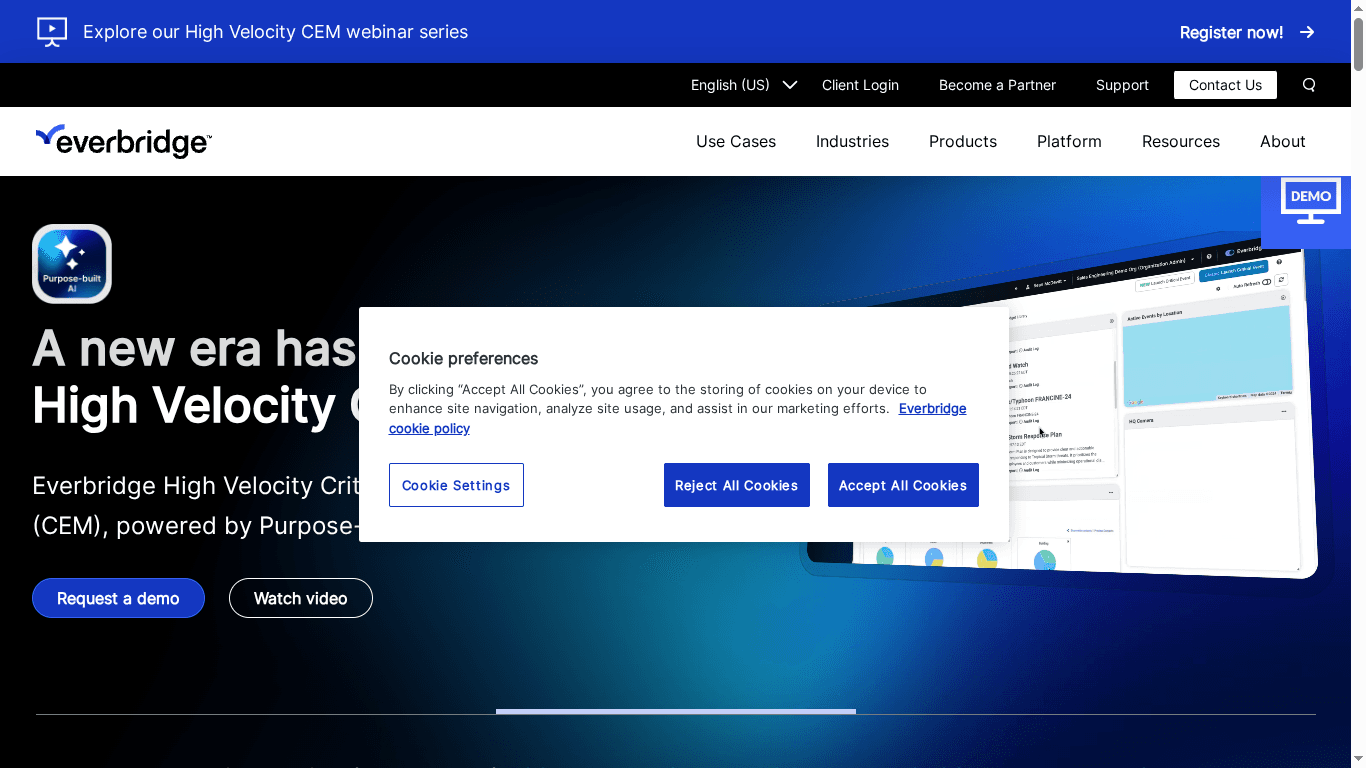
Everbridge High Velocity Critical Event Management (CEM) is a purpose-built, AI-driven platform that helps organizations detect threats, automate responses, and learn from incidents to strengthen resilience. It focuses on speed — delivering real-time insights and one-click alerts to accelerate decision-making when every second counts. For large enterprises, government agencies, and public-safety teams that need centralized, automated incident workflows, Everbridge offers a powerful foundation; however, the vendor-supplied information leaves integration and pricing specifics unclear.
Core Features
Everbridge combines AI-powered threat detection with a high-velocity incident workflow that emphasizes automation and measurable improvement. Key capabilities include real-time risk identification dashboards, one-click automated alert management to push notifications across multiple channels, and detailed after-action reports with response analytics designed to drive continuous improvement. The platform presents a closed loop: detect, act, analyze, and refine — all within a single ecosystem.
Pros
- Automation reduces manual delays: The platform automates alerting and response steps so teams can act faster without routing every decision through human gatekeepers. This speeds containment and coordination in time-sensitive events.
- AI-powered detection sharpens situational awareness: Real-time insights help identify emerging threats earlier, allowing responders to prioritize actions based on evolving risk data.
- One-click alerting simplifies communications: The one-click automated alert management capability enables rapid multi-channel notification, reducing the chance that critical messages are delayed or missed.
- Analytics support continuous improvement: Detailed after-action reports and response analytics make it easier to measure outcomes, identify gaps, and refine playbooks over time.
- Multi-channel communications increase reach: Built-in support for multiple communication channels helps ensure messages reach stakeholders whether they’re on mobile, email, or other systems.
Cons
- Limitations are not fully documented: The provided content does not include specific details about functional limits or performance under heavy load, which makes risk assessment harder for buying teams.
- Integration requirements are unclear: The source data does not discuss how the platform connects with existing IT, safety, or command-and-control systems, so organizations may need to validate integration effort before committing.
- Pricing transparency is lacking: Cost and licensing structure are not specified, which complicates budgeting and makes direct cost-benefit comparisons difficult.
Who It’s For
Everbridge High Velocity CEM is aimed at large organizations — enterprises, government agencies, and public safety organizations — that require rapid detection and automated coordination across many stakeholders. If your mission depends on reducing time-to-notify and improving post-incident learning at scale, this platform is built for that environment.
Unique Value Proposition
Everbridge emphasizes high-speed, AI-assisted incident management with a tight feedback loop from detection through after-action analytics. Its central promise is to shrink response times via automation while giving leaders measurable insights to improve resilience over repeated events.
Real World Use Case
A large corporation uses Everbridge High Velocity CEM to monitor cybersecurity alerts, physical threats, and natural hazards in a single platform; security teams trigger automated alerts, coordinate response actions across departments, and generate after-action reports to refine procedures for future incidents.
Pricing
Not specified.
Website: https://everbridge.com
d4h
At a Glance
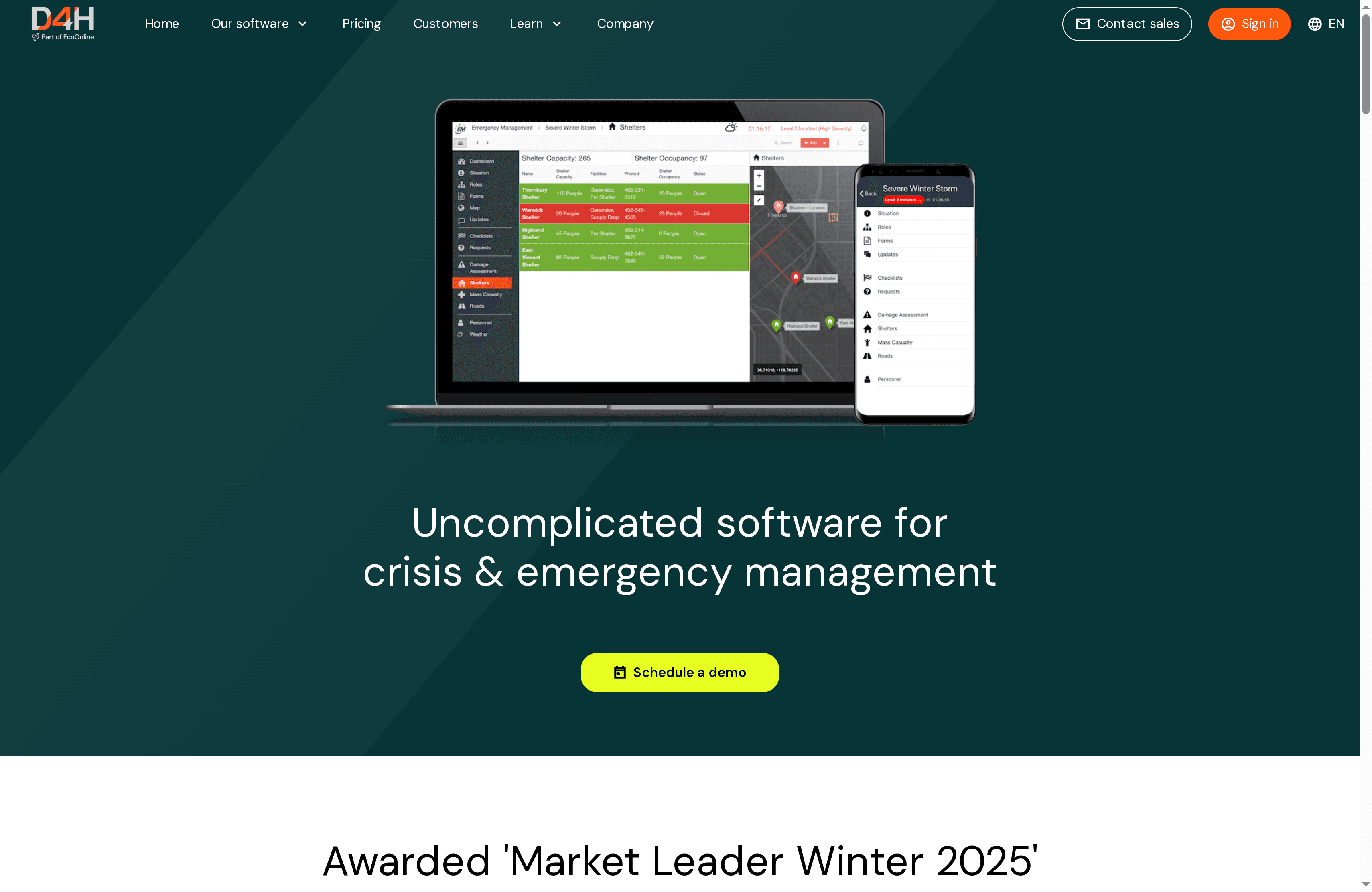
d4h is uncomplicated crisis and emergency management software built for fast adoption and broad use across sectors. It centralizes incident management, reporting, personnel training, alerting, and equipment tracking into a single, customizable platform with ISO 27001 information security certification. If you need a secure, user-friendly tool that adapts to many response scenarios and emphasizes sustainability, d4h belongs on your shortlist.
Core Features
d4h’s core capabilities center on modular, customizable workflows that let teams design forms, alerts, and response processes without coding skills. Key modules include incident management, reporting, personnel training, alerting, and equipment management, all designed for real-time scenario adaptation. The platform is ISO 27001 certified, supports integrations with existing workflows, and highlights environmental stewardship by offsetting its carbon footprint.
Pros
- Very user-friendly interface: The platform is described as easy to adopt, which reduces training time and speeds operational rollout.
- Highly customizable modules: You can tailor forms and workflows to match different emergency types, avoiding one-size-fits-all limitations.
- Real-time adaptation: d4h supports scenario-driven updates so responders can pivot quickly as incidents evolve.
- Strong data security posture: ISO 27001 certification demonstrates a formal commitment to information security and risk management.
- Recognized by users and industry: Multiple 5-star reviews and awards like “Market Leader” and “Best ROI” indicate broad satisfaction and measurable value.
- Sustainability focus: The vendor offsets its carbon footprint, aligning with agencies that prioritize environmental responsibility.
Cons
- Vendor materials do not list explicit limitations, making it hard to assess edge-case constraints: The absence of documented drawbacks means you may discover product boundaries only during pilots.
- Customization/setup may require significant effort for complex programs: While customization is powerful, tailoring many modules to a large agency could demand time and internal resources.
- Pricing not specified in the provided content: Without published pricing, budgeting and procurement will require direct vendor engagement.
Who It’s For
d4h fits emergency response teams, crisis managers, safety coordinators, and organizations that need a secure, easy-to-use platform adaptable to many incident types. It’s particularly suitable for agencies and organizations that want fast onboarding, modular configuration without heavy developer involvement, and a vendor that takes security and sustainability seriously.
Unique Value Proposition
d4h’s strength is combining straightforward usability with enterprise-grade security and broad modularity. Organizations gain a single platform that centralizes incident reporting, training, alerts, and equipment oversight while enabling rapid configuration to different response workflows — all backed by ISO 27001 and eco-conscious practices.
Real World Use Case
A county emergency management office uses d4h to centralize incident reporting, manage personnel training records, and push timely notifications during multi-agency incidents. The county benefits from faster coordination, consistent reporting across departments, and a single source of truth for equipment status and responder assignments.
Pricing
Not specified in the provided content.
Website: https://d4h.com
Pratus

At a Glance
Pratus is a cloud-based platform from Disaster Tech built to support disaster response and recovery from remote or impacted locations. It bundles real-time communication, mapping, and inventory tools so teams can coordinate faster across chaotic environments. In practice, Pratus is best for organizations that need a compact, configurable toolset for field operations — but it does rely on connectivity and some training to unlock its full value.
Core Features
Pratus centers on five core capabilities: a real-time communication platform, resource and inventory management, mapping and geolocation tools, data collection and analysis, and accessibility in remote areas. These components work together: mapping pins resources and teams, inventory tracks supplies, and data collection feeds analysis dashboards for decision-making — all updated in near real time when connectivity permits.
Pros
- Enhances coordination among disaster response teams: Pratus centralizes messages, locations, and task status so responders get a single source of truth during fast-moving events.
- Supports remote and field operations: The platform was designed for field conditions and includes offline-aware features to extend usability in dispersed operations.
- Facilitates real-time data sharing and decision-making: Continuous data collection and analysis reduce lag between observation and operational response.
- Customizable to various disaster scenarios and needs: Organizations can adapt workflows and resource categories to floods, wildfires, or earthquake response without rebuilding systems from scratch.
- Cloud-based with easy updates: Centralized hosting means Disaster Tech can push updates and new features without complex on-site installs.
Cons
- Requires internet connectivity which may be limited in disaster zones: When cellular or satellite links are down, full functionality degrades and synchronization may be delayed.
- Learning curve for new users: Teams unfamiliar with coordinated digital platforms will need training and practice to use Pratus effectively under stress.
- Potential need for hardware integration in certain situations: Some field setups may require additional devices or sensors to link inventories or geolocation feeds into the platform.
Who It’s For
Pratus is aimed at disaster response agencies, NGOs, government emergency management departments, and humanitarian relief organizations that run field operations and manage distributed resources. If you coordinate multi-team responses or track supply distribution across zones, Pratus is built to reduce manual handoffs and improve visibility.
Unique Value Proposition
Pratus combines mapping, inventory, and communications into a single, configurable toolkit purpose-built for disaster contexts. The platform’s tight focus on field usability and cloud-delivered updates makes it a pragmatic choice for organizations that need a focused, adaptable system rather than a sprawling enterprise suite.
Real World Use Case
A humanitarian NGO deployed Pratus during a recent flood to coordinate rescue teams, log resource distribution points, and communicate between field crews and a central operations hub. The NGO reported smoother task allocation and faster confirmations of deliveries, which translated into safer, more efficient response activity.
Pricing
Pricing details are available upon inquiry; typically tailored to organizational needs.
Website: https://disastertech.com
Crisis Management Tools Comparison
This table provides a comprehensive overview of various crisis management tools, highlighting their features, pros, cons, and pricing for organizations needing emergency response solutions.
| Product | Key Features | Pros | Cons | Pricing |
|---|---|---|---|---|
| Disaster Victim Services | 24/7 emergency response, housing solutions, insurer coordination | Rapid assistance, nationwide coverage, no out-of-pocket expenses for clients | Requires partnership agreements for financial flow | No out-of-pocket expenses |
| IRTH | Damage prevention, asset integrity, risk assessments, 811 ticket management | Comprehensive toolset, advanced analytics, call center integration | Pricing transparency limited, complex implementation for smaller teams | Not specified |
| Veoci | No-code app building, real-time tracking, GIS mapping, mass notification | Highly customizable, strong support, cross-industry applicability | Complex onboarding, potential cost considerations | Not specified |
| Juvare | Unified Command Platform™, WebEOC technology, AI-powered response | Integrated system, strong user adoption, positive customer feedback | Pricing not transparent, complex for smaller organizations | Quote-based |
| Everbridge High Velocity CEM | AI-driven threat detection, high-velocity incident workflow, automation | Automation reduces delays, AI-powered detection, one-click alerting | Limited integration details, pricing transparency lacking | Not specified |
| d4h | Incident management, reporting, alerting, equipment tracking, ISO 27001 certified | User-friendly, customizable, real-time adaptation, strong security | Customization effort may be significant, no explicit limitations listed | Not specified |
| Pratus | Real-time communication, mapping, inventory management, data analysis | Enhances coordination, supports remote operations, real-time data sharing | Requires internet connectivity, learning curve for new users | Tailored to needs |
Trusted Emergency Coordination When Every Second Counts
Finding the right emergency coordination platform can feel overwhelming when disaster strikes. This article highlights the need for rapid, seamless communication and multi-agency collaboration to support responders and displaced families. The challenge lies in bridging gaps between first responders, insurance carriers, and recovery teams while delivering fast, no-cost emergency housing. The key pain points include minimizing delays, removing financial barriers, and maintaining steady coordination at a critical time.
At DisasterVictimServices.com, we share your urgency and commitment. Our expert team specializes in delivering swift emergency housing alongside integrated collaboration with insurers and government agencies. When every minute matters, we provide the steady, compassionate support that moves families from crisis toward stability. Ready to experience the power of coordinated care? Explore how our solutions support disaster recovery on our Uncategorized – Disaster Victim Services | Helping You Recover After Disaster page and learn more about our ongoing initiatives at Developing – Disaster Victim Services | Helping You Recover After Disaster.
Find reassurance in a partner who understands the complexity of emergency response workflows. Don’t wait to secure expert guidance that streamlines recovery. Visit DisasterVictimServices.com now and take the first step toward faster, more effective disaster victim support.
Frequently Asked Questions
What are the key features to look for in an emergency coordination platform for responders?
A good emergency coordination platform should offer real-time data tracking, mapping capabilities, and robust communication tools. Evaluate platforms that allow you to customize workflows and automate alerts to ensure efficiency during crisis management.
How can I assess which emergency coordination platform suits my organization’s needs?
Start by identifying your specific requirements based on the types of emergencies you face and the scale of your operations. Create a checklist of essential features and compare how different platforms meet these criteria in terms of functionality, user experience, and support.
What kind of training is typically required for emergency responders to use these platforms effectively?
Most emergency coordination platforms require some level of training for users to become proficient. Ensure that the platform you choose offers comprehensive onboarding and ongoing support, which can include hands-on sessions and user guides, allowing responders to be operational within a few days to weeks.
Can these platforms integrate with existing emergency management tools?
Yes, most emergency coordination platforms offer integration capabilities with other tools and software. Review the platform’s integration options to ensure they align with your current tools, which can streamline your coordination efforts and improve overall efficiency.
How quickly can an emergency coordination platform be deployed in a crisis situation?
Many platforms are designed for rapid deployment, often allowing users to set up vital functions within hours. Choose a platform that is cloud-based and easy to access, enabling your team to mobilize effectively and improve response times during critical situations.
What kind of reporting capabilities do these platforms typically provide?
Emergency coordination platforms usually come with extensive reporting features that allow teams to analyze response data post-incident. Find a platform that generates detailed after-action reports, which can help you track performance metrics and refine future response strategies.
Recommended
- First Responder Coordination Tips 2025: Effective Support for All – Disaster Victim Services | Helping You Recover After Disaster
- Understanding Emergency Response Roles in 2025: Key Insights – Disaster Victim Services | Helping You Recover After Disaster
- How to Coordinate Response in Disasters: A Guide for 2025 – Disaster Victim Services | Helping You Recover After Disaster
- First Responder Coordination Tips 2025: Effective Support for All – Disaster Victim Services | Helping You Recover After Disaster