

Section 8 housing isn’t just a government program. It helps more than 2.2 million low-income families and individuals every year find stable places to live. Sounds like just another set of rules, right? The real surprise is how this one set of qualifications can completely change a family’s future and open doors many never thought possible.
Table of Contents
- What Is Section 8 And Its Purpose?
- Why Qualifications Matter For Housing Assistance
- How Section 8 Qualifications Work: Eligibility Explained
- Key Concepts In Section 8 Housing Qualifications
- Real-World Impact Of Meeting Section 8 Qualifications
Quick Summary
| Takeaway | Explanation |
|---|---|
| Section 8 aids low-income families | This program helps low-income households afford stable housing in private rentals through vouchers covering excess rent costs. |
| Eligibility focuses on income levels | Applicants are classified based on income brackets to ensure assistance is targeted to those in true need. |
| Rigorous qualification protects funds | Strict qualification criteria maintain program integrity and ensure limited resources reach vulnerable populations effectively. |
| Housing stability promotes personal growth | Securing Section 8 assistance enables families to redirect resources towards education and health, fostering overall development. |
| Meeting qualifications can change lives | Qualifying for Section 8 can lead to long-term housing stability, enhancing community integration and economic mobility opportunities. |
What is Section 8 and Its Purpose?
Section 8, officially known as the Housing Choice Voucher Program, represents a critical federal initiative designed to address housing affordability for low-income Americans. This program provides essential rental assistance to families, elderly individuals, and people with disabilities who struggle to secure stable housing in the private rental market.
Understanding the Core Mission
The fundamental purpose of Section 8 is to ensure that vulnerable populations have access to safe, decent housing regardless of their economic circumstances. According to the U.S. Department of Housing and Urban Development, the program operates on a simple but powerful principle: helping low-income households pay a manageable portion of their income for housing.
Key characteristics of the program include:
- Subsidizing rental costs so participants pay approximately 30% of their adjusted monthly income
- Allowing recipients to choose their own housing, including apartments, townhouses, and single-family homes
- Providing flexibility for families to live in neighborhoods that best suit their needs
How Section 8 Financial Assistance Works
The program functions through a collaborative approach involving federal government funding, local housing authorities, and private landlords. When a family qualifies for Section 8, they receive a voucher that covers the difference between their affordable rent contribution and the actual market rental rate.
Financial Mechanics:
- Housing authorities determine the maximum voucher amount based on local rental market rates
- Participants can use their voucher with any landlord who agrees to participate in the program
- Government directly pays the remaining rental cost to the landlord
By creating a bridge between government support and private housing markets, Section 8 plays a transformative role in preventing homelessness and providing housing stability for millions of Americans facing economic challenges.
Why Qualifications Matter for Housing Assistance
Qualifications for housing assistance are not merely bureaucratic checkboxes but critical safeguards that ensure limited resources reach those most in need. These requirements help maintain the integrity of support systems while providing targeted relief to vulnerable populations facing significant housing challenges.
Protecting Program Sustainability
Research from the Center on Budget and Policy Priorities highlights that strict qualification criteria are essential for maintaining the financial sustainability of housing assistance programs. By establishing clear eligibility standards, government agencies can effectively manage limited funding and prevent resource depletion.
Key considerations in qualification assessment include:
- Verifying household income levels
- Confirming citizenship or eligible immigration status
- Assessing family size and composition
- Reviewing past rental and housing history
Ensuring Fair and Equitable Distribution
Qualification standards serve as a critical mechanism for addressing systemic inequities in housing access. These requirements help prevent arbitrary selection and create a transparent, standardized approach to distributing housing support. Precise eligibility criteria guarantee that assistance reaches individuals and families experiencing genuine economic hardship.
The qualification process involves comprehensive evaluations that go beyond simple income thresholds. Housing authorities conduct thorough assessments that consider multiple factors affecting a family’s housing stability. Learn more about our detailed housing eligibility process.
Important qualification factors include:
- Demonstrating financial need
- Proving inability to secure standard housing through traditional means
- Meeting specific program-related residency requirements
By implementing rigorous yet compassionate qualification standards, housing assistance programs can effectively bridge the gap between housing insecurity and stable living environments for millions of Americans.
How Section 8 Qualifications Work: Eligibility Explained
Section 8 housing qualifications are a comprehensive system designed to identify and support families experiencing significant economic challenges.
Here is a breakdown of the main income eligibility categories used to determine Section 8 qualification and their definitions.
| Income Category | Percentage of Area Median Income (AMI) | Description |
|---|---|---|
| Extremely Low-Income | Less than 30% of AMI | Households with the greatest financial need |
| Very Low-Income | 30% to 50% of AMI | Households with significant, but less severe, economic challenges |
| Low-Income | 50% to 80% of AMI | Households with limited income, still eligible for some assistance |
| These eligibility requirements serve as a structured approach to determining who receives critical housing assistance, ensuring that limited resources reach those most in need. |
Income-Based Eligibility Criteria
According to the U.S. Department of Housing and Urban Development, income is the primary determinant for Section 8 eligibility. The program categorizes applicants into three primary income brackets:
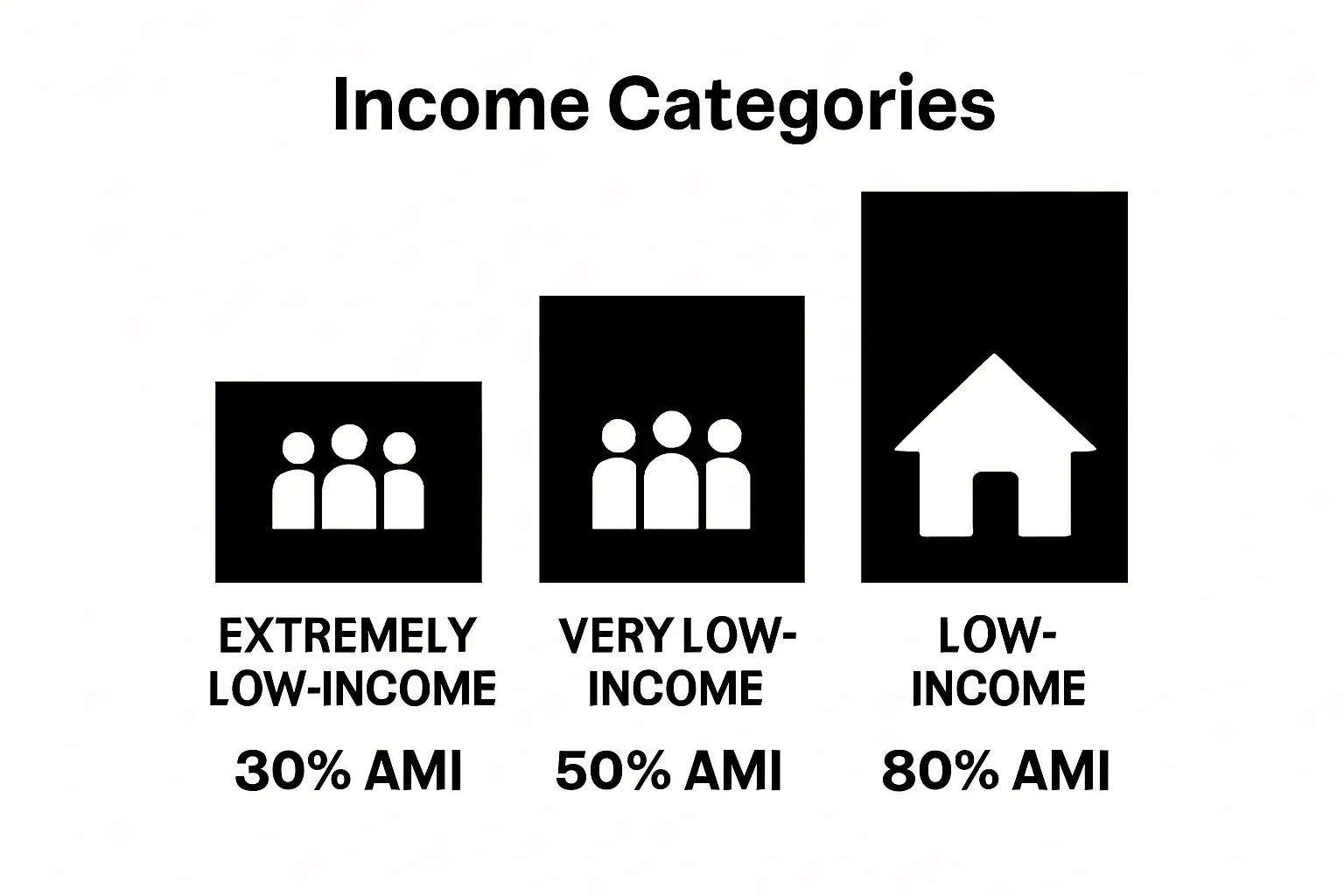
- Extremely Low-Income: Households earning less than 30% of the area median income
- Very Low-Income: Households earning between 30% and 50% of the area median income
- Low-Income: Households earning between 50% and 80% of the area median income
Important Verification Parameters:
- Documentation of all household income sources
- Verification of current employment status
- Assessment of non-wage income including social security, unemployment benefits, and child support
Additional Qualification Factors
Beyond income, Section 8 considers multiple factors to determine comprehensive eligibility. Read more about our detailed housing process guide for deeper insights into qualification requirements.
Key additional eligibility considerations include:
- U.S. citizenship or eligible immigrant status
- Clean rental history without significant lease violations
- Background checks to ensure community safety
- Family size and composition relative to housing availability
The qualification process is intentionally thorough to guarantee that housing assistance reaches families facing genuine housing insecurity.
 Local housing authorities conduct meticulous assessments, examining not just financial metrics but also the holistic circumstances of each applicant.
By implementing these rigorous yet compassionate eligibility standards, Section 8 creates a targeted approach to addressing housing challenges, transforming the lives of millions of Americans struggling to secure stable housing.
Key Concepts in Section 8 Housing Qualifications
Section 8 housing qualifications represent a nuanced framework designed to address housing insecurity through structured, comprehensive assessment criteria. Understanding these key concepts is crucial for potential applicants navigating the complex landscape of housing assistance.
Defining Area Median Income
According to the U.S. Department of Housing and Urban Development, Area Median Income (AMI) serves as the foundational metric for determining housing assistance eligibility. AMI represents the midpoint of a region’s income distribution, with housing assistance levels calculated as a percentage of this baseline.
Key characteristics of AMI include:
- Calculated annually for each metropolitan and non-metropolitan area
- Adjusted based on family size
- Used as a benchmark for income-based program qualifications
- Varies significantly between different geographical regions
Comprehensive Household Evaluation
Household composition and total income are critical factors in Section 8 qualification assessments. These evaluations go beyond simple financial metrics to consider the holistic circumstances of applicants. Learn more about housing accessibility for diverse populations.
Important evaluation components include:
- Total household income from all sources
- Number of dependents
- Specific household challenges or special needs
- Citizenship and legal residency status
Program Specific Terminology
Section 8 housing assistance employs specialized terminology that applicants must understand. These terms help standardize the application and qualification process, ensuring transparency and fairness.
Critical terms to know:
- Voucher: A document enabling participants to secure housing in the private rental market
- Payment Standard: The maximum subsidy amount the housing authority will provide
- Utility Allowance: An additional amount to help cover utility expenses
- Gross Rent: Total rent including utilities
By comprehending these fundamental concepts, potential applicants can better navigate the Section 8 housing assistance landscape, understanding the intricate mechanisms that determine eligibility and support.
The following table summarizes key Section 8 program terms and their definitions to help applicants navigate the qualification process.
| Term | Definition |
|---|---|
| Voucher | Document that allows participants to secure housing in the private rental market |
| Payment Standard | Maximum subsidy amount provided by the local housing authority |
| Utility Allowance | Extra amount to help cover utility expenses |
| Gross Rent | Total rent amount including utilities |
| Area Median Income (AMI) | Midpoint income of a geographic area used for eligibility calculations |
Real-World Impact of Meeting Section 8 Qualifications
Meeting Section 8 housing qualifications represents more than bureaucratic compliance; it signifies a transformative opportunity for families facing economic challenges. The program’s impact extends far beyond immediate housing assistance, creating pathways for long-term stability and personal growth.
Breaking the Cycle of Housing Instability
According to the Urban Institute, Section 8 qualifications provide a critical lifeline for families trapped in cycles of housing insecurity. By offering stable housing, the program enables recipients to redirect financial resources toward education, healthcare, and career development.
Key transformative impacts include:
- Reducing frequency of housing relocation
- Minimizing risk of homelessness
- Creating opportunities for family financial recovery
- Supporting children’s educational continuity
Economic Mobility and Opportunity
Qualifying for Section 8 housing assistance can be a pivotal moment in a family’s economic trajectory. Learn more about our comprehensive housing support strategies.
Economic advancement opportunities include:
- Ability to save money for future investments
- Reduced stress from housing cost burden
- Improved credit potential
- Enhanced job search and employment stability
Long-Term Community and Personal Benefits
Section 8 qualifications do more than provide immediate housing relief. The program supports broader social integration and personal development by enabling families to access safer neighborhoods and more robust community resources.
Broad societal benefits encompass:
- Reduced generational poverty
- Improved mental and physical health outcomes
- Enhanced educational opportunities for children
- Increased social mobility
By meeting Section 8 qualifications, families gain more than a housing subsidy. They secure a foundational platform for rebuilding, growing, and ultimately thriving in an increasingly challenging economic landscape.
Fast-Track Your Path to Emergency Housing Support
If you are struggling to meet Section 8 housing qualifications and worried about keeping your family safe when disaster strikes, you are not alone. Many people face uncertainty finding stable housing after unexpected events, even when they understand eligibility terms like Area Median Income or subsidy requirements. Navigating long government processes can slow down your recovery and leave you feeling overwhelmed. You deserve support that matches the urgency of your situation.
Get critical help with DisasterVictimServices.com. Our dedicated team specializes in connecting disaster victims directly to emergency housing, bridging gaps while you work through programs like Section 8. Want expert guidance on qualifying for assistance or need immediate placement? Contact our compassionate recovery team here. Take the next step now and stabilize your future while our experts guide you from crisis to secure housing, twenty-four hours a day.
Frequently Asked Questions
What are the income limits for Section 8 housing qualifications?
The income limits for Section 8 housing qualifications categorize applicants into three brackets: Extremely Low-Income (under 30% of the area median income), Very Low-Income (between 30% and 50% of the area median income), and Low-Income (between 50% and 80% of the area median income).
What additional factors are considered for Section 8 housing eligibility besides income?
In addition to income, eligibility for Section 8 housing considers factors such as U.S. citizenship or eligible immigration status, rental history, background checks, and family size and composition.
How does the Section 8 housing voucher system work?
The Section 8 housing voucher system allows families to choose their own housing within the private rental market. The voucher subsidizes the difference between the amount the household can afford to pay (approximately 30% of their adjusted income) and the actual rental cost, with the government paying the remainder to the landlord.
What is the importance of Area Median Income (AMI) in Section 8 qualifications?
Area Median Income (AMI) serves as a critical benchmark for determining eligibility for Section 8 housing assistance. AMI is calculated annually for each area and is adjusted based on family size, influencing the income-based qualifications for applicants.
Recommended
- Understanding Housing Eligibility Requirements 2025 – Disaster Victim Services | Helping You Recover After Disaster
- Direct Housing Process Guide 2025: Steps, Eligibility & Tips – Disaster Victim Services | Helping You Recover After Disaster
- Understanding Housing Reimbursement Process Steps – Disaster Victim Services | Helping You Recover After Disaster
- Rehousing Process Steps: A Complete Guide for 2025 – Disaster Victim Services | Helping You Recover After Disaster