

Section 8 might sound like just another government program, but for millions of Americans it means something much deeper. Over 2.2 million low-income households rely on Section 8 vouchers for safe and affordable housing. Most people think strict rules and long waiting lists make help nearly impossible to get. The truth is, some families actually qualify immediately if they meet certain conditions and the whole process can move much faster than you might expect.
Table of Contents
- What Are Section 8 Qualifications And Who Do They Help?
- Why Section 8 Qualifications Matter For Housing Assistance
- How Section 8 Qualifications Function In Practicing Agencies
- Key Concepts In Section 8 Qualifications For Displaced Families
Quick Summary
| Takeaway | Explanation |
|---|---|
| Income limits are crucial for eligibility | Households typically must earn at or below 50% of the area median income to qualify for Section 8 assistance. |
| Citizenship is a requirement | Applicants need to be U.S. citizens or have valid immigration documentation to receive support from the program. |
| Targeted support for vulnerable populations | Section 8 helps single parents, seniors, disabled individuals, veterans, and low-wage workers facing economic challenges. |
| Structured prioritization is essential | Public housing authorities create waiting lists that prioritize those most in need, such as homeless families and veterans. |
| Special provisions exist for displaced families | The program includes expedited processing and flexible requirements for families suddenly losing their housing, addressing their unique situations. |
What are Section 8 Qualifications and Who Do They Help?
Section 8, officially known as the Housing Choice Voucher Program, represents a critical federal assistance initiative designed to support low-income individuals and families in accessing affordable housing. Housing assistance programs provide crucial support for vulnerable populations struggling to secure stable living environments.
Understanding Program Eligibility
Section 8 qualifications are structured around several fundamental criteria that determine an applicant’s eligibility.
The following table summarizes the primary eligibility factors required for Section 8 and how each impacts an applicant’s ability to qualify.
| Eligibility Factor | Description | Why It Matters |
|---|---|---|
| Income Limit | Household income must be at or below 50% of local median | Determines financial need for assistance |
| Citizenship Status | Must be a U.S. citizen or have eligible immigration docs | Ensures compliance with federal guidelines |
| Family Composition | Consideration of household members and special groups | Prioritizes families, elderly, and disabled individuals |
| Local Area Conditions | Area median income and cost of housing | Adjusts criteria based on local economic conditions |
| Background Checks | Checks for certain criminal history | Protects resident safety and qualification integrity |
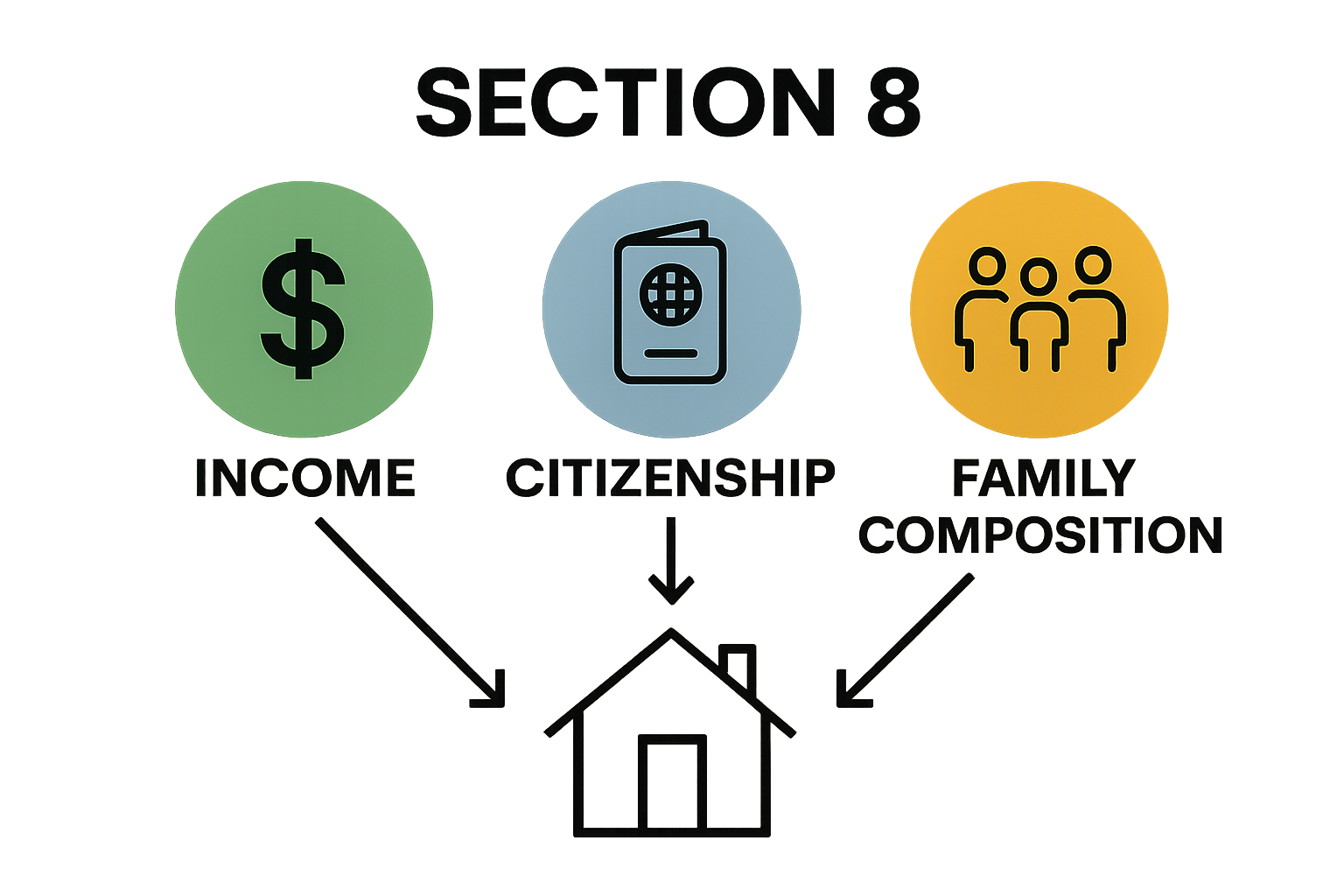
- Income Level: Household income must typically be at or below 50% of the area’s median income
- Citizenship Status: Applicants must be U.S. citizens or have eligible immigration documentation
- Family Composition: Preference often given to families with children, elderly individuals, and people with disabilities
The program specifically targets households experiencing significant economic challenges, creating a safety net for those most at risk of housing insecurity. Our guide on housing eligibility offers additional insights into navigating these complex requirements.
Who Benefits from Section 8
Section 8 serves a diverse range of vulnerable populations. This includes:
- Single parents struggling to maintain stable housing
- Senior citizens living on fixed incomes
- Individuals with disabilities
- Veterans transitioning to civilian life
- Low-wage workers in high-cost housing markets
By providing rental subsidies, the program enables participants to live in privately-owned housing while paying only a portion of their monthly income toward rent.
This table highlights and compares the main types of vulnerable populations prioritized in the Section 8 program and the specific challenges they often face.
| Population Group | Common Challenges | Section 8 Relevance |
|---|---|---|
| Single Parents | Housing instability, low wages | Eligible for prioritized assistance |
| Senior Citizens | Fixed incomes, health limitations | Targeted for support |
| Individuals w/Disabilities | Barriers to employment, special housing needs | Receive special considerations |
| Veterans | Transitioning to civilian life, homelessness risk | May get prioritization on waiting lists |
| Low-Wage Workers | High housing costs, financial precarity | Qualify under income guidelines |
Why Section 8 Qualifications Matter for Housing Assistance
Section 8 qualifications represent more than bureaucratic requirements. They form a critical framework ensuring that housing assistance reaches those experiencing the most significant economic challenges. Housing policy research demonstrates how these qualifications create a targeted approach to addressing systemic housing inequalities.
Addressing Economic Vulnerability
The qualifications serve multiple essential societal functions by strategically allocating limited housing resources. By establishing clear eligibility criteria, the program prevents housing assistance from becoming an arbitrary distribution and instead creates a structured support mechanism for vulnerable populations.
Key societal benefits include:
- Preventing homelessness for low-income families
- Reducing housing cost burdens for economically marginalized groups
- Creating pathways for economic stability and mobility
- Supporting communities experiencing significant economic challenges
Explore our direct housing process guide to understand how these qualifications translate into practical housing solutions.
Ensuring Fair and Strategic Resource Distribution
Section 8 qualifications function as a sophisticated screening mechanism that goes beyond simple income thresholds. The program considers multiple dimensions of economic vulnerability, including family composition, disability status, and local economic conditions.
This nuanced approach means that housing assistance is not just about providing shelter, but about creating meaningful opportunities for individuals and families to stabilize their living situations. By prioritizing those most at risk, Section 8 helps break cycles of poverty and provides critical support during challenging economic periods, ultimately contributing to broader social and economic resilience.
How Section 8 Qualifications Function in Practicing Agencies
Local public housing authorities (PHAs) play a critical role in administering Section 8 housing assistance, transforming federal guidelines into practical support for vulnerable populations.
Housing program administration requires meticulous verification and strategic implementation of complex eligibility requirements.
Verification and Documentation Process
PHAs conduct comprehensive evaluations of applicant eligibility through a detailed documentation review. This multistep process involves:
- Collecting and verifying income documentation
- Confirming citizenship or eligible immigration status
- Assessing family composition and size
- Reviewing criminal background checks
- Determining local area median income thresholds
Learn more about our rehousing process to understand the intricate steps agencies follow in housing assistance.
Prioritization and Waiting List Management
Because demand consistently outpaces available resources, PHAs implement strategic prioritization mechanisms. They typically create tiered waiting lists that provide preference to:
- Families experiencing homelessness
- Households with children
- Veterans
- Individuals with documented disabilities
- Families paying more than 50% of their income for rent
This structured approach ensures that the most vulnerable populations receive critical housing support when resources become available. The goal is not just allocation, but meaningful intervention that addresses systemic housing challenges and provides pathways to stability for struggling families.
This table provides an overview of the main steps that public housing authorities (PHAs) follow when verifying Section 8 eligibility and managing the allocation process.
| Process Step | What It Involves | Purpose |
|---|---|---|
| Income Verification | Collecting recent pay stubs, tax returns | Confirms financial eligibility |
| Citizenship/Immigration Check | Reviewing legal documentation | Ensures federal compliance |
| Family Assessment | Counting members, special needs evaluation | Determines housing unit size and priorities |
| Criminal Background Review | Screening for certain offenses | Safeguards community |
| Prioritization/Waiting List | Ranking applicants based on criteria | Allocates support to those most at risk |
Key Concepts in Section 8 Qualifications for Displaced Families
Section 8 qualifications for displaced families represent a specialized approach to housing assistance that recognizes the unique challenges faced by individuals suddenly without stable housing. Housing displacement research reveals the critical importance of targeted support for families experiencing sudden housing instability.
Understanding Displacement Context
Displaced families often face multiple barriers when seeking housing assistance. Section 8 qualifications are designed to provide a flexible framework that addresses these complex circumstances. Key considerations include:
- Expedited processing for families from disaster zones
- Flexible documentation requirements
- Temporary relief from standard income verification processes
- Priority status for emergency housing support
Learn about current displacement trends to better understand the evolving landscape of housing challenges.
Special Provisions for Vulnerable Populations
The Section 8 program recognizes that displaced families require more than standard housing assistance. Special provisions aim to address the holistic needs of families suddenly without a home:
- Comprehensive support for families with children
- Additional resources for elderly or disabled family members
- Coordination with emergency response agencies
- Flexible relocation assistance
These targeted approaches ensure that Section 8 qualifications are not merely administrative checkboxes, but meaningful interventions that provide genuine support during critical transition periods.
The table below contrasts standard Section 8 requirements with special provisions applied when assisting displaced families.
| Requirement | Standard Applicants | Displaced Families |
|---|---|---|
| Processing Time | Standard queue, may involve lengthy waits | Expedited processing for faster access |
| Documentation | Full proof of income, ID, and status needed | Flexible requirements, some waivers possible |
| Priority Status | Based on need and waiting list ranking | Often given priority for emergency assistance |
| Support Coordination | Basic agency support | Linked with emergency and relocation services |
Turn Understanding Section 8 Into Immediate Support for Displaced Families
If you have just learned about Section 8 qualifications and are worried about where to turn next, you are not alone. Navigating complex requirements and facing sudden housing instability can be overwhelming, especially after a disaster. Many families struggle with urgent needs such as emergency shelter, documentation, and long wait times. Our team at DisasterVictimServices.com understands these unique challenges. We specialize in rapid emergency housing solutions, working directly with insurance providers and public agencies.
Do not let uncertainty delay your recovery. Visit DisasterVictimServices.com right now to access compassionate, around-the-clock support. Need to see how the rehousing process works in detail? Check out our guide on the rehousing process steps or visit our main site today for expert help and a fast path to stability following disaster.
Frequently Asked Questions
What are the basic qualifications for Section 8 housing assistance?
To qualify for Section 8 assistance, applicants must meet several criteria, including an income level typically at or below 50% of the area’s median income, proof of U.S. citizenship or eligible immigration status, and consideration of family composition.
Who benefits from the Section 8 program?
The Section 8 program helps various vulnerable populations, including single parents, senior citizens, individuals with disabilities, veterans, and low-wage workers, by providing rental subsidies that allow them to live in privately-owned housing.
How is eligibility for Section 8 housing assistance verified?
Eligibility is verified by local public housing authorities through a comprehensive documentation process, which includes income verification, citizenship confirmation, family size assessment, and criminal background checks.
What special provisions are available for displaced families in Section 8?
Displaced families may receive expedited processing, flexible documentation requirements, and priority status for emergency housing support to address their unique needs swiftly during a critical transition period.
Recommended
- Understanding Housing Eligibility Requirements 2025 – Disaster Victim Services | Helping You Recover After Disaster
- Direct Housing Process Guide 2025: Steps, Eligibility & Tips – Disaster Victim Services | Helping You Recover After Disaster
- Rehousing Process Steps: A Complete Guide for 2025 – Disaster Victim Services | Helping You Recover After Disaster
- Understanding Housing Accessibility for Disabled Individuals – Disaster Victim Services | Helping You Recover After Disaster